
Welcome to the BEAM Blog!
Resources for Immigrant and LGBTQ+ Students and Families
In the hopes of being a source of information and support for our BEAM families and students, we are sharing some national resources and state-specific information about current rights and protections for immigrant and LGBTQ+ communities.
In the hopes of being a source of information and support for our BEAM families and students, we are sharing some national resources and state-specific information about current rights and protections for immigrant and LGBTQ+ communities.
If we are missing any resources you think should be included here, please email us at communications@beammath.org.
National / General Resources
Immigration: Printable cards in 14 languages to help people assert their rights and defend themselves in many situations, such as when ICE agents go to a home (2017 by Immigrant Legal Resource Center)
LGBTQ+ youth and college applicants: Map of LGBTQ Equality by State, searchable databases of US colleges through Campus Pride Index and Campus Pride Sports Index, and chat, text, and phone mental health support from the Trevor Project
Mental health and general wellness: Get Sleepy podcasts to support falling asleep and Calm meditation app (with 14-day free trial)
California Resources
Employment Rights of Undocumented Workers (2024 by Legal Aid at Work)
Learn Your Rights as Students in California's Schools with multiple topics including immigration, LGBTQ+ rights, and police in schools (2024 by My School My Rights (ACLU of Southern California))
CalHope's free mental health support apps: Brightlife Kids (for caregivers / children ages 0-12) and Soluna (for youth ages 13-25)
New York Resources
Know Your Rights Resources for Immigrant NYers (New York Immigration Coalition (NYIC))
Your Rights as a Transgender, Gender-Nonconforming, Nonbinary, or Intersex Student in English and Spanish (2024 NYCLU)
The Door's free legal / immigration services (for ages 12-24) and gender-affirming healthcare (for ages 18-23.5)
Free mental health support through Talkspace (for ages 13-17)
The Pipe Cleaner Problem and Answers!
Check out the pipe cleaner problem’s answer, written by BEAM’s CEO Dan!
The Pipe cleaner Problem
Imagine the rings below in three dimensions. They’re linked: you cannot separate them without cutting one open.

These two rings are not linked; they come apart easily.

Your goal in this problem is to make a very special collection of three linked rings that will not come apart without being cut, but where if you remove any one of the linked rings, the other two are no longer linked at all!
the solution
Written, and constructed with pipe cleaners, by BEAM’s CEO Dan Zaharopol
What's great about this problem is the way it makes you think.
Some people might look at the problem and just ask themselves, "what's the trick?" Find the trick, and once you do, it doesn't feel like there's any math here. You know it or you don't.
That's not how math really happens, though. Every "trick" comes from careful thinking and being able to reason through what, specifically, you need your "trick" to accomplish! That's what opens the door for creativity to solve new kinds of problems.
So, instead of just showing you a trick, I want to walk you through how you might come up with the trick yourself. As I tell our students: The more you learn how to think, the more you will be able to do, in math as well as in life.
To start off, you might just experiment. Three rings linked together in the standard way doesn't work, because if you remove any one of them, the other two stay linked:

Similarly, you could connect them in a line, and if you remove the middle one, sure enough the other two go free. But remove either one on the ends, and the other two stay linked, so pairwise links in a line does not work!

If you're being methodical, you'll realize that these are the only ways to link three rings using only pairwise linking. In other words, if we're going to answer this problem, we must come up with a different way of linking rings, one that does three all together, and is not just pairwise linking.
What, then, can that be? Methodical thinking doesn't just reveal that we need a new idea: it can reveal what we must accomplish with that new idea, which will open up the whole problem. Let's see how that works.
In this case, here's what I'd like to try to do: to connect three rings where no two are directly linked, but where two are almost linked and the third prevents them from moving past each other. That's still somewhat vague, but it might be enough.
So now I fiddle. I try several ideas, and eventually, I find something new. Here are two rings that are not actually linked, but to move them apart they must still slide past each other:

Then all I need to do is block them from sliding past each other. Perhaps a third ring could do that! Something through the center of the yellow ring could do that, because it would keep the blue one from sliding out. Sure enough, we can accomplish it with a third ring (in brown) that keeps the other two in place:

The brown ring is not linked to yellow or blue; if either yellow or blue was gone, it could move out of the other. But all together, these cannot separate, even though if you remove any one, the others come apart easily. Done!
And so our methodical approach, plus a lot of playing around and fiddling, led us to the moment of genuine creativity that solved the problem. It's also just incredibly satisfying to find; BEAM students are always delighted when they come across this idea.
After that moment of celebration, however, BEAM students also realize that there is another problem: problem 74 on the 100 Problem Challenge asks us to do the same for four rings!
the four ring challenge
So how can we do four rings? Where all four are linked, but if you remove any one, the other three come apart?
If we've done the careful approach above, then we can actually extend it fairly naturally. After a bit of thinking, you realize that you can connect as many loops in a row as you want with this method of doubling them over and hooking them together. Then, connect the ends with a final loop making one big circle, and it holds all of them in place until one is removed. So we start with three folded-over circles that could slide past each other:

And we add a fourth loop (in brown) that keeps them from sliding, but is not pairwise linked to anything, making one big loop-of-loops:

And with that, we have completed all four! In fact, we could keep this up as long as we'd like, making longer and longer chains of rings that are connected but where, if any one is removed, all of them come loose!
This really is one of those places where, when you see it, it feels like a trick: "oh, bend the circles over so they're not actually linked. Why didn't I see that?" Of course, the answer is that it's not just a trick. It came out of careful thought, defining the problem precisely, and then well-applied creativity. It also showcases how important it can be to start with an easier question; the four-ring question would have been much harder without our work on the three-ring question!
For more on this: check out the Borromean rings (the three-ring version we started with, which also has some fun history), and the more general multi-ring version, the Brunnian link (which uses a very slightly different method from above, although we're pretty sure ours still works!). It turns out that it's a good thing we gave you pipe cleaners: as an interesting geometry note, mathematicians have proven that you can't do these with perfect circles. You must have the flexibility of pipe cleaners, or be able to stretch the circles into ellipses, or something that changes the geometry of a perfect circle to make everything fit.
Celebrating a Summer of Growth
For hundreds of students in New York and Los Angeles, BEAM summer programs are something special — a place where they can discover the joy of math, nurture their curiosity and creativity, and build community.
Lia, who attended BEAM Summer Away, wrote: “BEAM is so much more than math, and so much more than just a summer camp.”
FOSTERING A LOVE OF MATH AT BEAM DISCOVERY
More than 270 rising 7th graders in Los Angeles and New York City spent five weeks at Discovery exploring deep and interesting math. Students chose their own classes — like Truth, Lies, and Logic; Mysterious Patterns; and Astronomy — solved math puzzles on teams as part of relays, and tackled the 100 Problem Challenge (100 brainteaser math problems they can collaborate to solve).
Haneul, a student at Discovery Los Angeles, came away with a new perspective on math: “BEAM encourages us to become our full self in math and to collaborate, share different ideas, and compare and contrast with others. We learn things in more complex and advanced ways that pretty much none of us thought would be possible.”
Some exciting math-y outcomes at Discovery this summer:
At Discovery, students showed growth on a pre-/post-test we use to measure problem solving; when we asked, “How much do you feel your math skills grew this summer?” (on a scale of 1 to 7, with 7 being the most growth), 82% responded with a 5 or higher!
Students also grew in their perseverance at challenging problems. Alonzo described his experience working on a particularly difficult problem: “It was not only devastating when I got it wrong multiple times, but it was also awesome learning from my mistakes and improving from them.”
Many of our Discovery students said they’d recommend BEAM to their friends. Josselyn said: “I would tell my friends that if you think the math is easy at your school and want to challenge yourself you should apply at BEAM. This program is everything: it's fun [and] challenging. This felt like a second home.”
building skills and community at beam summer away
116 rising 8th graders attended BEAM’s Summer Away program, held at Marist, Union, and Harvey Mudd colleges. At Summer Away, students spent three weeks on a college campus, where they challenged themselves in classes like Strategic Math Thinking, Graph Theory, and Cryptography. Students participated in math relays and collaborated on special "Challenge Problems," proof-based problems presented to the entire program to solve as a group for which they could earn prizes.
For many students, Summer Away is their first time away from home, so creating a welcoming, caring environment is critical. This year, 85% of students reported a strong sense of community, and 95% of students said they’d recommend BEAM to others. Izamar said: “I promise you, even if you know no one, BEAM will help you make life-long friends and connections with counselors and with teachers that will make you fall in love with math. This program will change your life, your perception, and how you view things. I would do this again in a heartbeat.”
Here are some highlights from our Summer Away outcomes:
At Summer Away at Harvey Mudd College, students left the program loving math more than ever before. At the beginning of Summer Away, 54% of students responded positively to a survey question about enjoying math, and post program, 87% of students responded positively, demonstrating a significant increase in math enjoyment and interest!
At Marist College, students surpassed our expectations when it came to growing their problem-solving skills — over the course of just three weeks, the median student grew 10.8% in national ranking on the AMC 8 mathematical contest!
Lastly, BEAM students at Union College left feeling much more confident about their math skills; when asked how much they felt their math skills grew over the summer on a scale of 1 to 7, 83% responded with a 5 or higher, and 20% of the students gave their skills growth a 7 out of 7.
At the end of the summer, Hangsa wrote: “The community, challenges, and fun you will get from BEAM Summer Away are life-changing!”
FAMILIAR FACES IN LEADERSHIP

Every summer, older BEAM students return to give back to the program and mentor younger students, while also gaining valuable (paid) work experience. This year, more than 30 summer program alumni served as counselors, teaching assistants, and in leadership roles, including two alumni who returned to teach.
BEAM student Maya P. reflected on her “full circle moment” returning to Discovery Los Angeles as a counselor: “I got to see [Discovery Los Angeles] from a different perspective, which showed me how much I’ve grown from middle school to now. I saw some of myself in the students and saw them go through obstacles that I dealt with in middle school, which made me even more appreciative of the BEAM program, as I got to truly understand how much it aided in my passion for mathematics.”

Annie, a summer program alumni and Summer Away counselor, emphasized her role in shaping a safe space for students. “Having been a part of BEAM, I understand the importance of giving young, historically marginalized students a place to grow. I love working with students who I share a background with and showing them that BEAM is here to help guide them throughout their academic journey.” Annie came away from her experience feeling proud of being a mentor students could relate to: “A student this summer wrote in our end of camp yearbook that they ‘want to come back and work for BEAM as [I] have.’ Moments like that show me the importance of students having role models, and the lasting impact that that positive influence can have on developing students.”
REFLECTING ON A TRANSFORMATIVE SUMMER

We’re so proud of what our students achieved this summer, and can’t wait to see what the future holds for them. For our students, BEAM is more than just a summer program; in the words of Summer Away student Lia, “You grow to feel at home with the counselors and other campers, so much so that they begin to feel more like your family. BEAM opens your mind to math you never thought possible, and I will never let go of the memories I've made here.”
Congratulations to our College Scholars!
BEAM is thrilled to announce our third class of College Scholars! This year, three students have been awarded a scholarship through Jane Street, a research-driven global trading firm that’s one of BEAM’s amazing corporate partners. Jane Street College Scholarships make it possible for BEAM students to attend strong-fit colleges that meet their academic goals, even when those schools do not meet 100% of financial need.
Here are the stories of our College Scholar recipients, in their own words.
BEAM is thrilled to announce the third class of scholarship recipients through our College Scholars program! This year, three students have been awarded scholarships generously provided by Jane Street, a research-driven global trading firm and one of BEAM’s incredible corporate partners. The Jane Street College Scholarships enable BEAM students to attend colleges that are a strong fit for their academic goals, even when those schools do not fully meet their financial needs.
Here are the stories of our College Scholar recipients, in their own words.
ABAY
Abay is attending SUNY Stony Brook where he plans to study Economics.

I was 12 when I first started at BEAM. I remember my first few days in BEAM Discovery at New Design High School. I enjoyed the way BEAM made learning feel fun again, so I was very interested when I heard about the rest of the program. The day we had the orientation, I remember one of the former students of the program said, “If you miss out on this opportunity, you'll lose a life that you'll never know you had,” and that was what got me on board. BEAM has been with me for a very long time, and I have been able to see in real time how it benefited my life, not just for academics but for a more complete perspective of education and school. It is through the classes I took and the friends that I made that I was able to manage high school.
Another element of BEAM I love is the trips, and one trip in particular stands out. The trip to Jane Street in early 2023 really exposed me to new waters. I had a loose idea of what career I wanted: a finance or business type of job. But when I got to Jane Street, my whole expectation was flipped on its head. I expected a bunch of guys in suits at desks, but I was exposed to a workplace that was full of smart, talented professionals in casual clothing who were both passionate and friendly. My friend and I fell in love with both the work setting and the work itself. After that trip, I found myself for the first time looking into specific majors. Although BEAM is known for mathematics, I always thought of myself as having interests in addition to math. So when I came across Economics, being able to bridge social or political events and financial trends was fun for me, like the world is one big web of interactions and transactions that all cascade and impact each other; it just clicked.
The BEAM scholarship makes this whole process much more manageable because I knew dorming at Stony Brook was going to put my family under a big financial burden. The BEAM scholarship has enabled me to pursue the education I wanted for myself in the environment I dreamed of being in without having to make any compromises. BEAM has given me so much to help me get here, and I'm deeply grateful for all the opportunities.
JOSE
Jose is attending UC Davis where he plans to major in Aerospace Engineering.

From my first day at BEAM Discovery at Rise Kohyang Middle School in 2018, I immediately felt at home. This sense of home grew as I discovered my passion for math. For the first time, I started spending free time doing math and also started tackling intricate problems that kept me puzzled during Open Math Time at Discovery. Although the summer ended, my passion for math did not. I convinced my math teacher to place me in the Algebra 1 class at school. BEAM Summer Away was also another big stepping stone for me, as I was introduced to number theory and how to write proofs. I got to spend three weeks at Harvey Mudd College, where I was away from home for the first time. Math was practically my whole day, but that only further excited me.
Going to high school was tough because of the COVID-19 pandemic, but BEAM was always there for me. Their Saturday classes on subjects such as Python and Linear Algebra were extremely helpful in maintaining my work ethic and making sure I did not give up. All these experiences also encouraged me to apply to be a junior counselor for the very same BEAM program I was part of. Being a junior counselor allowed me to reconnect with classmates I hadn’t seen in years. I also had the privilege of being part of the journey of students like me who were getting introduced to various concepts that aren’t normally taught in middle school. Additionally, I got to see the “Oh” moments when students realized how to solve a problem. These were just some of the moments that made being a junior counselor memorable and, more importantly, allowed me to help more students find a home at BEAM.
Now that I am going to major in Aerospace Engineering at UC Davis, I have found a new path. I plan to work on making renewable spacecraft for exploring space, as we will need more resources with the growing population.
SELINA
Selina is attending SUNY Stony Brook where she plans to study Biology on a pre-dentistry track.

BEAM came into my life in middle school. At first, I thought it was just going to be another boring program. I was wrong. BEAM opened up new doors and was a guide, leading me deeper into the world of STEM. They showed me a different side of math. Back then, I liked math because I was good at it, but BEAM gave me a better reason: it’s fun.
My first summer with BEAM was at Bard College in 2019. It was also my first time living away from home. We were challenged with interesting puzzles that didn't even feel like math. I especially loved the wall of 100 challenge problems waiting to be solved and relished the rewarding feeling of tackling one. BEAM's classes were never boring. From Addition and Subtraction with 0s and 1s to Intro to Circuits, they all sparked my creativity. Some were even bizarre (like frying a potato using the sun's rays). These classes and fun activities filled my summer with happy memories. These three weeks felt like a vacation with my friends, as we were given interesting classes as well as trips to water parks, hiking, and more! BEAM made me realize that learning and fun could be combined.
My journey with BEAM continued throughout high school. BEAM has always been a support system I could rely on, whether it was picking the right colleges, writing my college essay, or the application process. Without BEAM, none of it would have gone as smoothly. With BEAM's resources, I started to explore careers in STEM, joining CTY Scholars and learning about anatomy and diagnosis. In addition, I also joined various other programs like the Perry Initiative and Synthetic Biology Workshop. Ultimately, I decided to pursue dentistry.
I'm attending Stony Brook this year, majoring in biology. I know the path ahead will contain hardships, especially financial burdens from the potential 8 years of schooling. Thankfully for me, BEAM reached out a helping hand and alleviated some of the burden with this scholarship.
Looking back, BEAM has been a constant source of support and inspiration. From my early days of discovering the joy in math to my current pursuit of a career in dentistry, BEAM has always been there to guide me, challenge me, and lift me up. The memories I have made and the lessons I have learned through BEAM are invaluable, and I know I wouldn’t be where I am today without their constant support. Moving forward, I will carry with me the spirit of curiosity and resilience that BEAM planted in me, and I will always be grateful for the incredible experiences and opportunities they’ve provided.
We’re also so proud of the three students who received BEAM tuition assistance scholarships. Read on to learn more about their STEM journeys:
David l.
David is attending New York University where he plans to study Computer Science.

BEAM has been a huge part of my STEM journey. I started BEAM when I was in 6th grade, and I was part of BEAM Discovery. I used to think of math as a free class and ace it. There was nothing particularly interesting in it, and it was very easy for me since mostly it was just solving word problems that used similar expressions over and over again. However, at Discovery, math took a whole new turn for me. We weren’t doing worksheets that worked on the same skill with slightly different variations and finding one solution to an answer, like solving for x. We were working on questions that potentially had multiple solutions and exploring theorems and patterns that could be applied to solve other questions. It made me view math in a way that I could’ve never imagined. There was also the 100 Problem Challenge. Now math was interesting and more challenging to the point where I was only able to contribute to 3 to 5 of the questions on the bulletin board. Not only was I able to learn math at BEAM, but it also unlocked my interest in programming. It was my first time coding, and the first language I was introduced to was Python. With my interest in the program, I attended Summer Away at Union College the next summer and participated in Saturday school for the next 6 years.
As I mentioned, the start of my programming career was the introduction to Python. I was interested in programming because of it, and my middle school also supported me with a computer class. With prior knowledge of how programming generally works, I was confident enough to take a software engineering class in high school. It was one of the best decisions I made in my life since I was successful in it. BEAM, once again, was a partial reason why I was successful since it helped me ease into my software engineering class (since I took a Javascript class at BEAM). I was also a 3-time finalist at my high school in a competition to choose the best year-long projects in each grade. Finally, to hone my skills and keep my computer science skills active, BEAM helped me find a summer intensive program called All Star Code, where I learned HTML, CSS, and JavaScript. All this build-up led me here today, going into college with a potential career interest in computer science. This scholarship will help me go to the college I wanted and continue my computer science journey.
david r.
David is attending University of Southern California where he plans to study Business and Math.

I am a Mexican-Guatemalan male first-generation rising USC student aspiring to major in business administration and applied mathematics. I grew up in South Los Angeles, and it was there that I had the privilege of having access to many great resources through the Bridge to Enter Advanced Mathematics program. I have always enjoyed competing against my peers, and that passion has carried over to my time at BEAM. My journey at BEAM began in the summer when I was a rising 7th-grade student, and BEAM has changed my perspective on how math can be so much more than simple arithmetic. I remember vividly how excited I was to participate in the relays, the challenge of solving a difficult problem, and the joy of completing the program. BEAM has helped me realize that I’m capable of whatever I put my mind to. There are many complex challenges within mathematics, and the opportunity to work on them excites me.
My interest in math has grown because of BEAM, and I am willing to work hard in college to study this passion. I have worked at BEAM for two of my summers, where I assisted math classes as a teacher assistant and counselor to help the local community of rising 7th graders. The impact BEAM has has inspired me to make a similar impact on my community. The reason I will be studying business administration is to understand how an organization like BEAM can impact a community significantly and to learn more about managing a business. My reason for studying mathematics is to gain insight into college-level mathematics and go beyond that. Ultimately, my goal is to make a positive impact and inspire future generations, just like BEAM has done for me. (If I ever get to join BEAM, I most definitely would.) I plan to get a master’s degree in either math or business in the future. This scholarship will provide me with the opportunity to network with all kinds of individuals and provide the financial support needed to pursue my academic goals. I hope to use my education to contribute to positive change in society and my community.
Kenny
Kenny is attending UC Irvine where he plans to study Biomedical Engineering on a pre-med track.

Growing up, I saw many science fiction movies with my dad, movies where I saw the ideas and dreams of people before me on the screen. Movies such as Spider-Man, Jurassic Park, Back to the Future, and Terminator all had a spark of what could be achievable through effort in science. As I grew up, I found another interest within math; I found its problems to be an easy and fun puzzle, but it wasn't until BEAM that I learned what it meant to be truly stumped by a math problem. At BEAM, I learned about how to improve through the struggle of failing, hitting a wall over and over again, and learning from my errors. BEAM was always a circle of support while I went through middle school, mostly through math, but the lessons they taught me helped me when I reached other subjects, specifically science.
In high school, I took college-level chemistry, a real challenge at the time, mostly because it was so different from high school, where I needed to do more than what I was directly asked of in class. While I was doing poorly at first, I was able to follow the lessons I learned from BEAM, ignite the passion I found in science to master the subject, and rise to the top of my class. This was something that continued as I tackled harder math and science classes.
Part of the reason I enjoy science is that I not only learn how the world works around me, through the smallest particles and their effects due to their atomic properties, or the forces that act within our world, but I also see current discoveries in clean energy, genetics, and the possibility of cloning animals and species that are now extinct. One of my biggest concerns was whether I could afford to follow my dream of studying science. This scholarship helped alleviate that concern, allowing me to pursue a Biomedical Engineering major at UC Irvine. Now I can see just what the future holds, and understand what this field has to offer to the world, showing what once was on a TV screen through a window panel one day.
Congratulations to Abay, David L., David R., Jose, Kenny, and Selina!
Jane Street is a global trading firm and market maker with offices in New York, London, Hong Kong, and Amsterdam; trading a wide range of financial products. As a firm of collaborative problem solvers, Jane Street leverages quantitative analysis, technology, and expertise to provide consistent liquidity across market conditions.
Introducing This Year's Jane Street and Hudson River Trading Summer STEM Scholars!
We are immensely proud to announce the recipients of the Jane Street and Hudson River Trading Summer STEM Stipends, awarded to BEAM high school students in partnership with Jane Street Capital and Hudson River Trading.
We’re so excited to highlight the 15 recipients of the Jane Street and Hudson River Trading Summer STEM Stipends! These stipends are awarded to BEAM high school students in partnership with Jane Street Capital and Hudson River Trading.
BEAM provides individualized guidance and counseling to our high school students, and one of our aims is to support students with applying to and attending rigorous STEM summer programs and internships. With the support of our corporate partners, we’re able to ensure that more students can access these life-changing opportunities.
The Summer STEM Stipends also address the fact that BEAM students who attend summer programs often cannot take summer jobs; students who receive a stipend are relieved of the difficult choice between supporting their families by working through the summer and furthering their STEM journey.
Read on to see what our Summer STEM Scholars shared last spring in advance of their summer!
Los Angeles
Ashley v.
Edward R. Roybal Learning Center, 11th Grade
Attended: Pomona College Academy for Youth Success, Turner-UCLA Allied Health internship

Hello everyone! My name is Ashley and I’m currently a junior attending Edward R Roybal Learning Center near downtown Los Angeles. As a BEAM student, I have been exposed to challenging and intriguing math by attending BEAM’s Saturday classes throughout the school year. Additionally, I have been able to connect with many other BEAM students. I’ve formed strong friendships and have gotten so much support from BEAM staff, who helped me get into the amazing programs I will be attending this summer!
Math is everywhere, and it can be challenging at times, but developing a love for math comes from finding what type of math you most enjoy doing. This year I noticed that I loved doing math in my chemistry class at school. From balancing chemical equations to finding the mass of certain objects, I found I loved applying math to science. I am now considering majoring in biochemistry or biology and following a pre-med path in college.
I decided to apply to the Turner-UCLA Allied Health Internship, where I will have the opportunity to shadow various healthcare professionals and expose myself to different careers I could pursue in the future. This summer, I hope to be inspired by the many amazing healthcare professionals I meet and start imagining myself in their shoes.
Julysa A.
Fairfax Senior HS, 10th Grade
Attended: Upward Bound

STEM excites me because there’s always a puzzle to solve and always something to dive deep into. Using STEM, you can go from solving the world's greatest mystery of how the universe was born to understanding how the chemicals within your food make it so delicious. I especially love math, as there is always an answer that can be found through steps. And even if it seems impossible, like understanding the fabric of space, new math can be created, such as calculus.
Something I have done that has grown my love for STEM is MESA and Robotics. Both brought me joy and great experiences, while allowing me to learn more about the world. I am currently planning to attend Upward Bound, and I hope to learn Physics there, as well as ASL! I chose Upward Bound because I did it last year and really enjoyed their field trips and activities.
New York
Lorraine A., NYC
Bard HS Early College Queens, 11th Grade
Attending: Kode with Klossy, Girls Who Code, Wave Hill's Woodland Ecology Research Mentorship (WERM)

STEM excites me because using STEM, you can find ways to make the world a better place. A moment that increased my interest in STEM was when I went to Japan during the summer of 2023 and witnessed the culture there. During the trip, I became certain that I wanted to protect nature and bring the beauty of nature everywhere.
In June, I will be attending Kode with Klossy and Girls who Code because I want to continue learning about coding and technology. Then, in July and August I will be a part of the WERM program at Wave Hill in the Bronx. I am very excited to learn about taking care of nature. All these programs will help me learn more about biology, ecology and technology, which is something I believe will have a big impact on my life and future. I want to learn about the connection between nature and technology and ways I can help, and then I want to teach others about how they can help.
Allison W.
The Brooklyn Latin HS, 11th Grade
Attending: Columbia SHAPE, Bucknell Engineering Camp

I am very excited about the field of STEM, particularly science and engineering because math is involved. Ever since I was a kid, I really enjoyed using conceptual and procedural math. Understanding these 'types' of math allows me to use different logical structures and apply them to various science and engineering fields to help me understand the world. For example, in chemistry, when calculating the theoretical yield of a property, you have to be able to follow fundamental math procedures to actually arrive at an answer. Likewise in engineering, if you're trying to build a living knee replacement due to arthritis, you have to use math concepts to program the knee to its desired position. Since 6th grade, BEAM has given me the opportunity to explore many different concepts in math, from infinity to probability.
This summer, I will be attending engineering camp at Bucknell University. At camp, I hope to expand my knowledge of the engineering field and delve deeper into mechanical engineering as well as biomedical engineering. I am trying to explore and immerse myself into the exciting fields of engineering. I hope to learn more about mechanical engineering and understand what purpose the field holds. Additionally, I will be attending another engineering program called Columbia SHAPE. In this program, I hope to learn more about chemical engineering and how it is applied to our everyday lives through energy sustainability.
Megan P.
Bronx HS of Science, 10th Grade
Attending: Columbia SHAPE

Hi! I'm Megan Pattanakul, a sophomore at the Bronx High School of Science. I was born and raised in Queens as a first-generation student, with proud Thai parents. As an older sister, I take great pride in my family.
Throughout my years, I have found many passions, such as public forum debate and swimming, where I actively compete for both a club and my school's swim team while also fostering my love for mathematics and STEM. I am passionately pursuing a career in STEM! My time at BEAM has provided me with guidance through career choices and explorations into the different routes and varieties of math. BEAM has opened up opportunities and doors that have helped me to discover what I want to do in life.
This summer I will be attending the Columbia SHAPE program, where I hope to expand my knowledge on mathematics and probability. I'm excited to explore the campus and design projects while learning about different theories and paradoxes. In the future, I aspire to expand my knowledge, advance in my career, and discover new avenues of opportunity.
Caren F.
Bronx HS of Science, 10th Grade
Attending: Memorial Sloan Kettering Summer Exposure Program, Manne Institute at Bronx Science

My name is Caren Fu, and I am a sophomore at the Bronx High School of Science. I am a first-generation student whose immigrant parents were born in Indonesia and China. In a family of five, I am the youngest, with an older brother and sister who are both attending college.
Through BEAM I have had many chances to further my math and STEM skills, which led me to a civil/bioengineering path. My interest in engineering and biology also stems from the Elements of Engineering course I took in my freshman year and the AP Biology course I am enrolled in this year. These different opportunities fostered my love for challenging myself and my eagerness to learn more about STEM.
I am also a part of the Spring Stanley Manne Institute researching E. Coli and bacteria, which has led to my interest in pursuing programs such as cancer prevention research at the Memorial Sloan Kettering Cancer Center. BEAM has helped me throughout this process by providing many different program options for me to choose from, such as the MSK Health Equity program. From this program, I hope to further my passion for bioengineering and to continue pursuing research opportunities.
Zain El J.
Darul Arqam School, 11th Grade
Attending: Brown Pre-College Program, Stanford Pre-Collegiate Summer Institute

Something that excites me about math is the many ways you can go about solving complex problems. BEAM has helped my interest in math grow with their Number Theory and Infinity classes! These classes are very challenging and intriguing, as many of the problems are very complex, and unlike basic math, the answers are never concrete.
Another BEAM class that helped grow my interest in math is the Introduction to Money and Investing Class, which gives students the basic rundown of how the stock market works, how to calculate compound interest, where to put their money, and how to invest in many different ways. The investing class is very interesting for those wanting to learn a mix of math and economics.
The programs I am attending this summer are the Brown University Pre-College Program and the Stanford Pre-Collegiate Summer Institute. I chose these programs to enhance my knowledge in fields that interest me, such as economics, psychology, and math. I also hope to get a good feel for the college experience in these advanced level programs.
Joelle N.
Bard Early College Queens, 11th Grade
Attending: Brown Pre-College Program

As an aspiring architectural engineer, I am deeply passionate about leveraging the advancements in civil engineering to fulfill my goal of creating innovative, sustainable, and transformative urban environments. The concept of smart infrastructure fires my imagination because it represents evolution in architectural design. Envisioning myself at the forefront of integrating cutting-edge sensors, data analytics, and IoT technologies into architectural projects fills me with boundless excitement. With smart infrastructure, I see the potential to design buildings that not only serve their functional purposes but also dynamically interact with their surroundings, proactively enhancing safety and efficiency. The prospect of crafting structures that seamlessly blend aesthetic appeal with intelligent responsiveness to the environment is profoundly inspiring to me.
Similarly, the emphasis on green infrastructure resonates deeply with my personal aspirations. The opportunity to integrate elements like green roofs, permeable pavements, and rain gardens into architectural designs excites me tremendously. These sustainable solutions offer a pathway to address critical environmental challenges such as stormwater management and urban heat island effects. By incorporating green infrastructure principles into my projects, I am driven by the belief that I can contribute to fostering more resilient and ecologically vibrant cities, where the harmony between people and nature thrives. The emergence of smart infrastructure and green infrastructure is an exciting frontier for me as an architectural engineer hopeful. Embracing these advancements allows me to pursue my passion for design innovation while making tangible contributions to building a more sustainable and resilient future for generations to come. This summer, I am attending the Brown Pre-College program.
Tasneem T.
Manhattan Center for Science and Mathematics, 11th Grade
Attending: Summer Research Mentoring Program, American Museum of Natural History

The field of STEM excites me because I’m a very curious person. It makes sense to me to use logic to try to figure out a phenomenon, and it feels satisfying to use reasoning as a way to prove your hypothesis is right. I’ve always loved math and science, and the idea that these fields are what explains so much in the world just amazes me.
This summer I will be attending the Summer Research Mentoring Program at the American Museum of Natural History. I chose it because of the opportunity it offers to students like myself from unsupported, underfunded neighborhoods. Going to this program will help shape my experiences, and give me a taste of what I might do in the future.
Sanjana A.
Manhattan Center for Science and Mathematics, 11th Grade
Attending: Columbia SHAPE

The amazing thing about STEM is that there's never only one way to solve a problem. I also enjoy seeing how different types of math and science connect with each other to build amazing things. I've joined BEAM Saturday classes in order to further my interest in math. Attending Saturday classes has helped me delve deeper into different types of math, whether it's combinatorics, theoretical math, puzzles, or investment. Beyond math, I have also done volunteer gardening from a young age and fell in love with it. Volunteering taught me a lot about grit and teamwork. I learned firsthand the necessity of expecting potential obstacles and creating plans to address them. Furthermore, I developed a deeper appreciation for my teammates and their resourcefulness in overcoming adversity.
The program I'll be attending this summer is Columbia SHAPE, where I’ll be taking a course called “Chemical Engineering: Material and Energy Balance.” I'm so excited for this course because it's focused on using the ideas of STEM to help others.
Jayden S.
Bard High School Early College Queens, 10th Grade
Attending: Bridge to Biostats Program

Something that excites me about math, and STEM in general, is how various technologies can solve the world's biggest problems. We have gene editing. quantum computing, brain computer interfaces and so much more. These technologies will be the key to the world's future and creating an innovative society.
My interest in the STEM field was sparked when I joined a program called The Knowledge Society (TKS), a 10-month program that drives high school students to go out in the real world and make an impact. We have sessions where we learn about many different fields, like AI, cancer biology and more. In this program, I have made pitch decks for both Microsoft and Meta focusing on solving the biggest problems that they are facing. I have created one pagers for many different technologies, and throughout the past year I have worked in and conducted research on a field called soft robotics. My work has been centered on creating articles and content about the potential applications that soft robotics has. I have even physically made my own soft robots. I developed this project into a potential startup where I would use soft robots in rovers for future space missions. I later presented this idea to multiple entrepreneurs and founders.
This summer I am attending the Bridge to Biostats program, which is centered on data science and biomedical research. I chose this program because computer science is a field that excites me, and data science helps contribute to learning data structures and other important concepts. Learning about biomedical research will also help me understand the importance of the anatomy of the human body and will help in my own research on soft robots’ medical applications.
Yasong F.
Stuyvesant HS, 11th Grade
Attending: Internship at Weill Cornell Medicine
Wonder, enthusiasm, and interest in new knowledge fuel my love for STEM. I enjoy everything from sitting in a classroom and learning how a process works for the first time to working out proofs or carrying out a research project. The never-ending pool of things to learn and discover in STEM creates a sense of mystery and sparks my interest.
BEAM was the start of me recognizing the parts of STEM that interested me so deeply. Throughout my summers at BEAM, the counselors always encouraged me to find the answer to a problem, and to do so in different ways. I was with BEAM when I realized that there is so much more to math and STEM than what I had thought previously; I used to always solve questions in the exact way that was taught to me, but BEAM encouraged me to go beyond that and to explore other methods.
In high school, the intricate processes and missing links in biology class intrigued me. Afterwards, I applied for my school's research class and it was there that I learned how the previously unknown became known. Because of what I learned in those classes, I took the opportunity to intern in a lab at Weill Cornell Medicine, where I will be learning about sex differences in hypertension and neurodegenerative diseases this summer. I'm super excited!
Trinity BJ.
Brooklyn Technical HS, 9th Grade
Attending: THE BKLVUP Cultivate: Flats Soil Testing Internship, Black Girls Code

I fell in love with math in 3rd grade, despite having a teacher who seemingly lacked a passion for math. She often rushed through our lessons, but I continued to ask questions about whatever math I found interesting. From then on, I excelled in math, and even participated in math classes outside of school. I took classes with New York, Stanford, Emory, and Michigan Math Circles, along with tech classes centered around math with Google, Techgirlz, and Black Girls Code.
I still love math because it challenges me to think critically and solve complex problems in creative ways. Mastering concepts in math gives me a strong sense of accomplishment and boosts my confidence in my abilities. When I went to BEAM Summer Away, I wrote a proof for the first time and it made me even more interested in doing math. I always like solving problems, but writing out exactly why I was right and how I came to my conclusion was very fun and exciting.
Oumou B., NYC
University Heights HS, 10th Grade
Attending: Memorial Sloan Kettering Cancer Center Summer Exposure Program

Hello! My name is Oumou, and I am a rising high school junior. I find math extremely fascinating because it offers a new perspective on the world we live in. The feeling that I get when I am able to solve complex problems, discover patterns, and create solutions is incredibly rewarding. Having the privilege of participating in BEAM has significantly increased my love for math. I was given advanced math challenges by BEAM, forcing me to think outside the box and consider new ideas. Collaborating with peers who shared the same passion created unforgettable memories for me. BEAM has made math such an enjoyable and educational experience.
This summer, I have the honor of participating in Memorial Sloan Kettering Cancer Center's summer exposure program. I have a deep-rooted love for the medical field and hope to pursue a career in medicine. This program will help guide me through my journey!
Samuel P., NYC
Brooklyn Technical HS, 10th Grade
Attending: City Tech CollegeNOW STEM Internship

This summer, I will be doing an internship at City Tech, where I’ll choose a topic I’m interested in and complete a research paper using my knowledge of STEM. I will have a mentor that helps me with my project along the way.
I’m focusing my research on Air Pollution using Data Science, which I’m excited about. I’ll also get to present on all the work I do at the Natural History Museum to other College Now students and families.
Celebrating a BEAM First: Our Inaugural Class of BEAM Los Angeles Students Is Heading to College!
This fall, BEAM is celebrating a momentous first: our inaugural cohort of Los Angeles-based students is heading to college! We couldn’t be more proud of our LA students who are starting as college freshmen at schools all across the United States.

This fall, BEAM is celebrating a momentous first: our inaugural cohort of Los Angeles-based students is heading to college! We couldn’t be more proud of our LA students who are starting as college freshmen at schools all across the United States.
AN OUTSTANDING GROUP OF STUDENTS

BEAM LA’s first cohort of students at Summer Away at Harvey Mudd College in 2019
In 2018, BEAM expanded to Los Angeles, serving 86 rising 7th graders at our Discovery summer program. The next summer, we added the next step in the BEAM Pathway, Summer Away - LA; 41 students attended the program (all but one having completed Discovery), which was held at Harvey Mudd College. Following that summer, they began year-round programming with BEAM. Thirty-three students from the original cohort have remained active with BEAM through high school and into college.
We are now celebrating so many successes as these students head to college this fall. The 2024 BEAM LA freshmen class includes:
Two Posse Scholars
Two Gates Scholarship recipients and three semi-finalists
Two Questbridge recipients and three finalists
Our first two students accepted into MIT
90% of students attending a Forbes “Top College”
Beyond these academic achievements, most of the students are pursuing STEM majors, have received significant financial aid, and all but one are the first in their family to go to college.
navigating a challenging admissions season
The college admissions process is never an easy one, and this past spring presented unique challenges. The new Free Application for Federal Student Aid (FAFSA) launched in January, months later than usual, leaving families little time to apply for aid. Additionally, the new application provided no way for parents to include their information without a social security number, a particular challenge for families with mixed immigration statuses. In the end, many students had to wait until long after they had received their acceptances to finally get the information they needed to determine if they could afford college, which was particularly troubling for the students and families that we serve.
Adding still more uncertainty was the Supreme Court’s decision to effectively ban the consideration of race and ethnicity in college admissions, which left many students and families trying to figure out whether — and how — to talk about their identities and experiences in their college applications.
[Read "BEAM's Statement on Affirmative Action in College Admissions and Equity in STEM," issued after the Supreme Court's ruling last summer.]
Despite these unprecedented circumstances, our first class of high school seniors in LA was determined to attend their dream schools. According to BEAM LA’s college admissions coordinator, Yesenia, “students weren’t just passionate about pursuing STEM majors and careers – they were also well prepared.” She praised them for their assuredness and critical thinking. “Our students are so confident in their abilities, and don’t hesitate to take advantage of resources. They are well-equipped to succeed, and BEAM helped them get there. I’m in awe of them!”
what beam does to support our high school seniors

BEAM students visiting Harvey Mudd and Pomona Colleges in November 2023
As students begin their college admissions journey, BEAM is there every step of the way to support and demystify an often-intimidating process. We provide personalized guidance through one-on-one check-ins, virtual appointments, and in-person meetings tailored to each student’s needs and goals. BEAM’s high school seniors receive intensive college application support, including essay reviews, college and scholarship recommendations, assistance with financial aid applications, and individualized academic advising. Students can also participate in college field trips, overnight retreats, workshops, classes, and more. Importantly, BEAM fosters a strong community of students who look to each other for reassurance, connection, and support.
We also recognize the importance of educating BEAM students’ families on the college admissions process. Bilingual resources, workshops, and individual meetings help ensure that families are engaged, informed, and excited about their students’ pursuit of higher education.
We also think a lot about how to get better at this work. As we strive to engage more students and families, we make efforts to reflect, assess, and adapt to serve our students to the best of our ability.
where are our students headed this fall?
See a complete list of our first class of BEAM LA students’ colleges:
Adib A. - Cal State Long Beach
Alexis M. - MIT
Aracely C. - UCLA
Brian B. - CSU Dominguez Hills
Brissia G. - Cal State Long Beach
Brizza G. - Kalamazoo College
Bryan H. - UCLA
Cherokee S. - Northwestern University
Chris G. - UC Riverside
Daniel T.P. - MIT
David W. - UC Santa Barbara
David R. - USC
Edilson M. - Los Angeles City College
Emily C. - UC Irvine
Fernando U. - USC
Janet M. - Vanderbilt University
Jarek E. - UC Berkeley
Jazmin H. - UC Riverside
Jordan H. - UC Berkeley
Jose M. - UC Davis
Julian O. - Cal Poly San Luis Obispo
Karla G. - UC Davis
Kaylee D.C. - UCLA
Kenny G. - UC Irvine
Kimberly C. - UC Santa Barbara
Ludmila C. - Los Angeles City College
Maxine H. - UC Berkeley
Maya P. - Kalamazoo College
Mishelle P-J. - Cal State LA
Oscar S. -USC
Samantha O. -Southern California Institute of Architecture (SCI-Arc)
Sofia V. -San Jose State
Steve H. -UC San Diego
Congratulations again to this remarkable group of students!
Happy First Week of School to our BEAM New York High School Freshmen!
With students heading back to school campuses this past week, BEAM is reflecting on the success of our rising high school freshman class in New York. We’re so proud of the achievements of these students:
64% received offers from high schools that we rank as “Tier 1”; these schools offer AP calculus or an equivalent and more than 85% of graduates are college ready — fewer than 10% of schools qualify;
90% received offers from “Trusted” schools with good course offerings and support;
12 students were admitted to specialized high schools including Brooklyn Latin; Brooklyn Technical High School; High School for Math, Science, and Engineering; and Stuyvesant.
With students heading back to school campuses this past week, BEAM is reflecting on the success of our rising high school freshman class in New York. We’re so proud of the achievements of these students:
Admissions results:

64% received offers from high schools that we rank as “Tier 1”; these schools offer AP calculus or an equivalent and more than 85% of graduates are college ready — fewer than 10% of schools qualify;
90% received offers from “Trusted” schools with good course offerings and support;
12 students were admitted to specialized high schools including Brooklyn Latin; Brooklyn Technical High School; High School for Math, Science, and Engineering; and Stuyvesant.
BEAM works closely with each individual student as they navigate the complex path of choosing the best high school to fit their needs. Our goal is for every student to find a “strong-fit” high school; a school that provides high-quality classes and advanced math classes (especially calculus) as well as plenty of support and college counseling.
In New York City, all 8th graders must apply to high school. Since most schools do not offer advanced STEM coursework — fewer than half of schools offer calculus or even precalculus — the school a student attends determines a lot about what opportunities they will have. BEAM works one-on-one with students and families to ensure they can navigate the application process successfully, which helps keep students on-track to pursue STEM degrees and careers. For students who are interested in going to a specialized high school, we offer classes to prepare for the exams that determine admission. We also provide office hours where students can get help writing application essays, assembling portfolios, scheduling interviews, and more.
Here’s a complete list of NEW YORK high school admissions for BEAM students:
A. Philip Randolph Campus High School
Academy for Software Engineering (3)
Aviation Career & Technical Education High School
Baruch College Campus High School
Beacon High School
Bard High School Early College Bronx (2)
Bard High School Early College Manhattan
Bard High School Early College Queens (2)
Bronx Center for Science and Mathematics
Brooklyn Collaborative Studies
Brooklyn College Academy
The Brooklyn Latin School
Brooklyn Technical High School (3)
City College Academy of the Arts
Franklin Delano Roosevelt High School
George Westinghouse Career and Technical Education
Gotham Tech High School
High School for Construction Trades, Engineering, and Architecture
High School for Environmental Studies
High School for Mathematics, Science, and Engineering at City College
John Browne High School
Knowledge and Power Preparatory Academy International
Manhattan Center for Science and Mathematics (4)
Manhattan Village Academy (2)
Midwood High School (2)
Park East High School (2)
Queens Gateway to Health Sciences Secondary School
Staten Island Technical High School
Stuyvesant High School
Susan E. Wagner High School
University Heights - STEM Program
Washington Heights Expeditionary Learning School
Williamsburg High School for Architecture and Design
We’re overjoyed to share these incredibly strong results and are so proud of our BEAM students.
Highlights from Summer Programs 2024
BEAM Discovery, Los Angeles


BEAM Discovery, Downtown New York City


BEAM Discovery, Uptown New York City


BEAM Summer Away, Harvey Mudd College
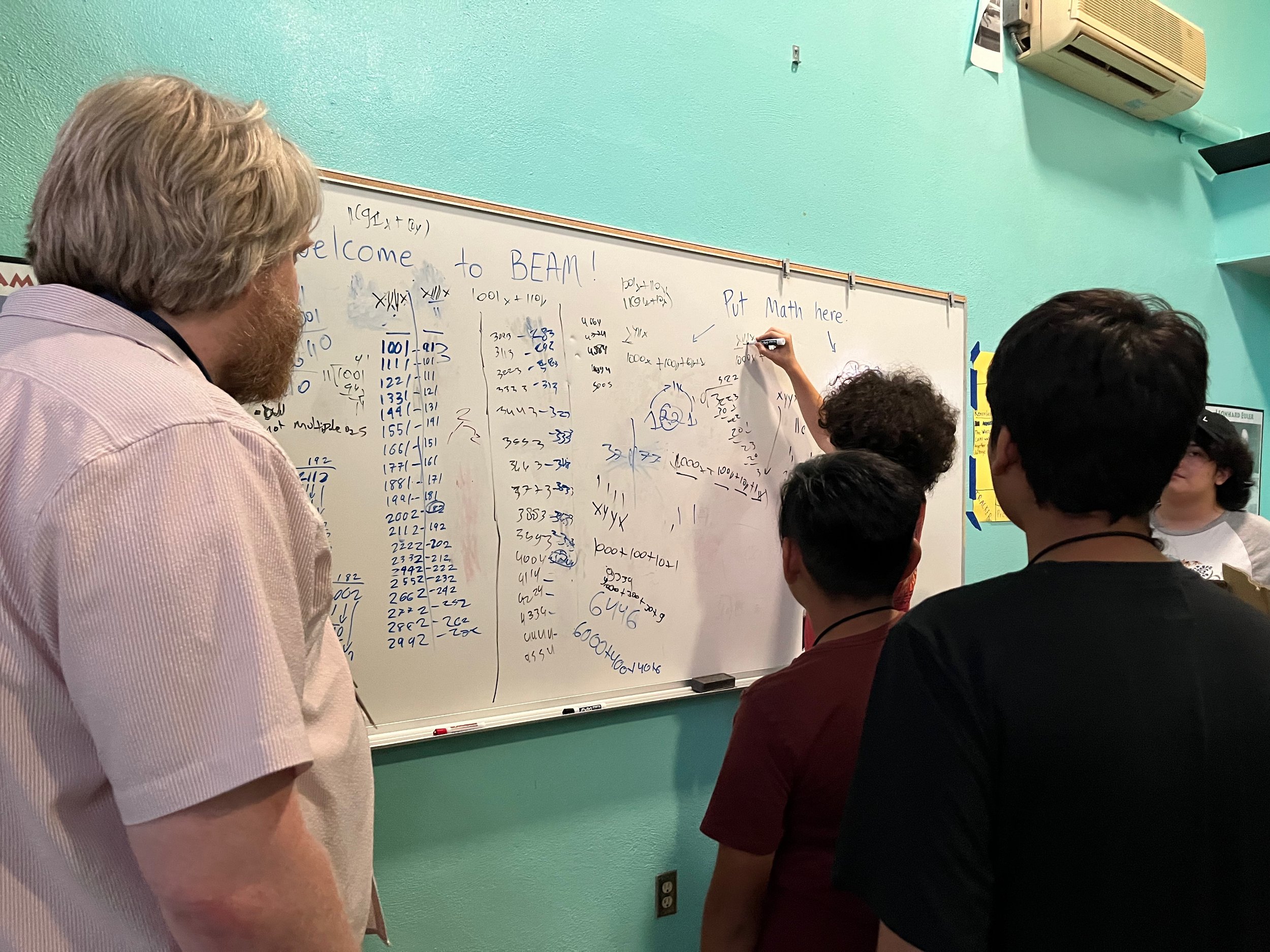


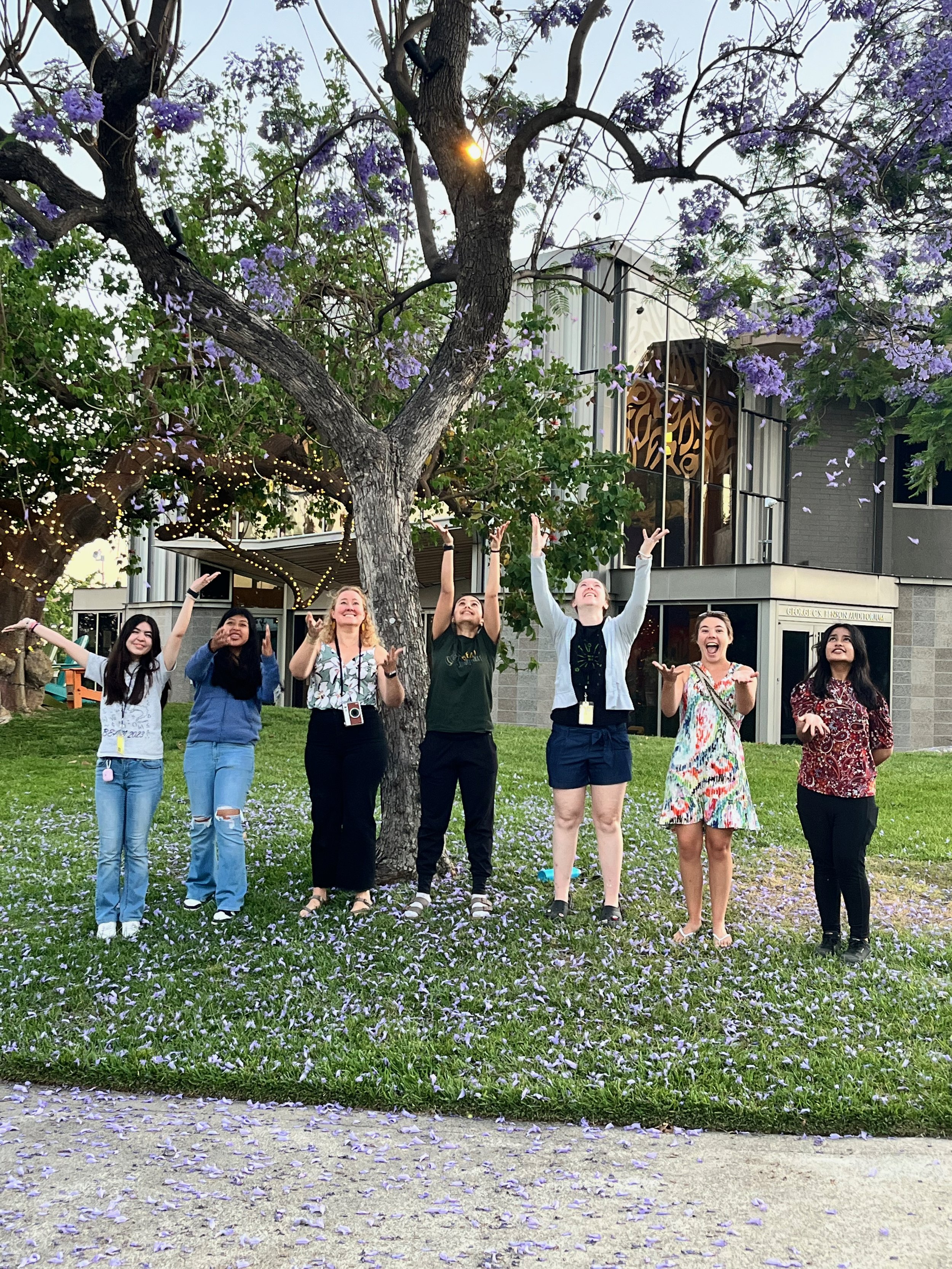
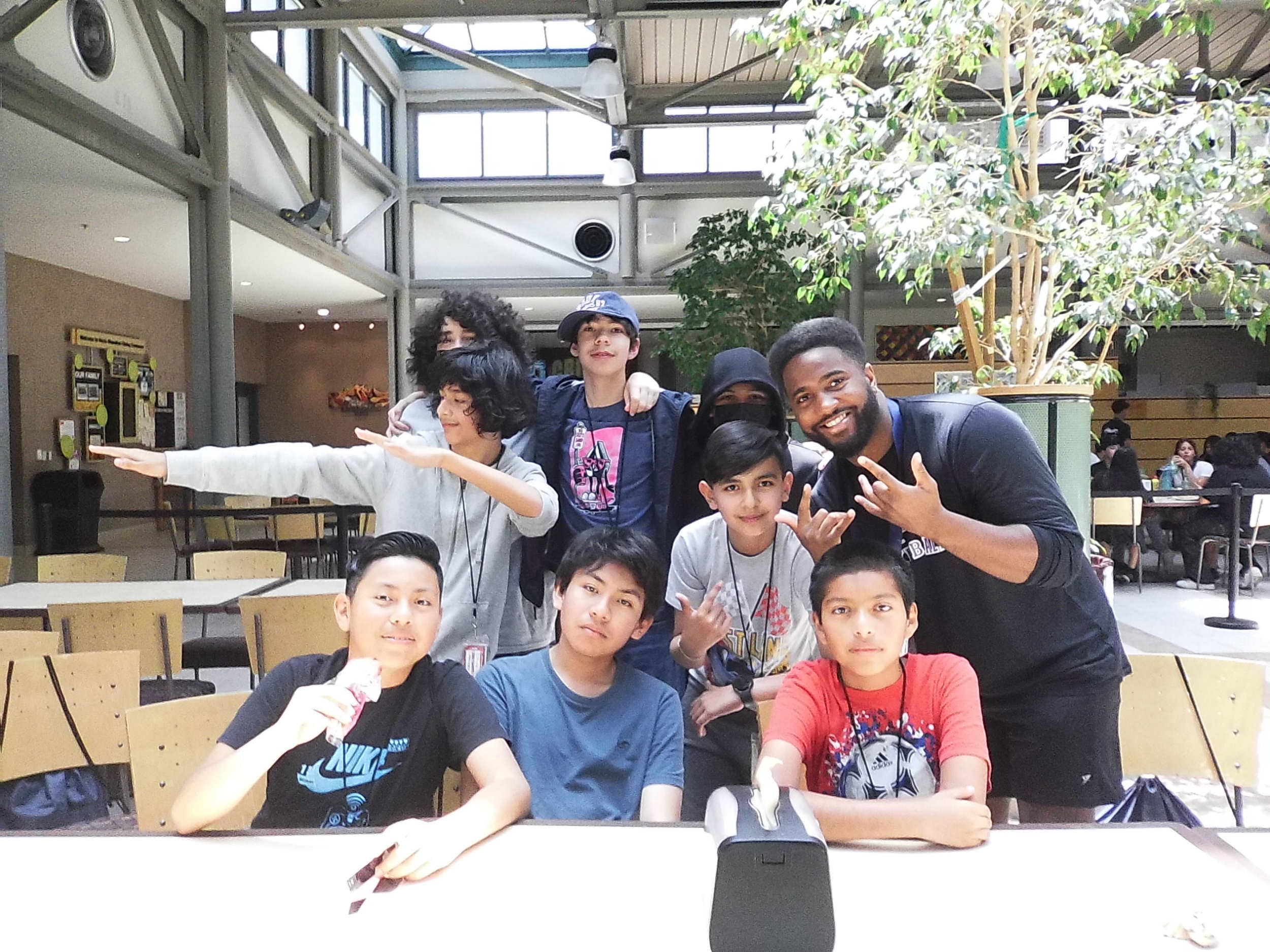


BEAM Summer Away, Marist College


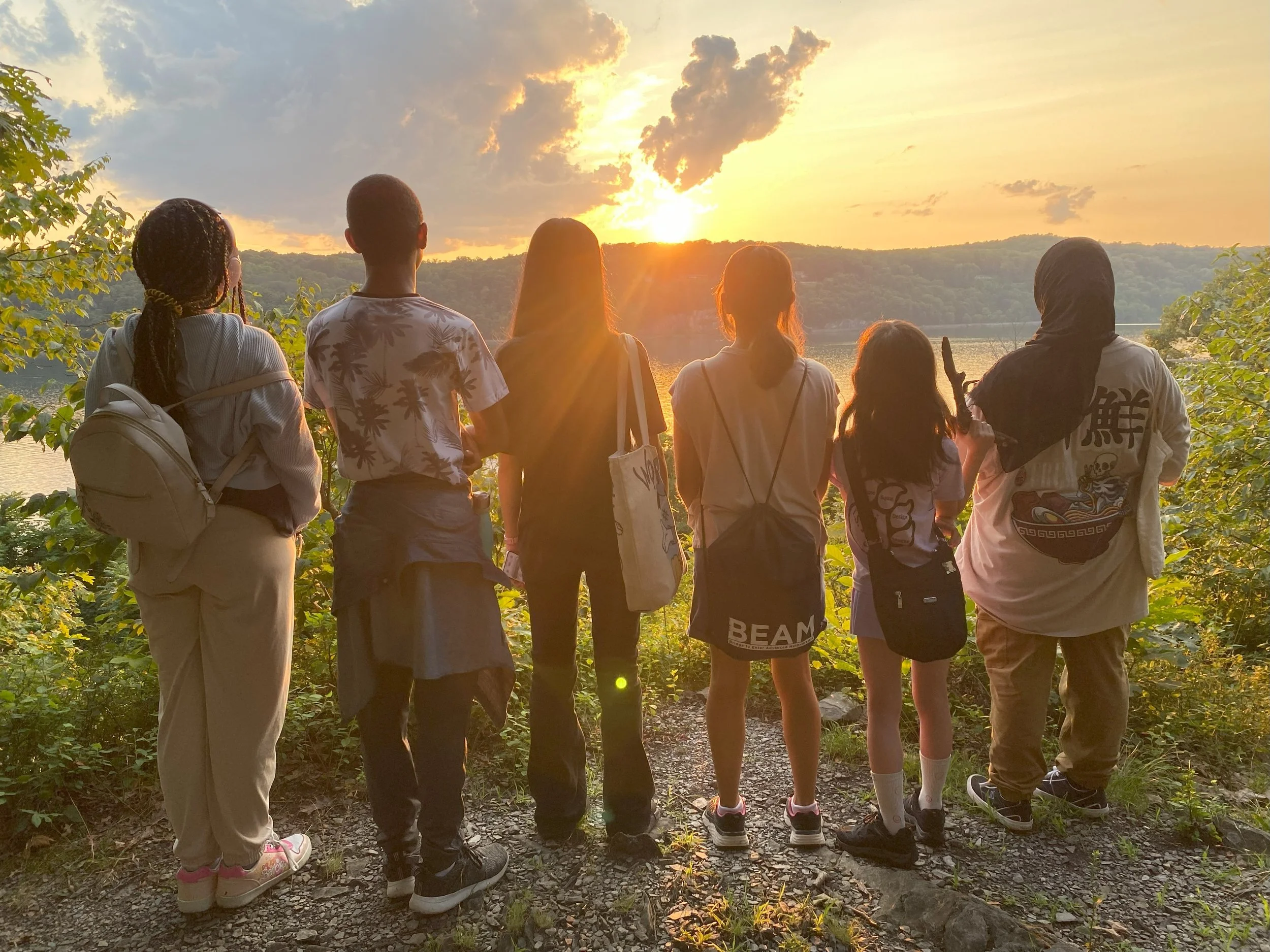


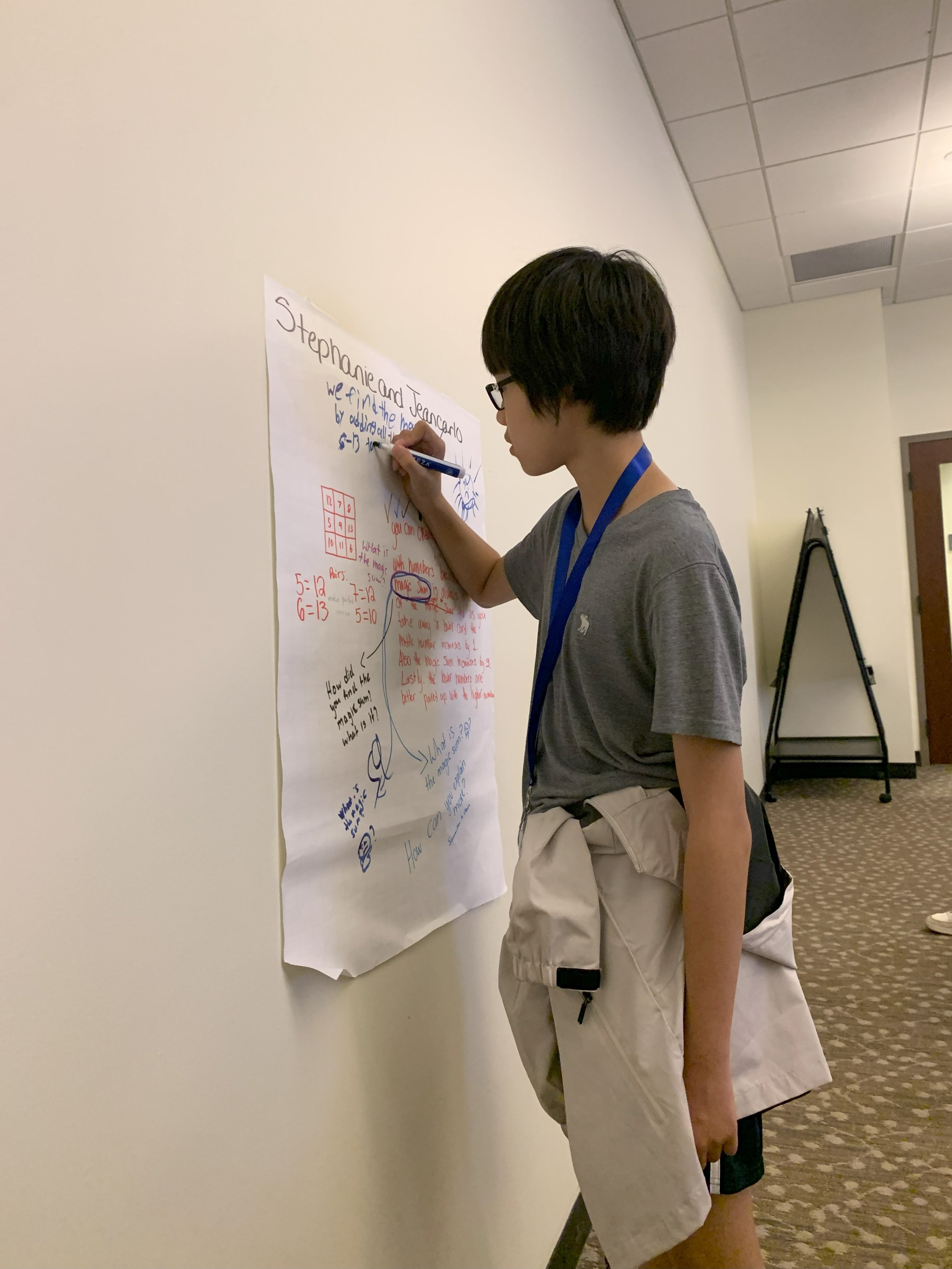


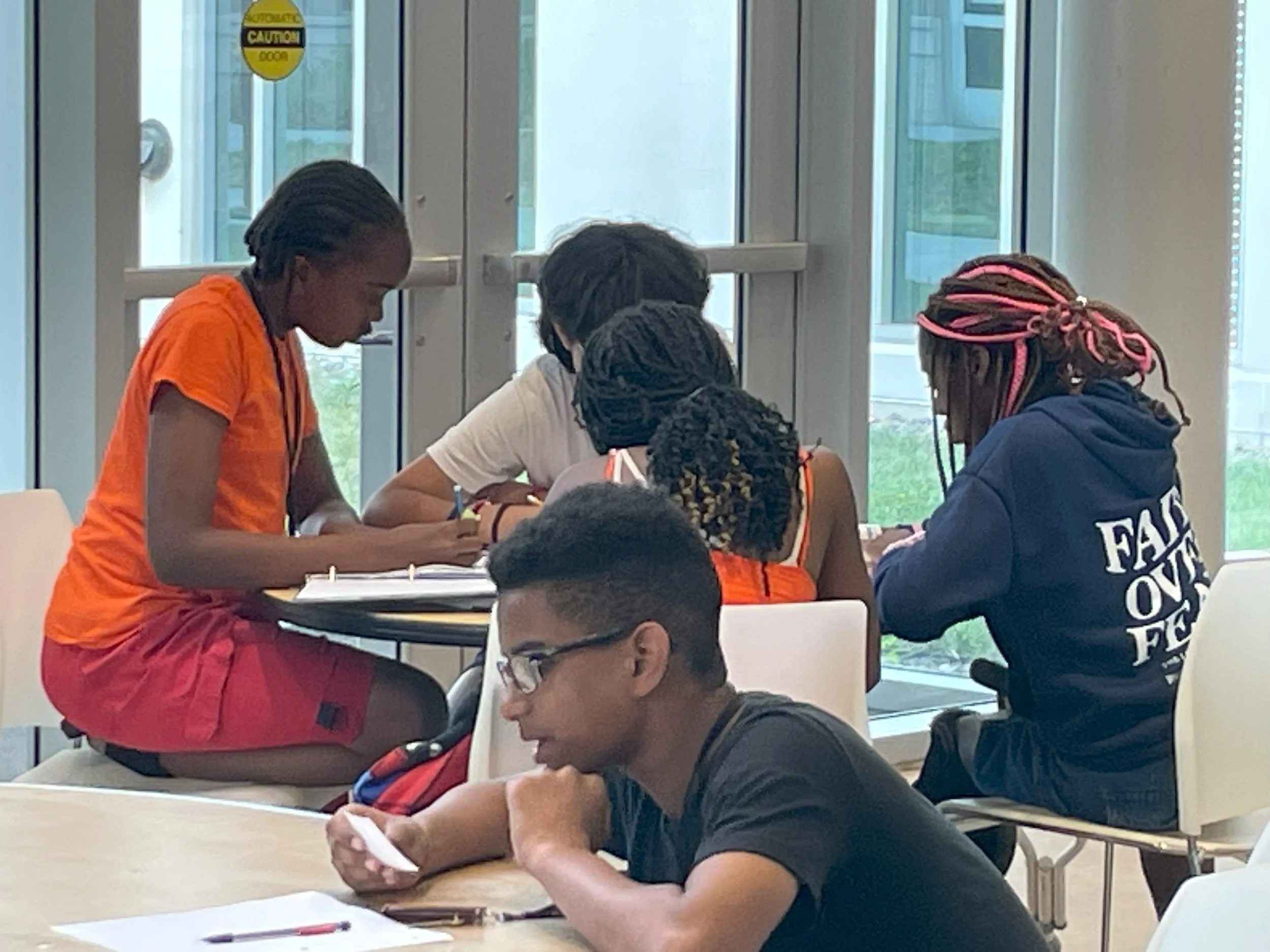
BEAM Summer Away, Union College




...And Now for Some Math on Pi Day!
Curious about more math this Pi Day? Here’s the problem we included in this year’s Pi Day card:
Problem:
Two logicians (A and B) each secretly pick a whole number from 1 to 30, inclusive. They have the following conversation:
A: “Is your number double mine?”
B. “I don’t know. Is your number double mine?”
A. “I don’t know. Is your number half mine?”
B: “I don’t know. Is your number half mine?”
A: “I don’t know.”
B: “I know your number.”
All the statements are true. What is A’s number and how did B know?
Curious about more math this Pi Day? Here’s the problem we included in this year’s Pi Day card:
Problem:
Two logicians (A and B) each secretly pick a whole number from 1 to 30, inclusive. They have the following conversation:
A: “Is your number double mine?”
B. “I don’t know. Is your number double mine?”
A. “I don’t know. Is your number half mine?”
B: “I don’t know. Is your number half mine?”
A: “I don’t know.”
B: “I know your number.”
All the statements are true. What is A’s number and how did B know?
Solution:
Let’s break this down into what everybody knows after each exchange.
A: Is your number double mine? B: I don’t know.
If B’s number is odd he could say, “No, my number is not double yours.” But instead he says he doesn’t know, so B’s number must be even.
At this step B’s number is one of the following 2, 4, 6, …, 30. A’s number is still anything from 1, 2, …, 30.
B: Is your number double mine? A: I don’t know.
This definitely tells us that A’s number is at least even too, but it actually tells us more. Because A already knows B’s number must be even, so A’s number must be double an even number (which is another way to say it must be a multiple of 4).
So at this point both logicians know that:
B’s number is one of these: 2, 4, 6, ..., 30 and A’s number is one of these: 4, 8, 16, 20, 24, 28.
A: Is your number half mine? B: I don’t know.
Now B knows that the largest A’s number could be is 28, so if B’s number is greater than 14 he could say with certainty that no, his number is not half of A’s. But he says “I don’t know,” so now we know that B’s number is 14 or less.
Now both logicians know that:
B’s number is one of these: 2, 4, 6, 8, 10, 12, 14, and A’s number is one of these: 4, 8, 16, 20, 24, 28.
B: Is your number half mine? A: I don’t know.
A knows that the largest B’s number could be is 14, so if A’s number was larger than 7, A would know that their number was certainly not half B's. However, A says I don’t know, so their number must be equal to or less than 7. But we already knew that A’s number was 4, 8, 16, 20, 24, or 28. Only one of these options is less than or equal to 7, and that is 4.
So now both logicians know that A’s number is 4.
WANT TO LEARN ABOUT the pizza theorem?
Check out our Pi Day blog post!
The Pizza Theorem: How Sharing a Pizza Got Even More Fun!
Pizza holds a special place in our hearts at BEAM. From the very beginning, through the challenges of COVID, we’ve shared pizza (even when we could only do it virtually) and built community together. So this Pi Day we’re spotlighting the humble pizza pie. Since it’s impossible to share an actual pizza with you all, we’re doing the next best thing — sharing a theorem about sharing pizza, the aptly named pizza theorem.

Zereena at Family Lunch in 2016
Pizza holds a special place in our hearts at BEAM. From the very beginning, through the challenges of COVID, we’ve shared pizza (even when we could only do it virtually) and built community together. So this Pi Day we’re spotlighting the humble pizza pie. Since it’s impossible to share an actual pizza with you all, we’re doing the next best thing — sharing a theorem about sharing pizza, the aptly named pizza theorem.
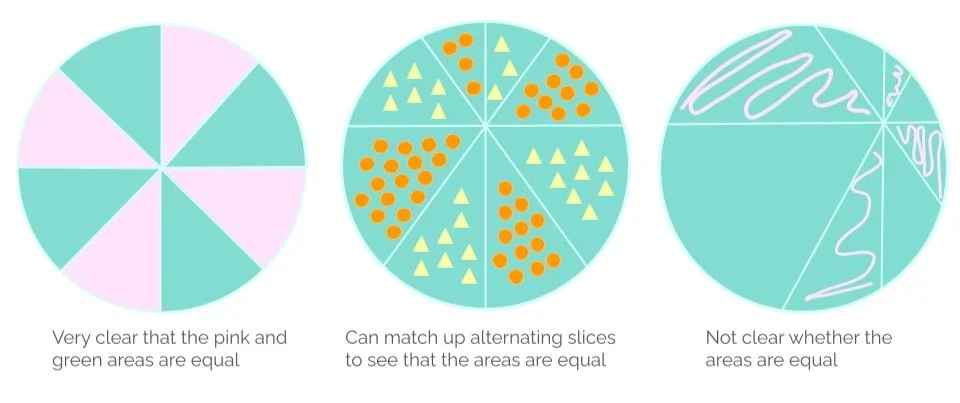
The pizza theorem says that if a pizza is cut 4 times through a point P into 8 slices of equal angle 45°, and slices are alternately topped with pepperoni and mushrooms, then the total area of the pepperoni slices equals the total area of the mushroom slices.
Note that the point P can be any point within the pizza.

If we ordered a half-and-half pizza and this arrived, we would be flabbergasted, but we'd have to ask ourselves: is there really the same amount of pepperoni and mushrooms? The longer we look at the picture above, the less sure we are that it is true at all.
The pizza theorem belongs to one of the most intriguing sorts of math problems — the statement is simple and straightforward, but it’s not obvious whether it’s true or not and the path towards proving it appears tricky, or even impossible.
Problems like these are responsible for entire fields and careers in pursuit of answers, and they also showcase one of the strengths of mathematics: that we can use logic to wade through the uncertainty, and arrive at what is, 100%, true.
To build some intuition about whether the theorem holds or not, let’s draw some examples. You see that you can create some pretty wild (potentially) half-and-half pizzas!
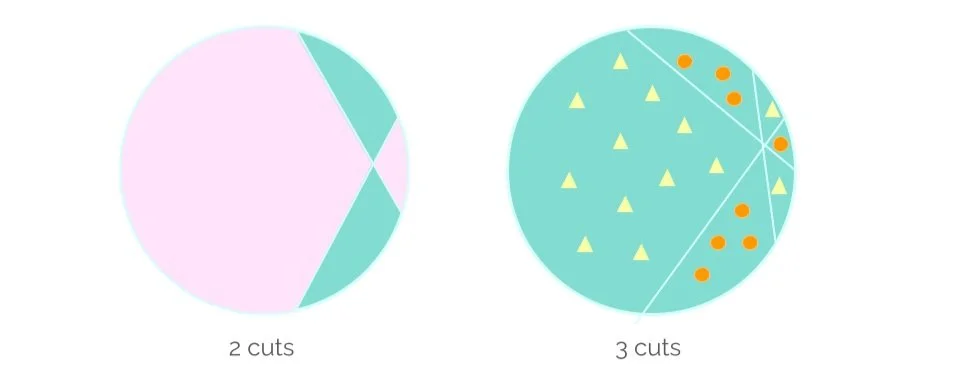
From the last example, it's not clear how you'd write a proof. So let's test the assumptions: what if you cut the pizza 2 or 3 times (instead of 4) into slices with equal angles? We can come up with examples with 2 or 3 cuts where the alternating slices definitely do not share the same value for combined area, so the theorem does not hold for 2 or 3 cuts. So, there's something special about making 4 cuts that makes the theorem hold. (In fact, it works with 4, 6, 8, etc. cuts.)
Proof with calculus and π
We'll share the proof from the article "Dividing a pizza into equal parts — an easy job?" by Professor Hans Humenberger of the University of Vienna. Most proofs are surprisingly complex, but here you can understand what is going on and the final answer actually includes pi (how perfect)! However, we have to warn you: this part gets technical and uses some calculus, so if that's not your thing, you might want to skim past!
A proof inside a proof:
To begin, we need a "lemma." Lemma is just a fancy way of saying "a proof within a proof," a little mini-fact that we'll use to prove our final fact. In fact, the word "dilemma" comes from the same root: "lemma" means premise, so a "dilemma" makes you cope with two premises!
Key Lemma: For every pair of orthogonal chords (segments a, b, c, d in Figure 7) in a circle of radius r, the following equation holds:
a2 + b2 + c2 + d2 = (2r)2

The Key Lemma (which looks suspiciously like the Pythagorean theorem) states that for each orthogonal (i.e., meeting at a right angle) pair of chords, the sum of squares of the lengths of the subchords equals the square of the diameter. A lovely (and relaxing) visual proof of this lemma can be found here: Four squares with constant area | Visual Proof | Squaring the segments. But let's make sure we have all the details of the proof.
Proof of the Key Lemma. The proof will rely on the fact that subchords a and b meet at a right angle and subchords c and d also meet at a right angle.
We can consider the hypotenuse of the triangle with a and b as legs and then make a square with this hypotenuse as one of its sides (green square below). Similarly, we can make a square with the hypotenuse from c and d as one of its sides (pink square below).

There's another geometry theorem that will help us out here: The Angle of Intersecting Chords Theorem (see here) implies that the sum of the lengths of the green arc and the pink arc equals half the circumference of the circle. This means that if we rotate the green square and the pink square towards each other along the circle so that the two squares meet, the white arc of the circle contained within the green and pink squares will be half the circle.

This is practically begging for us to apply the Pythagorean theorem, but for the Pythagorean theorem to give us the desired result, we need two things to be true:
The orange line (that connects the corners of the green and pink squares) is a diameter. This is true because as stated above, the arc of the circle contained within the green and pink squares makes up half of the circle.
The green and pink squares meet at a right angle. To see this is true, note that the intercepted arc of the angle formed by the green and pink squares’ sides is also exactly the opposite half circle (see point 1), which has angle 180 degrees. By the inscribed angle theorem, the angle of the intercepted arc is twice the angle of the inscribed angle in the circle, which means the angle between the green and pink squares is 90 degrees.

We can then apply the Pythagorean theorem to the side lengths of the green and pink squares with the diameter of the circle to prove the Key Lemma:
(2r)2 = a2 + b2 + c2 + d2
Proving the Pizza Theorem (using the Key Lemma)
The Leibniz sector formula calculates the area of a pizza slice (in other words, a sector of a circle) based on the distances from the tip of the pizza slice to the edge of the crust (that is, the original circle). Written below is the formula when considering 45-degree slices for the pizza theorem, where r(𝜃) is the distance from the slice’s point to the outer crust at angle 𝜃. Here, angle = 𝜋/4 refers to the side that is clockwise from the angle = 0 side.

In the pizza below, consider the dark slices as the pepperoni slices. We can calculate the total area of the pepperoni slices as the sum of the area of the individual slices using the sector formula:

The right sum in the formula above can be grouped as:

Now we can use the incredible fact that for any given 𝜃, the four radii r1(𝜃), r2(𝜃), r3(𝜃), and r4(𝜃) are orthogonal to each other, which means that the initial “Key Lemma” holds for each 𝜃. This means that we have

This proves that the dark slices (aka, the pepperoni slices) make up half the total area of the pizza, which means the light slices (aka, the mushroom slices) must also make up half the total area. This proves the pizza theorem!
This is just one proof of the pizza theorem. This theorem has also been proven a few times via “proofs without words,” starting with a purely picture proof published in Mathematics Magazine in 1994 by Carter and Wagon. The idea of these proofs is to cut up the slices into smaller pieces, then match up congruent “mushroom” pieces to “pepperoni” pieces. The article above by Humenberger includes a great discussion on these proofs, and you can even visualize a dissection into smaller, congruent pieces via the awesome web app by Christian Lawson-Perfect at Proof without words of the pizza theorem.
We hope that you’ve had a scrumptious time proving the pizza theorem with us. Feel free to hit us up on social media with your favorite pictures of half-and-half pizzas!

Zoom Pizza Party in 2020
More Math
At BEAM, we love statements like the Pizza Theorem — the statement is simple and straightforward, but it’s not obvious whether it’s true or not and the path towards proving it appears tricky, or even impossible. These problems can grab your attention and get your mind racing. A few other math problems that are similar in this way (all coming here from number theory) include:
Goldbach’s Conjecture: Every even integer (greater than 2) can be written as the sum of two primes.
The Twin Prime Conjecture: There are infinitely many pairs of primes 2 apart from each other.
Fermat’s Last Theorem: There are no solutions to the equation a2 + b2 = c2, for positive integers a, b, c, and n with n > 2.
We’ve actually explored all of these problems here at BEAM, and Dan, our CEO, has given talks on the Twin Prime Conjecture in several classes. So if you are in need of more math to contemplate this Pi Day, one or all of these should give you plenty to chew on!
…and now for some Math on Pi Day
Check out this blog post!