Welcome to the BEAM Blog!
Holiday Card Problem + Answers!
A Panoply of Place Value Problems
By Dan Zaharopol, BEAM's Founder and CEO
Everyone learns about place value in school. The ones place, the tens place, the hundreds place… it all seems so boring! It's just memorizing, right?!?
As usual, though, when you think deeply about a topic, you discover hidden depths. For this year's set of holiday problems, I looked for place value problems because I wanted to show that even with something you learn in elementary school, there are still interesting problems to do and more to discover. Let's have some fun with this!
The first problem on our holiday card came from our "Puzzling, Yet Logical" class for 6th graders. The problem was:
If each letter represents a digit, what is the true equation?
MA X CA = WWW
STOP! Give the problem a good try before you read the solution below!
SOLUTION:
We can't possibly try all of the possibilities. There are 9 possibilities for M and C, and 10 possibilities for A (because A is allowed to be zero), so altogether there are 9 x 9 x 10 = 810 possibilities. We'd need to try them all and see which results in a three-digit answer with the same digit repeated. That's way too much work!
Sometimes, it’s easier to start by working backwards: think about where you want to be, and ask if it’s possible to get there. That especially works when you need to narrow things down. So, can W = 1? In that case, WWW would represent 111. Can 111 be the product of two 2-digit numbers?
When you're looking at multiplication, all numbers are built out of primes. The prime factorization of 111 is 111 = 3 x 37. Because both 3 and 37 are prime, there's no way to break them down further. But then we can't write 111 as a product of two 2-digit numbers, because there's no way to recombine the primes into two 2-digit numbers.
What if W = 2? We can do the same thing: 222 = 3 x 74 = 2 x 3 x 37. Again, there's no way to recombine those primes to get two 2-digit numbers to multiply together.
Now, when you look at that prime factorization, you might realize something: of course, 222 is just two times 111, so its prime factorization just includes an extra 2! That makes it much easier to get prime factorizations rather than tedious dividing things.
333 = 32 x 37, because it's just 3 times the prime factorization of 111. Again, there are no ways to recombine those primes to get two 2-digit numbers!
What about 444 = 4 x 3 x 37 = 22 x 3 x 37? You can break it down as 12 x 37, but the final digits are different, so it doesn't fit the pattern of digits the problem asked for.
555 = 3 x 5 x 37? Unfortunately, 15 x 37 doesn't fit the pattern either.
666 = 6 x 3 x 37 = 2 x 32 x 37? The only way to do it is 18 x 37, which still doesn't fit the pattern.
777 = 3 x 7 x 37? That breaks down as 21 x 37, which also doesn't fit the pattern. We're almost done... but we might be worried if we'll actually find anything!
888 = 23 x 3 x 37. This is the first one that gives two options: we can recombine all the primes other than 37 to get 24 x 37, or we can move one of the 2's to multiply with the 37 to give 12 x 74. But neither option fits the pattern.
One possibility left. 999 = 9 x 3 x 37 = 33 x 37. We can only break that down into 2-digit numbers in one way: 27 x 37. That fits the pattern, so it must be the answer!
So M = 2, C = 3, A = 7, and W = 9. By thinking carefully, we could bypass 810 possibilities and quickly find the only one that works. As a bonus, we've also proven that there's only one possible answer.
The second problem on our holiday card is a problem of the week at our BEAM Discovery program (for sixth graders). Here's the problem:
The numbers 1234 and 4213 are both four-digit numbers that use each of the digits 1, 2, 3, and 4 exactly once.
Find the sum of all possible four-digit numbers that use each of the digits 1, 2, 3, and 4 exactly once. Find a clever way to do this without adding all the numbers. A full solution to this challenge problem means that you must explain why your answer is correct — you can’t just give a number, you have to prove it!
STOP! Give the problem a good try before you read the solution below!
SOLUTION:
You could write out all 24 four-digit numbers that use each of the digits 1, 2, 3, and 4 exactly once and then add them together, but we can do a lot better. Instead of actually doing the addition… let's just be lazy and imagine we did it.
What does that mean? Well, suppose you write them all out. How many times does 1 appear in the 1000s place? Well, every number with 1 in the 1000s place is of the form 1XYZ, which gives you 3 options for X (2, 3, or 4); 2 options for Y (whatever's left after X), and only one option for Z (whichever of 2, 3, and 4 are left after X and Y each claim one). That's 3 x 2 x 1 = 6 possibilities. So there are 6 numbers with 1 in the 1000s spot. There are also 6 numbers with 2 in the 1000s spot, 6 numbers with 3 in the 1000s spot, and 6 numbers with 4 in the 1000s spot.
Do the same reasoning, and you find that in that giant, tedious addition problem, each digit appears six times in each position.
So what if you just added up the 1000s places? How many 1000s are in the sum? That's easy: the thousands place will add to 4 x 6 + 3 x 6 + 2 x 6 + 1 x 6 = 60, so we get sixty 1000s in the sum.
How many 100s in the sum? If you add all the numbers in the 100s place, you get sixty again.
There are also sixty 10s, and sixty 1s.
So the sum is 60 x 1000 + 60 x 100 + 60 x 10 + 60 x 1 = 60(1000 + 100 + 10 + 1) = 66,660.
That proves that if you did that whole boring addition problem, you'd just get 66,660! It also shows how understanding place value can simplify a big messy problem.
That’s it for the problems on the holiday card, but if you want more, let me share a couple more that might be different from what you've seen before! I went rooting around in our archives and came across a cool place value problem from our January 2019 newsletter to our high school students.
Crystal is filling in the blanks in the following addition problem:
First, she chooses a random two-digit number for the first line. Then, she chooses a random two-digit number for the second line. Finally, she chooses a random three-digit number for the third line. What is the probability that the addition comes out correct?
Remember: Numbers don't start with 0.
STOP! Give the problem a good try before you read the solution below!
This is the kind of question I always asked myself while doing addition — wondering, if you filled things in at random, how likely it would be to get a correct answer. I'll share two solution methods, each of which gives different insight into the problem.
SOLUTION 1:
To figure out the probability, we need the total number of ways to fill in two two-digit numbers and one three-digit number, and the total number of ways to fill the addition in correctly. Then the probability is:
(# of ways to fill in the addition correctly) / (# of ways to fill in the numbers, even if the addition is wrong).
Finding all the ways to fill in the numbers, even if the addition is wrong: This is actually the easy part! There are 90 two-digit numbers from 10 to 99. There are 900 three-digit numbers (going from 100 to 999). So in total, you have 90 options for the first two-digit number, times 90 options for the second, times 900 options for the three-digit number: 90 x 90 x 900 = 7,290,000.
Finding how many ways there are to fill the addition in correctly: One way to count correct addition problems is to fill in the first two-digit number, and then count how many two-digit numbers can be added to it to produce a three-digit number. Each second two-digit number is a way to fill in a correct addition, so long as the two actually add to a three digit number (and that they’re not too small—it might be less than 100, and so not a three-digit number). If we look, we’ll find a pattern.
If the first two-digit number is 10, then the second two-digit number can be 90-99 to get a three-digit number as the answer. That's 10 possibilities.
If the first two-digit number is 11, then 89-99 works, giving 11 possibilities.
If the first two-digit number is 12, then 88-99 works, giving 12 possibilities.
And so on . . .
Until, if the first two-digit number is 90, then every single other two-digit number 10-99 works, giving 90 possibilities.
It's the same for 91, 92, all the way up through 99: each one gives 90 possibilities, because any two-digit number you add gives a three-digit number. In total, ten different two-digit numbers have 90 options each for how to finish the addition.
So there are ten ways to make the addition work if your first two-digit number is 10. There are 11 ways to make it work if your first two-digit number is 11. Altogether, the total number of ways to make the addition work is:
10 + 11 + 12 + … + 89 + (10 x 90)
There are several addition tricks you can use to calculate this sum, but however you do it, the number of ways to correctly fill in the addition is 4,860.
The probability is the number of ways it might come out correct divided by the number of ways to do it in total: 4860/7,290,000 = 0.06667%. That translates to 1/1500; so about one out of every 1500 times, Crystal will randomly fill in the addition correctly!
SOLUTION 2:
Just for fun, here's another way to figure out the total number of ways to fill in the addition correctly, starting instead from the three-digit number.
If it's 199 or bigger, the addition doesn't work, because the largest possible number we can get is 99 + 99 = 198.
If it's 198, there is exactly one way to fill in the 2-digit numbers: 99 + 99.
If it's 197, there are exactly two ways: 99 + 98 or 98 + 99.
If it's 196, there are exactly three ways: 99 + 97, 98 + 98, or 97 + 99.
If it's 195, there are exactly four ways: 99 + 96, 98 + 97, 97 + 98, or 96 + 99.
And so on . . .
For 109, there are 90 ways to do it: 99 + 10, 98 + 11, 97 + 12, ..., 10 + 99.
For 108, there are 89 ways to do it: 99 + 11, 98 + 12, ..., 11 + 99
And so on . . .
Until 100, where there are 81 ways to do it: 90 + 10, 89 + 11, ..., 10 + 90
Below 100, it is no longer a three-digit number.
So to find all the ways that work, the final step is to add up all of the ways we've found so far. That means we must add:
1 + 2 + 3 + 4 + … + 88 + 89 + 90 + 89 + 88 + … + 81
Again using your favorite way to add numbers, you will once again get 4,860 ways to fill in a correct addition problem, leading to the same answer as before!
This next problem, from our May 2018 newsletter, is also a bit different from most place value problems I've seen before.
0._ _ _ + 0._ _ _ + 0._ _ _
Write the digits 1 - 9 into the sum above, using each digit exactly once, to make it as close to 1 as possible. The sum can be over or under; all that matters is how far it is from 1. Include an explanation of how you decided where to put the numbers.
How do you know that is as close to 1 as you can get?
STOP! Give the problem a good try before you read the solution below!
SOLUTION:
This problem can be solved by really diving into the decimals, which presents a nice little logical way to get through it. I’ll leave that to you to explore, and instead what I want to show you is a really beautiful way to quickly see the closest you can get to 1.
Forget about the decimals for a minute. Imagine just adding three three-digit numbers: ABC+DEF+GHI, where each of A through I represents the digits 1 through 9 in some order. It turns out that this sum will have to be divisible by 9! This is very similar to the classic divisibility trick to check if something is divisible by 9: add the digits, and if the result is divisible by 9, so is the original number.
To prove that the sum is divisible by 9, we can just use place value:
ABC + DEF + GHI
= 100(A + D + G) + 10(B + E + H) + (C + F + I)
= 99(A + D +G) + A + D +G + 9(B + E + H) + B + E + H +C + F + I
= 99(A + D + G) + 9(B + E + H) + (A + B + C + D + E + F + G + H + I)
= 99(A + D + G) + 9(B + E + H) + 45
(You might be wondering how we got 45 in the last line. Adding A + B + … + I is just adding all the numbers 1 through 9 in some order, which is 45.)
Look closely at this addition: 99 is divisible by 9, and 9 is divisible by 9, and 45 is divisible by 9, so each of the summands is divisible by 9. Thus, ABC + DEF + GHI is itself divisible by 9!
In other words, the closest that ABC + DEF + GHI can get to 1000 is 999. (The next biggest multiple of 9 is 1008, which is farther from 1000.) Going back to our original problem: add 0.ABC + 0.DEF + 0.GHI and the closest you can get to 1.000 is 0.999!
All that remains is to verify you can actually get the sum of 0.999. To find a way to do it, Look at the addition problem by columns:
0. A B C
0. D E F
+____0.___G___H____I
The easiest thing would be to get A + D + G = 9, B + E + H = 9, and C + F + I = 9. However, that doesn't work because 9 + 9 + 9 = 27, but the sum of 1 through 9 is 45.
What if you take advantage of "regrouping" (or "carrying" as they called it back in the day)? Aim for A + D + G = 8, B + E + H = 18, and C + F + I = 19. Then the addition will give 0.999, and the digits correctly add up to 45. To get 8, you must use {1, 3, 4}. Now to get 18, you can use {2, 7, 9}. Finally, what's left gives you 19, in our case {5, 6, 8}. Then the following sum does, indeed, give you 0.999, which is the closest to 1 that we can get:
0.196 + 0.425 + 0.378 = 0.999
Finally, I'll wrap up with a problem that involves a bit of place value but is really just a fun logic puzzle in disguise. It comes from BEAM Discovery's problem of the week. Here's the problem:
Is there a 10-digit number where the first digit is equal to how many 0s are in the number, the second digit is equal to how many 1s are in the number, the third digit is equal to how many 2s are in the number, all the way up to the last digit, which is equal to how many 9s are in the number? If yes, can you find all of them? If no, how do you know for sure?
STOP! Give the problem a good try before you read the solution below!
SOLUTION:
Let's explore and see what we can figure out.
First of all, the sum of the digits of the mystery number is 10, because the number is 10 digits long and the digits count themselves. So how many 5's, 6's, 7's, 8's, or 9's can you have? It's at most one, or else the sum gets above 10! Thus, of the final five digits in the number, at least four of them are 0's.
Even better, you can't have all five of them be zeros, or there would be five 0's and then there would be a 5 or bigger in the first spot! So we know that of the last five spots, four are 0's, and exactly one is a 1.
Let's consider how many zeros there can be in total. This is a great problem to learn methodical thinking!
If there are nine zeros, there must be one 9 in the first digit to count them, which means our number is 9XXXX00001. Now we need a number in the 1's spot to count the 1, but that makes our total bigger than 10, which doesn't work!
If there are eight zeros, our number is 8XXXX00010. Again, we must put a number in the 1's spot, but if we put a 1 there, that’s incorrect because there are now two 1s; if we put a 2 in the 1's spot, now we must fit in another 1 somewhere, which does not leave room for eight zeros!
If there are seven zeros, our number is 7XXXX00100. Once more, we need to put a number in the 1's spot. It can't be a 1 because there would be two 1's. If it's a 3, there isn't space for seven 0s and three 1s and a 3. Hence, it must be a 2. Then the number is 72XXX00100. Unfortunately, we now need a non-zero number in the 2's spot, which doesn't leave room for seven 0s (plus two 1s and one 2).
If there are six zeros, our number is 6XXXX01000. Again, we must have a number in the 1's spot, which cannot be a 1. It also cannot be a 3 or we quickly run out of space for six zeros. Can it be a 2? If so, we'd get 62XXX01000. Now we can't fit two 2's (we'd run out of space for the zeros), so there must only be one 2. That would give 621XX01000. This works if the X's are all 0's! 6210001000 has six 0's, two 1's, and one 2, and nothing of any other digit. This is a possibility!
What about five zeros? In that case, our number is 5XXXX10000. Try to fill this in, and you'll see that the sum of the digits gets bigger than 10 really quickly. (For example, we can only fit in one more zero, but that means that out of the numbers 1, 2, 3, 4, we'd need three of them to appear, which makes our sum bigger than 10.)
You can similarly eliminate four zeros, and we already proved there must be at least four zeros.
So not just did we find the number that works — 6,210,001,000 — but we proved that it's the only one that does! It's cool and surprising that this simple question has only one solution.
One of my favorite things to do at BEAM is take something students think they know well and then show them that there's much more to learn to really understand it deeply. I hope that you had fun with these place value problems, and perhaps that you too discovered there's more to it when problems get tricky!
Reflecting on a Summer of Success
Summer is a special time at BEAM, when hundreds of middle schoolers from New York City and Los Angeles attend BEAM camps to dive into advanced mathematics. This past summer, BEAM campers built strong, lasting communities, grew their problem-solving skills, and deepened their love and appreciation for math.
“It was like a dream,” said Ruby, a student who attended BEAM Summer Away at Marist University. “All the activities BEAM offers are so, so great. And the math is like the strong knot that brought the students and staff here together.”
Finding Joy in Math at BEAM Discovery
In July, BEAM welcomed nearly 300 rising 7th graders to Discovery, a 5-week day camp held at two sites in New York City and one site in Los Angeles.
At Discovery, students had the opportunity to choose from a wide variety of classes, including Count Without Counting; Game Theory; and Truth, Lies, and Logic. During Open Math Time, they worked collaboratively on math of their choosing. Especially popular was the 100 Problem Challenge, 100 fun, puzzly math problems students worked collaboratively or independently to solve. Some students spent upwards of 20 hours solving a single problem: Jade, who spent over a day solving Problem #13, wrote: “It was really difficult, but it was a fun experience and I learned that not all math problems have to be done in one day.” By the end of camp, Discovery students across all sites demonstrated statistically significant growth in key attitudes related to math, including love of math, sense of community, and math-specific perseverance and self-efficacy.
While students spend a lot of time at Discovery doing math (more than 90 hours!), they also get to let loose and make friends through social activities such as group meal time, sports, and field trips. In fact, 85% of Discovery students said they had fun this summer. Here’s what Caleb said when we asked if he’d recommend BEAM to a friend: “I would tell [my friends] that their math skills will grow and they will know higher grade math. I would tell them that it is truly fun and amazing and something I will never forget.”
Many of our Discovery students said they’d recommend BEAM to their friends. Josselyn said: “I would tell my friends that if you think the math is easy at your school and want to challenge yourself you should apply at BEAM. This program is everything: it's fun [and] challenging. This felt like a second home.”
Friendships and Formulas at BEAM Summer Away
This summer, over 100 rising 8th graders attended BEAM Summer Away at Marist University in New York and Harvey Mudd College in Southern California.
Over the course of the 3-week residential camp, Summer Away students got a taste of life on a college campus while studying advanced mathematical topics through courses like Tessellations, Logic Games, and Ethomathematics. Outside of class, students competed in math relays and collaborated to complete special “Challenge Problems,” proof-based problems that groups solve to earn prizes. Students didn’t shy away from harder math: at the conclusion of the program, 95% of students across sites reported that their math skills grew, and 84% agreed with the statement “I like to solve complex problems.” At Summer Away, the median student grew nearly 20% in national ranking on a national math contest, the AMC 8, which we use to measure problem-solving growth. We see this as strong evidence that students were engaged in deep learning and grew significantly as mathematicians this summer!
Summer Away is a transformative experience for many students, and building a community of math-loving peers is central to that experience. When they weren’t in class, BEAM students played sports and board games, did arts and crafts, and went on field trips. Students formed close friendships living in residential halls and attending nightly hall meetings. BEAM’s welcoming and collaborative atmosphere led to amazing social outcomes: 94% of students reported feeling a sense of community at BEAM, and 96% of students said that they had fun in the program!
“BEAM Summer Away is a once-in-a-lifetime experience,” said Rowan about the SoCal program. “I feel like I learned more here in one of the week-long courses than I did in a whole semester at regular school. I learned a lot, made new friends, connected with staff members, found new hobbies, gained confidence, worked on myself as a person, and enjoyed the camp. My experience here at BEAM Summer Away was wonderful. I don’t think I’ll ever forget it.”
Welcoming Our Academic Directors
Every year, BEAM uses feedback from staff, faculty, and students to refine our programs and make each summer the best one yet.
Gabe, the Academic Director for one of the cohorts at Marist University, leading a fun activity
This summer, we introduced a new leadership role at each site: Academic Directors. Serving as a resource and support for the faculty at our camps, Academic Directors provided one-on-one coaching, observed classes, and created space for faculty collaboration. Sarah, the Academic Director at BEAM Discovery in Los Angeles, emphasized the importance of faculty collaboration at camp: “The faculty really enjoyed having time to debrief and discuss their classes, and it helped them build relationships and learn to lean on each other.” She often guided conversations with prompts like “How do you work with your Teaching Assistants?” or “What’s more important, that a student completes a problem or comprehends it?” to inspire thoughtful discussions around pedagogy and classroom management.
Beyond faculty support, Academic Directors also ran math-focused activities beyond the classroom, including math relays, a “problem of the week,” and the 100 Problem Challenge. “The faculty really appreciated having a thought partner,” reflected Sarah, ”someone who could help them think critically about their classes and their teaching.”
Spotlight on BEAM Alumni
We’re honored when BEAM alumni choose to give back to the program by joining our summer staff; this summer alone, over 35 counselors and junior counselors at BD and BSA were former BEAM students!
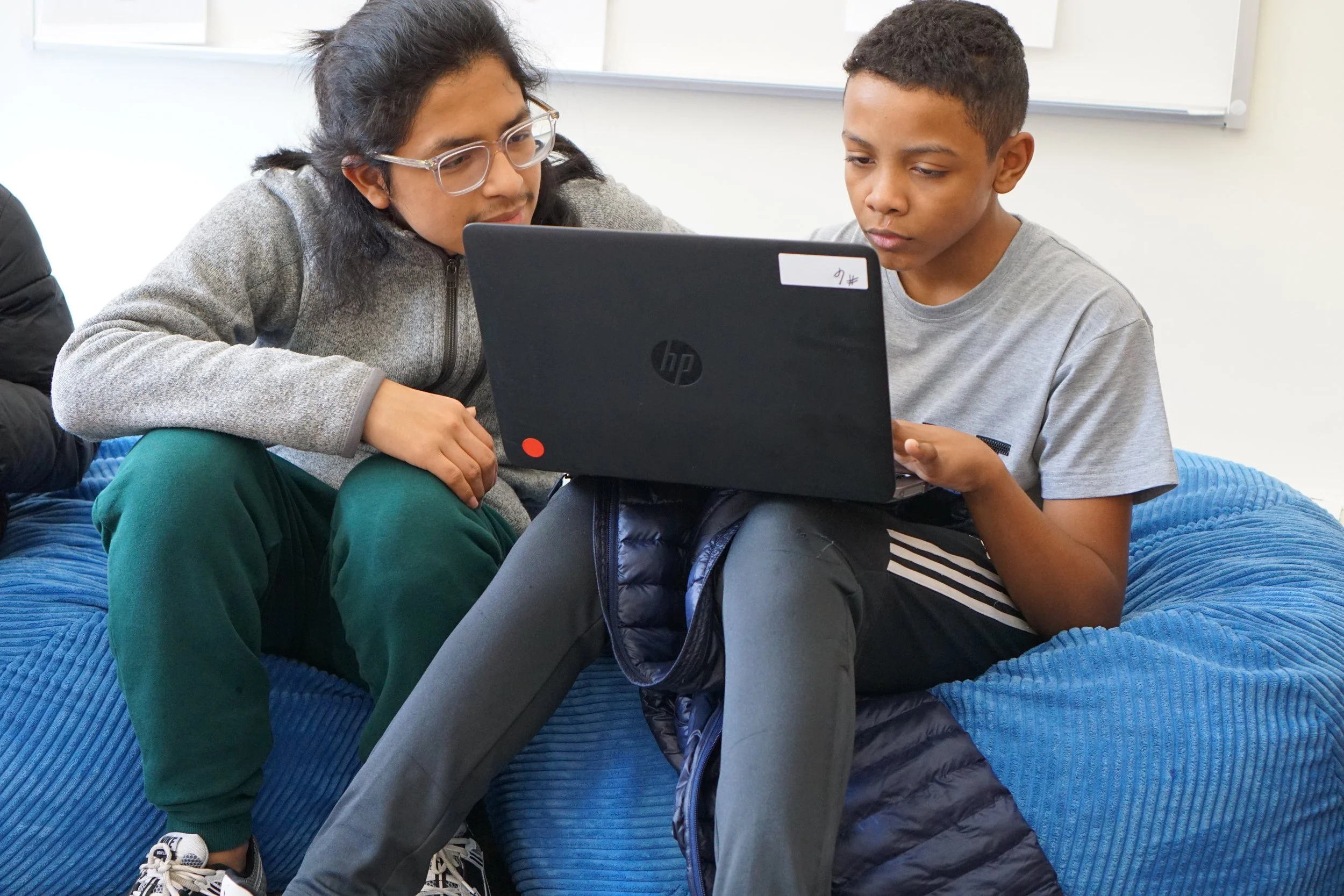
SJ helping a student with a computer science project during her beginner-friendly class “Code Logic”
Two program graduates from BSA 2015, Crystal and SJ, returned to BEAM as junior faculty this summer. After sitting in on their classes, BEAM’s founder Dan Zaharopol wrote:
“Crystal knew exactly what it means to develop students' problem solving skills in a deep way, and she had a bond with the students that was extraordinary to see. My heart was really full sitting in on her class and seeing what a great teacher she is. Equally special to me was seeing SJ, who is now a computer science teacher. I found out that she'd reached out to her former BEAM teacher to get his notes so that she could teach a version of it to her students. It's an incredible, full-circle story: a class had a really big impact on SJ, and then she used the same materials to inspire the students coming up next. Both Crystal and SJ really brought the spirit of our program in their bones, a deep knowledge of what BEAM can do, and they carried it forward.”
Reflecting On an Impactful Summer
We had an incredible summer with our students. For many, it was a transformative experience where they got to engage with a whole new kind of math and found a life-long community of mathy peers. In the words of BEAM Summer Away student Mariana, “BEAM is the most cheerful, fun, and interesting place to be. It was the best time of my life.”
Meet BEAM’s 2025 College Scholars!
BEAM is thrilled to announce our third class of College Scholars! This year, three students have been awarded a scholarship through Jane Street, a research-driven global trading firm that’s one of BEAM’s amazing corporate partners. Jane Street College Scholarships make it possible for BEAM students to attend strong-fit colleges that meet their academic goals, even when those schools do not meet 100% of financial need.
Here are the stories of our College Scholar recipients, in their own words.
BEAM is excited to announce the fourth class of scholarship recipients through our College Scholars program! These scholarships are made possible thanks to the incredible generosity of our corporate partners, Hudson River Trading and Jane Street.
The scholarships enable BEAM students to attend their dream college and pursue their academic goals, even when financial barriers might otherwise stand in the way. With this invaluable support, our scholars can fully focus on their STEM education.
In addition, we are also thrilled to share three College Scholars who have been awarded scholarships sponsored by BEAM. These BEAM students have excelled in our math-focused programs and we know that they will continue to thrive as they move on to the next stage of their STEM journey.
We’re so proud of these accomplished students and all they’ve achieved. Keep reading to learn more about our new College Scholars!
Brandon C.
Brandon’s scholarship is sponsored by Jane Street. He is attending Case Western Reserve University where he will double major in Computer Science and Computer Engineering.
In middle school, I struggled with identity and purpose as I went through a variety of personal and financial issues. When BEAM first came to my school, I remember being one of the few who were excited. I had been waiting for a challenge, for something bigger than myself or what was offered in my school. Through BEAM, I discovered and have maintained my passion for computer science since 7th grade.
BEAM made me feel special. BEAM challenged me, believed in me, and opened the doors to opportunities I never imagined. It was through BEAM that I discovered my talent in math and my passion for engineering. I took my first computer science class because of BEAM, and from there, my interest only grew. BEAM recommended me for enrichment programs like the Center for Talented Youth (CTY) at Johns Hopkins, where I explored engineering design and Arduino prototyping. Those experiences allowed me to explore different areas in my field.
BEAM wasn't the end of my passion; it became a part of my problem-solving and challenge-seeking personality. I continued to seek opportunities of my own. I started taking computer science classes in school and sought out opportunities on my own. I earned a paid internship with the DOE through CS4ALL, where I learned Java, and I completed a two-semester course in quantum computing with The Coding School.
Every step of the way, BEAM was in the background — whether it was the Saturday classes, SAT prep, or helping me find programs like CODE, a summer coding experience that strengthened my skills. Even when I didn’t initially pass the CTY placement test the first time, BEAM encouraged me to try again. On my second attempt, I succeeded, and that small change resulted in so many other changes — my maturity as an athlete, a student, and a minority grew in ways I never imagined.
Today, I’m preparing to attend Case Western Reserve University, one of the top colleges in the country for STEM. I plan to double major in Computer Science and Computer Engineering, with a minor in Cybersecurity. After that, I plan to earn my master’s in Robotics.
BEAM was the beginning of this journey. BEAM showed me that being a kid from Brooklyn — a kid with dreams bigger than my circumstances — didn’t mean I couldn’t achieve great things. This scholarship will help me continue this path, allowing me to pursue my education without financial barriers and stay true to the goal I set for myself years ago: to one day create technology that empowers and uplifts underrepresented communities, just like BEAM empowered me.
In the future, I also hope to work for BEAM. I want to live up to my passion to give back to the program — and more importantly, to the community it serves — regardless of the wealth or success I once thought I needed to do so. BEAM helped me find my purpose, and I want to be part of helping the next generation find theirs.
Nehemias D.
Nehemias’s scholarship is sponsored by Jane Street. He is attending UCLA where he will major in mathematics.
When I was younger, I hated the idea of education. Like every child, I felt my time would be better spent elsewhere, viewing school as another boring feature of life. However, even then, one subject piqued my interest: mathematics.
By middle school, I had grown to adore math, and I quickly progressed through my classes. Soon after, my math teacher introduced me to BEAM, and despite my initial reservations, I promptly signed up. The moment I began BEAM Discovery, my whole life changed. Surrounded by students and staff who shared my passion for mathematics, I quickly fell in love with BEAM, and I thrived. I took advanced-level math courses that a low-income student like me couldn’t receive elsewhere. While initially intimidating, the program became the catalyst that sparked my passion for mathematics and nurtured my desire for knowledge. I’m extremely grateful for everything BEAM has given me.
Throughout high school, my love for mathematics grew. I took the highest-level courses provided to me, including AP Calculus AB and BC in my junior and senior years. While the work was grueling at times, the sensation of finally understanding a complex concept is what kept me hooked. I also had opportunities to teach younger students and found it extremely rewarding to help them grasp concepts that they struggled with. Additionally, I grew to enjoy sciences like chemistry and physics, which often explore the real-world applications of mathematics. Overall, my high school experiences were key to my mathematical journey and gave me a greater appreciation for STEM as a whole.
Naturally, I applied to university, choosing to major in mathematics. College applications were stressful and confusing; however, BEAM’s support kept me on track. Through BEAM’s college access program, I had the support I needed to craft quality college profiles, eventually leading to my acceptance to UCLA, where I have now committed. At UCLA, I hope to join clubs and activities that align with my interests, while continuing to take rigorous courses as I work towards my bachelor’s degree. BEAM has given a low-income, first-generation college student like me the chance to thrive, and for that, I am eternally grateful. I’d like to work with BEAM again in the future, contributing to the positive environment they have cultivated while spreading the beauty of mathematics to younger generations.
While I’m not entirely set on a career path, I hope to use my love for mathematics and problem-solving to make a difference. Specifically, I’d like to help low-income individuals like myself receive the quality education they deserve. As someone who’s received help from programs like BEAM, I understand the importance of a high-quality support network throughout your educational career, and I’d like to give future students the same opportunities I was given.
I know I cannot achieve these goals without continuing my education, so this scholarship is critical to my success. Without the support of this scholarship, my college tuition would impose a significant financial burden on my family. This scholarship significantly helps me finance my education as I work towards my long-term goals.
Daisy D.
Daisy’s scholarship is sponsored by BEAM. She is attending UC San Diego where she will major in Biology.
When I was younger, I didn’t have much of an interest in math. It was just a subject I happened to excel in and that I had to do well in to get to college. Then BEAM visited my middle school and explained how their program was not only meant to hone our math skills but would also support us throughout high school and college. During the entrance examination, I was nervous about the problems I was solving. Some of the questions felt too easy for an advanced math program, and others I felt would take too long to solve in the amount of time they gave us. Then some questions were so bizarre that I almost forgot I was taking a math exam. But these strange questions were the ones I had most fun solving.
During my first summer at BEAM, math became more than just a graduation requirement. At the end of each day, I felt sad having to leave Kohyang Middle School. The classes I took made me realize the intricate world of math. I would take Sarah’s riddle class again if I could, and listen to Taylor talk about different strategies to win games using statistics. And, God, could I eat their delicious lunch food for all the lifetimes all of humanity has ever lived. But most of all I was relieved to have found a community within BEAM—within staff and students—to share these beautiful memories of spending the summer days chatting about math (MATH!).
In eighth grade when I was struggling with geometry, BEAM was there to offer support. If it had not been for them, then I would not have been prepared to take AP classes during high school. During senior year, when our college counselor was too busy to help all of us, Yesenia was there to offer her support. If not for the generosity and passion of the staff in this program, I might not have realized how fun math really is. When I play a sudoku and my friends wonder how I could find enjoyment in playing that game, I recall all the SAMSAMs I solved during my first summer at BEAM. When I read an explanation on how to solve a statistics problem, I remember the pride I felt when I wrote a math proof during my second summer at BEAM. Math and BEAM have become such ∫ parts of my life.
Rica H.
Rica’s scholarship is sponsored by Hudson River Trading. She is attending CUNY Hunter College where she will double major in Computer Science and Mathematics.
In the summer after sixth grade, I joined the Bridge to Enter Advanced Mathematics (BEAM) program. That was the first time I felt like I truly belonged in a space where people loved learning math. BEAM wasn’t just about solving equations—it was about exploring ideas, asking questions, and learning to think deeply. I still remember struggling with a logic puzzle during open math time, and how proud I felt when I finally figured it out. BEAM made math exciting and helped me see how creative and rewarding STEM could be.
Since then, BEAM has been with me every step of the way. They supported me through the high school application process, gave me access to amazing programs and trips, and helped guide me toward college. Five years later, I returned to BEAM as a counselor. I wanted to give back by creating the same welcoming environment I once experienced. During open math sessions, I helped students tackle hard problems and reminded them that it’s okay to make mistakes. One student told me, “Thank you for showing me math is fun.” That moment meant a lot to me because it felt like a full-circle moment from when I was a camper.
Now, I plan to major in computer science and math because I enjoy solving problems and creating things that can help others. BEAM helped me believe in my abilities and showed me how powerful support and encouragement can be. This scholarship will help ease the financial burden of college and give me more freedom to focus on learning, internships, and research. I’m excited to keep building bridges, just like BEAM taught me.
Jipper R.
Jipper’s scholarship is sponsored by BEAM. He is attending UCLA where he will major in Business Economics.
My interest in math grew at a very young age. My dad would teach me basic math concepts before school started, so going into kindergarten and 1st grade, I had a strong foundation already. Because of this, math became very easy for me. Simple addition that would take students multiple minutes to solve, I could do in a few seconds. However, as I got older and more mature, my interest for math developed into something else. It was when I took AP Calculus AB in 11th grade that I was pushed to my limits in math (no pun intended), and also when I realized why I liked it. My teacher would always tell me that they liked giving problems harder than the AP exam to better prepare students for the AP test. And it was when I was taking their tests, getting stuck on a problem for multiple minutes, my brain running through numbers and formulas… when... in an instant... my brain comes up with the next 10 steps to solving the problem. I really like how math makes me think and use problem solving, forcing me to solve a puzzle and piece things together using prior knowledge. I like how math encourages my brain to think at rapid speed, and that eureka moment when I do come up with the answer.
This enjoyment for math has always been with me, but pushing myself by taking AP Calculus AB made it clear why I enjoyed it. Because of my hard work, I was able to score an amazing 4 in AP Calculus AB, and as a senior, I am currently the only student in my high school who is taking AP Calculus BC, and using online resources like Khan Academy and YouTube to guide me. While I do not know my score yet, I feel very confident that I got a passing score, and am proud of my math skills.
My journey with math would be incomplete without acknowledging the tremendous support that BEAM has provided for me to help cultivate this interest. Specifically, when I took a Saturday class titled “Financial Mathematics”. This class really opened my eyes to the possibilities of math in the real world. I learned the basics of investing, how you could invest only a couple of dollars a month, and by the time you are 65, you would already be a billionaire. The world of money and math connected with me so much because it related to my favorite hobby of playing video games. Similar to obtaining an item that would help you progress faster in a video game, or changing your strategy to get a desired outcome you want, the world of money acts similarly, just like if you choose to invest your money in some place, you could progress faster and exponentially compared to if you just kept it. BEAM has taught me valuable pathways that the subjects of mathematics could lead to. And it is this specific class that I took for one semester in 10th grade that ultimately cultivated my interest in economics, and is the reason why I am going to be pursuing Business Economics at UCLA. I do not know where this major will take me, but I know that I am passionate about combining mathematics with the world of money, whether that be as an econometrist, a business analyst, a consultant, or even as an investment banker. BEAM really helped me decide where I want to take my math passion to study.
This scholarship will be such an amazing opportunity and support for me and my family, since paying for college has been one of the biggest things I’ve been worrying about this entire semester while waiting for my college admission decisions. The financial support is a big relief to my family, and to my mental health. Along with the constant support from BEAM, it will ensure that I will be able to succeed as a BEAM scholarship student in college.
I am 18 years old and I’m sure a lot of you all have been in a similar position as me at my age, where the world looks so full of opportunities so overwhelming at the same time. So while I am uncertain of what I want to do with my life, I do know this: I want math to be a core aspect of whatever I end up being in the future. Whether that be in economics, business, or another field, I want math to be in any career I pursue.
Finally, I want to give a big thank you to the sponsors of this scholarship. I really appreciate your value and significance for education, and specifically the importance of mathematics in our world. You are changing dozens of lives, just like you are about to do with mine. I am sure I can speak for every student when I say, this is a life changing opportunity and will definitely help us achieve the dreams we want to.
Diego R.
Diego’s scholarship is sponsored by Jane Street. He is attending UC Berkeley where he will major in Engineering.
Math and science have always been my favorite subjects. Unfortunately, I never had the opportunity to explore my STEM interests at school. Every school I went to only offered the most basic classes, and I was stuck taking classes where I already knew everything. The only reason I didn’t lose interest in STEM was because of BEAM.
BEAM gave me the opportunities that my school never gave me. They offered classes where I learned topics such as category theory. They even taught us about life skills, like how to write an email to how to build a resume. Even as I was preparing to go to college, BEAM helped me understand my financial aid options so I could make the most informed decision when choosing a college to commit to.
Thanks to the support I received from BEAM, this fall I will be attending UC Berkeley, where I will be majoring in engineering.
To this day, STEM-related topics continue to be my favorite subjects. The more I learn, the more I am reminded and fascinated by the fact that we can explain so many things through math and science. This interest is something I will continue to grow as I move on to college.
As I start my college journey, I am so grateful to receive this scholarship, because one of the biggest obstacles in pursuing the college of my dreams was financial aid. If I didn’t get the aid I needed, I knew I would be forced to make difficult choices, potentially leading to me missing out on lots of opportunities. Without this scholarship, my dreams of being the first in my family to graduate college and eventually getting a master’s degree may have never been a possibility.
Desara Z.
Desara’s scholarship is sponsored by BEAM. She is attending CUNY City College and will major in Chemical Engineering.
I consider the day I learned about BEAM to be one of the most defining moments in my academic journey. At the time, I thought I liked math simply because it felt straightforward. However, BEAM showed me that math wasn’t just about getting the answer in the end, it was about thinking outside of the scopes I was taught to stay within, asking deeper questions, and developing a persistence that turned setbacks into a drive for motivation rather than discouragement. What I once saw as simple memorization and replication turned into satisfying logic, and I realized that I wasn’t just enjoying math when I did something right; I had a genuine curiosity for it.
One of my most memorable experiences at the Discovery program was “free math time.” It was the first time in an educational setting where I felt completely in control of what I got to work on. My go-to was usually working on the 100 Challenge Problems, one of which began my specialized interest in proofs. In that problem, I was tasked with cutting a single hexagon into two, but of course, knowing BEAM, I wasn’t told how. Rather, it's a work of labor at first, making attempts, starting again, and adding onto a past technique. This was an effective mini-example of the logical thinking seen in proofs. A type of reasoning that later became a skill I was set on improving upon, and even became one of the first skills I wrote on my curriculum vitae.
After Discovery, I wasn’t ready to leave BEAM, and thankfully, it felt like BEAM wasn’t planning on doing so anytime soon either. They were always there with Saturday class invitations, the BEAM Pathway being brought to my attention, and the constant emails about new outside opportunities. Through all of it, they reminded me through everything that success isn’t about just having a knack for something or some fixed level of talent, but that it’s about the effort I bring to everything I do.
Later, BEAM itself helped jumpstart the other key moments I would see in my educational journey. They helped me prepare for the SHSAT, resulting in my acceptance into The Bronx High School of Science. Beyond academics, BEAM also gave me a strong foundation in collaboration, which became a blueprint for how I later worked with other people while conducting research in a neuroscience lab. It was my first real experience with the kind of teamwork and communication these types of environments demanded.
Today, still being the kid who blocks out everything to focus on a problem, I plan to bring that same energy as I major in Chemical Engineering at college. And I know that I have the Bridge to Entering Advanced Mathematics to thank for being the bridge that has been helping take me from where I was to where I want to be.
Introducing This Year's Jane Street and Hudson River Trading Summer STEM Scholars!
We are immensely proud to announce the recipients of the Jane Street and Hudson River Trading Summer STEM Stipends, awarded to BEAM high school students in partnership with Jane Street Capital and Hudson River Trading.
Every year, several talented BEAM high school students receive a Summer STEM Stipend sponsored by BEAM’s corporate partners Jane Street and Hudson River Trading. This stipend is dedicated to covering the costs associated with attending a top-tier summer STEM program. This year, we are thrilled to recognize ten lucky recipients of this award!
BEAM is committed to supporting each of our students to and through college with personalized guidance and resources. One essential part of that support is helping students access rigorous, enriching STEM experiences outside of school. These programs provide students with the incredible opportunity to immerse themselves in STEM topics while building career skills, community, and college readiness.
Jane Street and Hudson River Trading’s invaluable partnership makes it possible for our students to attend these exciting STEM-focused programs. The stipends ensure that students can attend these transformative programs without financial burden, allowing them to fully focus on their passions, rather than on summer jobs or financial stress.
Keep reading to learn more about our Summer STEM Scholars and what they shared in their own words in advance of the summer!
Los Angeles
Angel T.
Miguel Contreras Academic Leadership Community, 11th Grade
Attended MIT Introduction to Technology, Engineering and Science (MITES)
To me, all of STEM — but mainly math — has always been exciting to learn. I love how math’s many rules don't contradict and can always be applied the same way. Every answer can be proven, and math can only be right or wrong – there is no in between. Math either makes sense or it doesn't.
BEAM has been instrumental in growing my interest in math and STEM. BEAM introduced me to probability, weirdly fascinating math problems, and unique logic puzzles. I have also been inspired by my AP Physics teacher, who helped me develop my interest in science and taught me advanced mathematics.
This summer, I am so excited to attend MITES at MIT. Out of all the programs I applied to, MITES was the one I most wanted to experience. I applied to MITES because I wanted to take Calculus, Physics and other STEM courses.
I’m also looking forward to MITES feeling less like a “camp” – I wanted a program that would really challenge me and be rigorous. At school, I often don’t feel challenged by STEM courses, and it’s a goal of mine to continue to be challenged in the STEM field. I know that I will learn a lot from this program and that the program will teach me many things about STEM and beyond.
Amy G.
Rise Kohyang High School, 10th Grade
Attended Karim Kharbouch Coding Fellowship
My name is Amy Garcia, and I have lived in Los Angeles since I was born. I enjoy playing sports like soccer, track, and flag football. I also love STEM, especially mathematics.
I enjoy working on a math problem and persevering until I solve it, I love the excitement of thinking critically when solving problems, and I love getting to think outside of the box. For me, the best part of math is the feeling after you solve an especially challenging problem that you didn't understand at first. Beyond the classes I take with BEAM, I have also been taking honors Algebra II and AP Computer Science Principles. These school courses have helped me to strengthen my mathematical skills and have allowed me to find new ways to approach a math problem. Next year, I plan to continue taking advanced math courses, such as AP Pre-Calculus.
This summer, I will be attending the Karim Kharbouch Coding Fellowship. What I hope to gain from this program is learning how to program and to actually begin coding programs. I know this will help me pursue a career in computer science after I graduate from high school. I want to pursue computer science because I have always felt interested in learning how a phone app or website works. Learning how to code sounds so interesting, and I can't wait to excel in that area of my personal and educational growth. I am excited to begin this coding fellowship during the summer and expect to gain a lot of knowledge about coding.
Jordi Z.
Francisco Bravo Medical Magnet High School, 11th Grade
Attended the Oxford Tradition Program at the University of Oxford
My name is Jordi, and I am a junior at Francisco Bravo Medical Magnet High School. I’m Oaxacan and I am Indigenous to Oaxaca, Mexico.
Math excites me because it helps me understand the world and appreciate its hidden beauty. I see math as a universal language that reveals patterns in nature, structures in technology, and solutions to real-world problems.
My interest in STEM, especially science, comes from its power to improve lives. Through advances in medicine and technology, science has the ability to heal, connect, and uplift people, and that’s what inspires me. I’m especially passionate about the medical field because it brings together the marvels of science with the ability to care for and heal communities.
To deepen my passion for STEM, I volunteer at hospitals, where I witness firsthand the impact that medical knowledge and innovation can have on people’s lives. This summer, I will be volunteering at California Hospital Medical Center and Los Angeles General Medical Center. Furthermore, I will be preparing to enter two medical research labs, one at USC and one at UCLA, which will give me hands-on experience in the kind of work I hope to do in the future.
I’ll also be attending The Oxford Tradition summer program, where I’ll take two courses: Medical Science and Global Business. I chose this program because I want to explore the world while fostering my passion for medicine, and I’m excited to gain a global perspective on science and its real-world applications. Through these experiences, I hope to build a strong foundation for a future in the medical field.
Diana O.
Miguel Contreras Academic Leadership Community, 11th Grade
Attended MIT Introduction to Technology, Engineering and Science (MITES)
STEM, especially math, excites me because I love the feeling of overcoming difficult problems and knowing I can solve them. That feeling motivates me to keep learning and pushing myself.
BEAM has helped me love math even more by teaching me new, challenging math in a fun and supportive way. They create a safe space where making mistakes is okay and is a part of the learning process, which has made me more confident, especially when working on topics I’m not familiar with. Tackling challenging problems has made me even more certain that I want to follow a path in STEM.
This summer, I’m attending the MITES Summer program because it will allow me to experience what it’s like to be an engineer, and help me learn how to face the challenges that come with it. Without MITES, I wouldn’t have access to this kind of experience due to social barriers and limited resources at my school. I’m excited to learn from mentors and collaborate with others who share my passion for math as I work toward a career in aerospace engineering.
Jacqueline O.
Rise Kohyang High School, 12th Grade
Attended Jane Street Academy of Math and Programming (AMP)
My name is Jacqueline, and I will be studying Applied Mathematics at Yale in the fall. I'm a first-generation student and I come from a low-income family where I’m the middle child and only daughter.
In the almost 6 years that I've been involved in BEAM, I've learned so much from the Saturday classes, college field trips, and the many conversations with mentors. Without the support I received from BEAM, I don't think I would have been able to accomplish all that I have.
What excites me about math is the collaboration. I love discussions that introduce different perspectives. STEM not only gives me a new outlook to solve problems – it has also given me a chance to change my life for the better. Outside of BEAM, I've participated in research with a professor from Pomona and even presented my research at a conference at Pepperdine University.
This summer, I will be attending Jane Street AMP in New York City. I hope to learn what professions I might explore in the future by pursuing math, and how I can improve my approach to problems I'm not familiar with.
Julysa A.
Fairfax High School, 11th Grade
Attended Summer Science Program (Astrophysics Track), New Mexico State University
The excitement of trying to solve a puzzle is what continues to push me forward in my pursuit of STEM. It doesn’t matter how many questions I get wrong as long as I find the solution in the end. I've spent nights surrounded by crumpled paper, working through AP Calculus practice problems over and over until I finally understood how to solve them.
STEM doesn't just stay within the bounds of mathematics – understanding STEM concepts is essential for real-world application. Being a part of BEAM has helped me pursue mathematical adventures, and I’ve pursued other programs as well. I’ve completed college-level summer classes in physics and mathematics, so I could skip classes in high school and go straight into the classes I need. I have been accepted to the FLi Sci (short for first-generation/low-income scientists) Scholars Program, through which I’m writing a research paper on black holes. Additionally, I have gotten into EOPS (Extended Opportunity Programs and Services) and Upward Bound to find the right path for me to become an astrophysicist, rebuilt the STEM leadership within our school to run the Science Fair, and am the president of Math Engineering Science Achievement at my school, winning multiple competitions on STEM-related subjects.
The Summer Science Program (SSP) is amazing because it specializes in Astrophysics, and no matter your financial situation, the program will include you in an environment of scientific pursuit and growth. At SSP, I hope to make connections with the other students and have unforgettable moments like the ones I have had with BEAM. I won't ever stop doing STEM.
New York
Joyce W.
Brooklyn Technical High School, 11th Grade
Attended Baruch College Now Program: Personal Finance
What excites me about math and STEM is the way they challenge me to think outside of the box and think logically to solve problems.
During my summers at BEAM camps a few years ago, I participated in many unique activities that involved exploring mathematical patterns and seeing how those patterns could be applied to different scenarios. I specifically enjoyed the classes that explored arithmetic patterns!
Outside of BEAM, I am in the Accounting and Finance Clubs at my school, which help to expand my mathematical knowledge and to learn real-life techniques that are used in math-heavy careers.
This summer, I am attending the Baruch College Now Personal Finance class to dive deeper into finance and to expand my understanding of how math connects to real-world concepts like budgeting, saving, and investing.
Ayaan Z.
Stuyvesant High School, 11th Grade
Attended International Young Researchers’ Conference: Medicine and Research Summer Program
I've always been excited by STEM, especially math, because it’s a lens through which you can make sense of the world. Through classes at school, programs outside of school, and my observations about the world around me, I’ve learned to love the way that STEM helps me reason out the things I see and the problems I tackle through logic and strategic problem-solving. I enjoy the challenges that STEM presents across many aspects of our world, but even more so, I value the solutions it offers. STEM education is fundamental to the progress, transformation, and sustainability of our world.
Through BEAM, I've found a community of students interested in STEM, with whom I can collaborate and communicate around topics that interest me. Moreover, I strongly believe my overall interest in STEM has been defined by the numerous instructors that I've had who not only teach the content of required material, but share their genuine interest in the topic with me. STEM has become a passion of mine through those connections.
This summer, I'll be attending the International Young Researchers' Conference: Medicine and Research Summer Program, which I chose because of its focus on the intersection of public health, social service, and scientific research. I'm excited to explore how science can be used to improve communities, especially my local community, and how I can contribute to scientific fields that interest me through my own research.
Caren F.
Bronx High School of Science, 11th Grade
Attended Explore Engineering Innovation at Johns Hopkins University
I think what excites me about STEM is all the different solutions or ideas that can stem from just one issue (pun intended). When you think about a problem from a mathematical perspective, there are so many potential ways to reach the same answer. The person next to you might approach the problem in a completely different way and still get the same answer.
Something that helped my interest in STEM grow significantly was my recent research at Weill Cornell on PET Scan imagery recovery. Doing this research allowed me to combine my interests in medical engineering with the knowledge I had gained through my school classes in electrical engineering. I’ve also expanded my interest in STEM through BEAM Saturday classes, such as Number Theory.
This summer, I am attending the JHU Explore Engineering Innovation program. I know that I am very interested in engineering, but I don't exactly know what kind of engineering I want to pursue in college, so I think that this program will help me discover what kind of engineering I’m interested in pursuing further.
Edison L.
East Side Community High School, 11th Grade
Attended NYU Arise (Applied Research in Science and Engineering)
Hello! My name is Edison, and I go to East Side Community High School.
My favorite thing about STEM is how it is constantly improving and changing every day. When STEM professionals find a solution, they don't move on and start a new project. They find other ways to make their solution more efficient and up-to-date, and continue to revise and improve it.
The program I will be attending this summer is called NYU ARISE. I chose this program because I saw that it was an opportunity to work with people already in the industry and that you didn’t have to have any background knowledge in scientific research.
I will be working in a lab focused on machine learning, which I want to learn more about. Working in a machine learning lab this summer will help me decide whether I would like to pursue mechanical engineering or electrical engineering further.
Lorraine A.
Bard High School Early College Queens, 12th Grade
Attended Woodland Ecology Research Mentorship, Girls Who Code
What excites me the most about STEM is the many ways it can help people. STEM includes multiple different fields like technology, chemistry, biology, and more, that all come together to create innovations that improve lives and help people.
I’m especially interested in how science can support both human communities and nature. At school, I took an organic chemistry class, which taught me about the ways chemistry is all around us. In the organic chemistry lab, we explored how chemical reactions can lead to the creation of medicines. This sparked my interest in how science connects to real-world problems and solutions.
This summer, I’m interning at Wave Hill through the Woodland Ecology Research Mentorship (WERM) program. I chose this program because I care about the environment and wanted to get experience studying and researching ecology. Through WERM, I’m learning how to conduct ecological research, analyze data, and understand the different relationships that exist in nature. I hope to explore how ecosystems are affected by climate change and human activity, such as the difference between unmanaged and managed land.
Zachary S.
Bard High School Early College Queens, 10th Grade
Attended Memorial Sloane Kettering Cancer Center Summer Exposure Program
What excites me the most about STEM is how it connects curiosity with purpose. I’ve always been fascinated by how the body works, especially the brain, and I’m passionate about becoming a pediatric neurosurgeon. For me, science isn’t just about memorizing facts; it’s about asking questions, exploring the unknown, and using that knowledge to make a difference. STEM gives me a way to do that, whether it's through studying biology, tackling challenging math problems, or learning how diseases like cancer develop.
This summer, I’m attending the Memorial Sloane Kettering Cancer Center Summer Exposure Program because I want to deepen my understanding of medical research and gain insight into how scientists and doctors work together to treat complex diseases. I’m especially looking forward to receiving mentorship, exploring case studies, and building my skills through lectures and hands-on activities. Presenting research and drafting a personal statement will also help me grow as a communicator and prepare for college and beyond. I’m excited to be part of a program that supports students like me who are ready to work hard and dream big in STEM.
Megan P.
Bronx High School of Science, 11th Grade
Attended Entrepreneurship Lab at Bronx Science, the STEM Institute at the City College of New York
Hi! My name is Megan, and I’m a junior at Bronx High School of Science in New York City. I’m a first-generation Thai American student and an older sister, which has shaped my passion for learning and exploring different paths in STEM.
I first became interested in math when I was younger – I was drawn to the logic and problem-solving behind it. As I grew older, it was small moments of learning that inspired me to learn about the different branches of math and science.
BEAM has been a huge part of my STEM journey. BEAM opened my eyes to the wide range of possibilities in STEM, from engineering and computer science to data analysis and beyond. This summer, I’ll be participating in the Entrepreneurship Lab at Bronx High School of Science and in the CCNY STEM Institute summer program. I’m excited to utilize the skills I gain this summer to connect entrepreneurship and STEM, and I hope to use what I learn to make a positive impact in my community.
Oumou B.
University Heights High School, 11th Grade
Attended Summer Discovery at Georgetown University, Girls Who Code Summer Immersion Program
What excites me most about math and STEM is how they help make sense of the world. I love how one concept can connect to so many others and how there's always more to discover. Math pushes me to think critically and creatively at the same time.
My experience at BEAM really deepened my interest in math. It was the first time I got to explore math beyond the classroom in a way that was fun, challenging, and collaborative. I remember struggling through a tough problem at BEAM Discovery with my peers and teaching assistant, and the moment we figured it out felt so rewarding. That kind of hands-on, problem-solving environment made me realize how much I enjoy diving into difficult concepts and learning through trial and error.
This summer, I will be attending Georgetown University, taking medical-related courses to prepare me for my future. Alongside that, I will be participating in the Girls Who Code Summer Immersion Program to learn more about coding and technology, considering how prevalent it is in today's world. I hope to take the skills that I learn through both of these programs and apply them to my everyday life.
Samuel P.
Brooklyn Technical High School, 11th Grade
Attended Urban Arts Game Academy Summer Program
The thing that excites me about STEM is the fact that you can use your creativity to create what you want.
BEAM has shown me several different fields of STEM that I find really fascinating, which was a key reason I became interested in STEM.
I chose to attend the Urban Arts Game Academy Summer Program this summer because the idea of becoming a Game Developer seems like a great way to use my creativity and knowledge of coding. I am looking forward to learning more about game development.
Sylvan C.
High School of American Studies, 12th Grade
Attended Hampshire College Summer Studies in Mathematics (HCSSiM)
I have been interested in math since 2017, when I saw algebra for the first time and struggled to understand it. I was excited by each step of a problem: first, the beginning, when I saw something new and wasn’t sure how to solve it. That part was exciting because it was a challenge where I’d have to think in ways I never had before. Then, I was excited and challenged by the middle bits, those “Aha!” moments where new insights made me feel like I’d accomplished something. And then, the end – while math doesn’t ever truly end, each problem has a moment where the hard work put in and the new approaches discovered culminate in something satisfying.
This summer, I will be doing math for 8 hours a day at HCSSiM. The reason I want to do this is because of those beginnings, middles, and ends. It’s the process and what it gives you. In high school, math is almost linear, but in the programs I’ve done outside of school, each new problem has given me tools to explore a new path.
A couple of years ago, I joined the BEAM math research group. The math I did was unlike anything I’d done before, and it helped shape how I approach problems now. For example, when I was applying to HCSSiM, one of the problems stood out to me because I knew I could use the intuitions developed from working in the research group to solve it. I’m sure most people who applied didn’t approach that problem the same way I did, and that’s what makes it so valuable to participate in things that challenge you. Being in an environment where you can share ideas with other people and learn from their ideas is so valuable. I am excited to experience that at HCSSiM this summer – there is so much I can't wait to learn from other people, and also some stuff that I can show them.
Tess A.
Millennium Brooklyn High School, 10th Grade
Attended Columbia SHAPE (Summer High School Academic Program for Engineers)
What originally sparked my love for math and STEM was my eagerness to know and understand clear answers. When it comes to classes with writing, the endless void of unclear structures frightens me. Not knowing how to start, what to write about, or if I’m correct, and the overall feeling of having no boundaries pushed me away from ELA and towards math, a subject with structure, concrete answers, and clear rights and wrongs. My passion for math and STEM comes from the satisfaction of receiving a definitive answer – no beating around the bush, no ounce of uncertainty – just me, the problem at hand, and my mind.
A major aspect of math that BEAM has helped me with is collaborative work. In middle school, taking class online during COVID set my social skills back by a lot. I had trouble making friends, asking for help, and speaking up. BEAM has taught me, through summer programs and Saturday classes, not just about math and STEM, but about confronting difficult problems and not being afraid to ask for help. Gaining confidence, being able to make friends, and having the ability to solve math and STEM problems collaboratively increased my love and interest for those subjects.
This summer, I am attending Columbia SHAPE. I first heard about SHAPE through a BEAM coordinator, who thought this program would be a good fit for me because of what I’m interested in. When I looked further into the program, the idea of pursuing a career in STEM, especially engineering, really piqued my interest. Although I haven’t had much experience with engineering specifically, I do have a lot of experience in sustainability. As a strong believer in a cleaner society, I believe furthering my studies in sustainable engineering will help me gain a wider perspective on how to help our environment. I hope to learn about ways we can reduce climate change in its entirety through innovations and technology.
Photos from Summer Programs 2025
BEAM Discovery, Los Angeles
BEAM Discovery, Downtown New York City
BEAM Discovery, Uptown New York City
BEAM Summer Away, Harvey Mudd College
BEAM Summer Away, Marist College
BEAM x 2025 Evaluation Capacity Case Challenge
We’re proud to announce that BEAM has been selected as the case site organization for the 2025 Evaluation Capacity Case Challenge, hosted by the Max Bell School of Public Policy at McGill University on May 30–31!
BEAM has been selected as the case site organization for the 2025 Evaluation Capacity Case Challenge, hosted by the Max Bell School of Public Policy at McGill University on May 30 and 31. The Evaluation Capacity Case Challenge is dedicated to strengthening the evaluation capacity of institutions to foster and sustain high-quality evaluation practice. Every year, a real-world organization presents an evaluation capacity building (ECB) challenge to teams comprising the best and brightest minds from across the U.S. and Canada. These ECB teams then develop a plan to address the challenge and present it to a panel of esteemed judges. Through this challenge, participants identify creative, practical strategies to help organizations better understand their outcomes and improve their practices.
As the selected case site organization for the 2025 challenge, BEAM will collaborate with participants to address key challenges related to strengthening our evaluation practices and fostering a culture of continuous improvement. BEAM aims to enhance its capacity to evaluate its programs, measure its impact, and ensure that its efforts in expanding access to advanced mathematics education are as effective as possible.
BEAM's participation in the challenge as this year's case site will help advance our mission through the development of actionable, research-driven recommendations for enhancing our evaluation practices. The collaboration is expected to result in a series of tailored strategies that will guide BEAM in our ongoing commitment to advancing equity in the STEM fields. As BEAM continues to grow its programs and deepen its impact, the insights gained from the 2025 Evaluation Capacity Case Challenge will help inform the future strategies by which we measure the effectiveness of our programming.
Preparing BEAM Students for College Success
Preparing students for STEM success in college and beyond is central to BEAM’s mission. This work begins in our middle school summer camps, where students are introduced to problem solving, and continues through high school with enrichment classes that deepen their love of math. We prepare our students further by connecting them to advanced programs, internships, and research opportunities where they can see themselves as mathematicians, scientists and programmers. We organize trips to top colleges and universities so students can envision the reality of a 4-year STEM degree. Then in 12th grade, we provide targeted support around college admissions.
We’re proud to share that 90% of BEAM students attend college, with many—nearly 70%—attending Forbes “Top Colleges.” In 2025, BEAM students are celebrating admissions to dozens of great-fit colleges, including Bucknell, Columbia, Cornell, Duke, Pomona, Princeton, UC Berkeley, and Yale. Members of this year's BEAM cohort have been named QuestBridge, Posse, and Simons STEM Scholars, and several are finalists for the prestigious Gates Scholarship.
Preparing students for STEM success in college and beyond is central to BEAM’s mission. This work begins in our middle school summer camps, where students are introduced to problem solving, and continues through high school with enrichment classes that deepen their love of math. We prepare our students further by connecting them to advanced programs, internships, and research opportunities where they can see themselves as mathematicians, scientists and programmers. We organize trips to top colleges and universities so students can envision the reality of a 4-year STEM degree. Then in 12th grade, we provide targeted support around college admissions.
We’re proud to share that 90% of BEAM students attend college, with many—nearly 70%—attending Forbes “Top Colleges.” In 2025, BEAM students are celebrating admissions to dozens of great-fit colleges, including Bucknell, Columbia, Cornell, Duke, Pomona, Princeton, UC Berkeley, and Yale. Members of this year's BEAM cohort have been named QuestBridge, Posse, and Simons STEM Scholars, and several are finalists for the prestigious Gates Scholarship.
Preparing Students to Major in STEM
Navigating college admissions is a challenge—often even more so for BEAM students, a vast majority of whom are the first in their families to attend college. As BEAM students face a complex landscape of applications, financial aid, and countless options, BEAM’s college admissions coordinators, Hector (NY) and Yesenia (LA), provide critical guidance.
“There’s so much misinformation out there,” says Hector. “Students hear so many contradictory things from their schools, their friends, their families, and the internet. A big part of my job is counteracting the misinformation by connecting with students and getting them engaged in our college admissions prep as soon as possible.” Yesenia adds: “A lot of what I do is breaking things down into simple terms. With so many of our students being first generation college students, the goal is really to make sure our students and families have the resources they need.”
Hector and Yesenia introduce students to college STEM programs that align with their goals—whether that’s studying civil engineering close to home or pursuing math in a research-focused environment. They encourage students to explore scholarship programs like Posse, Posse STEM, Gates, and QuestBridge, using their deep knowledge to match each student with the right opportunities. They also tap into BEAM’s strong partnership network to open up additional opportunities for students: for example, BEAM’s relationship with the Simons Foundation gives Hector and Yesenia a deep understanding of which students would be a great fit for the Simons STEM Scholars Program at Stony Brook University, leading to multiple BEAM students being accepted to the program. A newer partnership with Bucknell University offers BEAM students key benefits, including financial aid that meets 100% of need, direct access to admissions staff, and ongoing support through Bucknell's Center for Student Access and Success.
Students at BEAM’S College Admissions Prep Retreat at Stony Brook University in June 2024
As the BEAM alumni network grows every year, Hector and Yesenia frequently draw on this strong community to connect prospective students with graduates who can share their experiences and insights. “Preparing students for a STEM major—it’s a great path, but it’s a difficult one,” says Yesenia. “As someone who was a math major in college, I’m aware of how isolating it can be, and how it can often feel intimidating.” Hector and Yesenia know that a wide support network is critical to students’ college success.
Inside a Year of College Admissions at BEAM
DIVING INTO APPLICATIONS IN THE FALL
In August, NY-based students attend College Admissions Prep Week: five days of workshops focused on essays, financial aid, and hearing directly from college admissions officers (this year: Lafayette and Syracuse). This week gets the students’ wheels turning as they begin to think about college applications. LA BEAM students receive the same workshops all through the fall semester.
Fall is also when students can choose to enroll in College Start, BEAM’s support program designed to guide them through the application process. Each student has an initial meeting to talk about their GPA, classes, extracurriculars, and college goals; at these meetings, Hector and Yesenia get a sense of the specific needs of every student. Throughout the rest of the fall, Hector and Yesenia provide personalized support, helping students to finalize their lists of colleges, apply for scholarships, and tackle their personal statements—one of the most daunting parts of the college application process.
FINAL TOUCHES AND FAFSA IN THE WINTER
Throughout the winter, students attend BEAM workshops to put the final touches on their essays and applications and to learn about financial aid; winter is when the FAFSA (Free Application for Federal Student Aid) and other financial aid forms must be submitted. As students submit their applications through December and January, Hector and Yesenia ensure that each BEAM senior has a strong mix of schools on their list; they recommend that students apply to at least a few schools where students will get 100% of their financial aid needs met. “There are plenty of schools that are 100% needs met that our students may not know about, because they don’t necessarily have a network of adults around them telling them where they went to college,” says Hector. “We give them the tools they need to make good decisions about where they apply.”
SPRINGTIME: ACCEPTANCES ROLLING IN
In mid-March, decisions from colleges and universities start to roll in. As students begin to excitedly share their acceptances with BEAM, Hector and Yesenia continue to check in with students to make sure they’ve received financial aid packages. Hector and Yesenia help students compare all the packages they’ve received—breaking down confusing numbers and helping them understand what’s actually being offered.
Ashley celebrating her QuestBridge Scholarship
Ashley, a BEAM senior, says Yesenia played a key role in her college journey: “Thanks to Yesenia’s endless support, whether she was checking my application essays many times or helping me with financial aid paperwork, I was able to match to Pomona College through the QuestBridge College Match, where I’ll be studying biology,” Ashley says. “Now, I will be able to attend college at one of the best private liberal arts colleges [in the US] without financially burdening my family, and I will only need to continue being the student BEAM has helped me become to succeed.”
Pi Day 2025: Infinite Sums of Pi
Happy Pi Day!
Written by BEAM CEO Dan Zaharopol
Wait, does that crazy infinite sum really equal π?!?
It does indeed! Let's walk through what's going on.
Can you actually add infinitely many numbers together?
As it happens, you can, but only certain numbers. For example, you can't add:
1 + 2 + 3 + …
That sum is infinite.
However, you can add:
½ + ¼ + ⅛ + ⅟₁₆ … = 1
Why does that work? You can get some intuition from the diagram below, which demonstrates how when you take half a square, and then ¼ of that square, and then ⅛ of that square, and so on, you cover essentially every point of that square.
Here's a more mathematical way to see it. If you have any two different real numbers x and y, and you subtract them, you have to get a nonzero answer: x − y ≠ 0. If the difference was equal to 0, they'd be exactly equal.
Why does that matter?
Well, suppose that ½ + ¼ + ⅛ + … = x. Then what is 1 − x?
It must be less than ½, because x is ½ plus more stuff, so when you subtract x from 1 you get a number smaller than ½.
It must be less than ¼, because x is ½ + ¼ = ¾ plus more stuff, so when you subtract x from 1 you get a number smaller than ¼.
Keep going, and you’ll find that 1 − x is less than ⅛, and less than ⅟₁₆, and less than ⅟₃₂; in fact, 1 − x is less than any positive number you can name no matter how small you go. So 1 − x can only be 0, and 1 and x must be equal!
But this isn't the only infinite sum that still adds to a finite number. There are lots more.
What about pi?
What we showed you on our Pi Day card is actually the Leibniz formula for π. It comes about from a mix of trigonometry and calculus (pardon us for a second as we get technical): in trigonometry, arctan(1) is equal to π⁄₄, and in calculus, the Taylor series expansion for arctan gives you an infinite sum to calculate it with. That gets you:
To get the formula on our Pi Day card seen above, we simply multiplied by 4. And like so many tantalizing equations in math, this equation has beautiful patterns in it, leads you to a deeper theory to discover about mathematics, and is undeniably appealing!
The Leibniz formula for π was actually first discovered by Madhava of Sangamagrama in the 14th–15th centuries, but was rediscovered by James Gregory in 1671 and Gottfried Leibniz in 1673.
It's a nice formula, and in theory, you can use it to calculate all the digits of π. Want to know the 1000th digit? Just keep adding and subtracting these fractions until they get small enough that they'll never affect the 1000th digit, and you've got it!
Unfortunately, that takes a long long looooooong time, especially because this formula "converges" slowly. There are much faster ways to calculate digits of π, usually from sums that converge faster. You can do a deep dive on Wikipedia if you want!
A bit more precise math for the curious and dedicated
(Warning: this part gets really technical!)
Formally speaking, an infinite sum (or "infinite series") converges to a value a if you can always win the following game: no matter how small a positive number (usually called ϵ, for the Greek letter "epsilon") someone names, the sum always gets closer than ϵ to a and stays closer.
That "game" is the same thing we did above when we showed that if you add enough terms of ½ + ¼ + ⅛ + … the sum is eventually less than ½ away from 1, and eventually less than ¼ away from 1, and less than ⅛ away from 1, and less than ⅟₁₆, and less than ⅟₃₂, and so on. It gets closer to 1 than any small number ϵ someone can name.
If we take that intuition and write a formal definition of what it means to converge, we end up with the definition that mathematicians use:
Def. An infinite sum of real numbers a1 + a2 + a3 + ... converges to a real number a if, for any ϵ > 0, there exists an integer N so that for every n ≥ N, |a – (a1 + a2 + a3 + ... + an)| < ϵ.
What in the world does that mean?
It means just what is written above. Suppose you have an infinite sum and someone doesn't believe it converges to a final value a. So they say "I bet it doesn't get closer than ½," and you have to find some N so that after N terms, the distance from the partial sum to a is less than ½. In the definition above, it's taking ϵ = ½ and then we go out far enough that the sum is less than ½ away from its goal: |a – (a1 + a2 + a3 + ... + an)| < ½.
Of course, it can't just work for ½. If they keep playing that game, and it always gets closer than whatever number they can name, then it converges. This definition makes the "game" we played precise enough to write mathematical proofs about it.
To me, the fact that you can be mathematically exact about how to add infinitely many numbers together is truly amazing. And now hopefully the Leibniz formula tempted you to learn a new bit of math, too!
Even more math this pi day!
Check out our blog post to tackle an extra math challenge!
...And Now for Some Math on Pi Day!
Curious about more math this Pi Day?
Written by BEAM CEO Dan Zaharopol
Curious about more math this Pi Day? Here’s the super serious, no-fun-at-all math test we included in this year’s Pi Day card:
Can we actually answer these questions? Let's approach it step by step.
Question 5 is a nice entry point. The answer isn’t A, because answer A requires Question 5’s answer to be a consonant, and A isn’t a consonant! The answer also isn't B, C, or D, because in all of those cases, Question 5's answer would be a consonant while stating that its answer isn’t a consonant. So the answer to 5 must be E.
By solving Question 5, we've also determined that the answer to Question 3 is a consonant, while the answer to Question 4 is a vowel.
So let’s now focus on Questions 2 and 3:
If the answer to 2 is A, then the answer to 3 is A.
If the answer to 2 is B, the answer to 3 is A or C.
If the answer to 2 is C, then the answer to 3 is A or E.
If the answer to 2 is D or E, the answer to 3 is A.
So the answer to Question 3 must be A, C, or E. But the answer can't be A or E (because it must be a consonant, from Question 5). That means the answer to Question 3 is C, and the answer to Question 2 is B!
Awesome! We're at:
Q1 - ?
Q2 - B
Q3 - C
Q4 - ?
Q5 - E
Because the answer to Question 5 is E, we know that the answer to Question 4 must be a vowel. The answer can't be E, or else Question 4 would be claiming that the answer B is the only letter that appears twice while its E is a repeat of Q5's E! So the answer to Question 4 must be A, and the answer C must appear twice in the test.
The only place left for another C is Question 1. So the answer to question 1 is also C, and now we have satisfied all of the requirements.
The final answer is:
Q1 - C
Q2 - B
Q3 - C
Q4 - A
Q5 - E
Wait a second... was that test actually... kind of fun?
Well, if you want even more fun, I based this little exam on the wonderful Self-Referential Aptitude Test by Jim Propp. Click the link to see his (more challenging by far!) test. Jim includes links to some other similar puzzles, and he also writes a lovely mathematical blog.
To read a super cool blog post from our CEO Dan Zaharopol on the infinite sums of pi, click here. There’s no shortage of exciting math for you to tackle this Pi Day!
Student Spotlight: Desara's Neuroscience Journey
Living in New York, Desara, a BEAM student and senior at Bronx High School of Science, has long been aware of food insecurity.
“Food insecurity is something I’ve seen around me all my life,” said Desara. “Understanding how it impacts brain development—especially in children—is critical.” For the past two summers, Desara has interned at the neuroscience lab at the Albert Einstein College of Medicine in the Bronx, where she researched the effects of food insecurity on human cognitive abilities and development.
For Desara, neuroscience has unlocked a path to combining her love of math and science with her desire to support her community. “Through my internship, I wanted to help identify key areas where targeted solutions could be developed for lasting change.”
Living in New York, Desara, a BEAM student and senior at Bronx High School of Science, has long been aware of food insecurity.
“Food insecurity is something I’ve seen around me all my life,” said Desara. “Understanding how it impacts brain development—especially in children—is critical.” For the past two summers, Desara has interned at the neuroscience lab at the Albert Einstein College of Medicine in the Bronx, where she researched the effects of food insecurity on human cognitive abilities and development.
For Desara, neuroscience has unlocked a path to combining her love of math and science with her desire to support her community. “Through my internship, I wanted to help identify key areas where targeted solutions could be developed for lasting change.”
Harnessing STEM to Make a Meaningful Impact
Desara attended BEAM summer programs in the summers before seventh and eighth grade. “Before [BEAM], I rarely had the chance to have my curiosity for science and math encouraged. I remember when I sought help with math questions [at BEAM], instructors and counselors helped me by hinting at pathways where I could find the answer myself. Look at a different perspective, test out something you’ve been thinking about but were too scared to try – this was what I learned at BEAM.”
Fast forward to high school: Desara is now an aspiring neuroscientist, driven to harness her love of analytical thinking to create lasting change. “The brain is such a complex part of us, and I wanted to learn more about it,” she said. She pursued an internship with the neuroscience lab at the Albert Einstein College of Medicine to further explore the world of the human brain.
Interning at the Albert Einstein College of Medicine
Desara interned for the Food Insecurity Project, which aims to replicate the effects of food insecurity in mice. “[We studied] the effects of food insecurity on metabolic processes in the brain,” Desara explained. Her day-to-day work involved cutting and mounting brain samples, analyzing neuron images, and collaborating with postdoctoral researchers.
While every day was different, Desara found herself constantly using skills she’d developed at BEAM. “A lot of my work was focused on compiling laboratory test data and performing relevant analyses, which usually meant using various research software tools to analyze and visualize the data effectively,” she explained. “BEAM helped me because when you do that kind of research, you need to understand how the different parts of the brain interact, and how to process lots of data and draw meaningful connections. That requires a lot of analytical thinking skills that BEAM has taught me; I felt comfortable approaching complex problems in a structural, logical way.”
When faced with challenges, like de-bugging a line of code, or choosing what research software to use, Desara would adopt a “BEAM” mindset, reminding herself to approach the problem from a different angle. According to Desara, “I won’t always find the answers I seek on my first attempt — and that’s perfectly okay!”
Desara calls her internship a “Eureka!” moment that has inspired her to pursue further education and research in this field. “I never really understood how detrimental food insecurity could be to someone's cognitive ability, especially in the case of younger children, and how it affects their development,” she said. “In New York City, food insecurity affects so many, particularly people in marginalized communities. While programs like food banks help alleviate the situation significantly, they aren’t deep-rooted solutions that can reverse the potential consequences.”
Looking Ahead
Now a senior in high school, Desara is applying specifically to colleges with strong neuroscience programs. In addition to the individualized college application support she’s received from BEAM, Desara attended BEAM college prep classes in the fall to help prepare her personal statement.
“BEAM is special because it’s not just a program; it’s a network that sticks with you,” she said. “I can depend on BEAM, which is important at this point in my life where I’m not always sure what to do, and I don’t have many connections.” We can’t wait to see what Desara’s future brings!