Welcome to the BEAM Blog!
Let's celebrate 𝜋!
Above: The first 54 digits of 𝜋 represented by colored discs. Design inspired by Martin Krzywinski’s 2013 Pi poster featured in the Numberphile video “Pi is Beautiful.”
Happy 𝜋 day! 𝜋 is probably the most familiar of the irrational numbers, and it represents a truly amazing mathematical fact: no matter what size circle you take, if you divide its circumference by its diameter, you always get the same number! That number, 𝜋, can be approximated as a fraction, such as 22/7, or a decimal, 3.14159…
The image above is actually another way to represent 𝜋. Instead of using digits, this image encodes 𝜋 in colors, where each of the numerals from 0 - 9 is matched to a different color.
A digit in the sequence of 𝜋 is then represented by a shaded disc, where the outside is the color corresponding to the digit itself, and the inside is the color of the digit that follows two decimal places later. The discs spiral from the outside to the inside, starting from the top left and moving right. The drawing represents a rich tradition of finding surprising beauty in mathematical randomness. The visualization was inspired by the work of Martin Krzywinski, which is featured in Numberphile’s video “Pi is Beautiful.”
It would be easy to overlook the richness and beauty embedded in 𝜋. The same thing can happen with math and mathiness. Sometimes, we’re quick to pigeonhole others and ourselves into convenient categories of math people or non-math people. It’s easy to decide what math should look like, or make assumptions about who looks like a mathematician and who doesn’t.
This 𝜋 day let’s take a step back from our preconceived notions. Celebrate the beauty and complexity of pi and of math, and remember that there's beauty and complexity in who is and who can be a mathematician, as well!
And if you’d like to celebrate 𝜋 Day with a little extra math, try out the challenge problem below. (The answer appears after the problem.)
Challenge problem: Jarek is bored in class and starts putting numbers on his paper like in the following pattern:
If he's really bored and keeps going with this pattern for a long time, what are the 8 numbers that will surround the square containing 1,000,000?
Bonus: What are the eight numbers surrounding the square containing 1,000,010?
Solution:
The numbers arrange themselves in squares. For example, 4 is in the top-left of a square containing the numbers 1-4, while 16 is in the top-left of a square containing 1-16, etc. There is a pattern of even square numbers going up and to the left, so because 1,000,000=1000^2, it is in the top left of a square containing the numbers 1-1,000,000.
That means that directly to the right of it, there will be the number 999,999, and directly to the left will be the number 1,000,001. That is when the pattern turns down, so below that is 1,000,002 (which is down-left from 1,000,000). So we've found three of the numbers around 1,000,000.
Down and to the right of 1,000,000, there will be the number 998^2=996,004 because another square finishes there. To the left of that (and right below 1,000,000) is 996,005.
Up and to the left of 1,000,000 is 1002^2=1,004,004. To the right of that (and directly above 1,000,000) is 1,004,003. To the right of that (and above-right of 1,000,000) is 1,004,002.
Thus, the eight numbers near 1,000,000 are 996,004, 996,005, 1,000,002, 999,999, 1,000,001, 1,004,002, 1,004,003, and 1,004,004.
Now, for the extra bonus. The number 1,000,010 appears nine spaces below 1,000,001 along the side of the square. Directly to the right of it is the number that is eight spaces below 996,005, which is 996,013. Directly to the left of it is the number that is ten spaces below 1,004,005, which is 1,004,015.
Above and below 1,000,010 are 1,000,009 and 1,000,011. Above and below 996,013 are 996,012 and 996,014. Above and below 1,004,015 are 1,004,014 and 1,004,016.
Thus, the eight numbers near 1,000,010 are 996,014, 1,000,011, 1,004,016, 996,013, 1,004,015, 996,012, 1,000,009, and 1,004,014.
BEAM Students Make Summer Plans
What does it really take to make it in STEM? This is a question we think about a lot at BEAM. We know one thing for sure ― early exposure to deep thinking is a key. That’s why BEAM provides summer programs in advanced math in the summers after 6th and 7th grades. Then, to make sure our older students continue challenging themselves in the summers, we help them learn about and access a variety of other summer enrichment programs.
To get BEAM students started in this process, each winter BEAM holds an information session about summer opportunities.
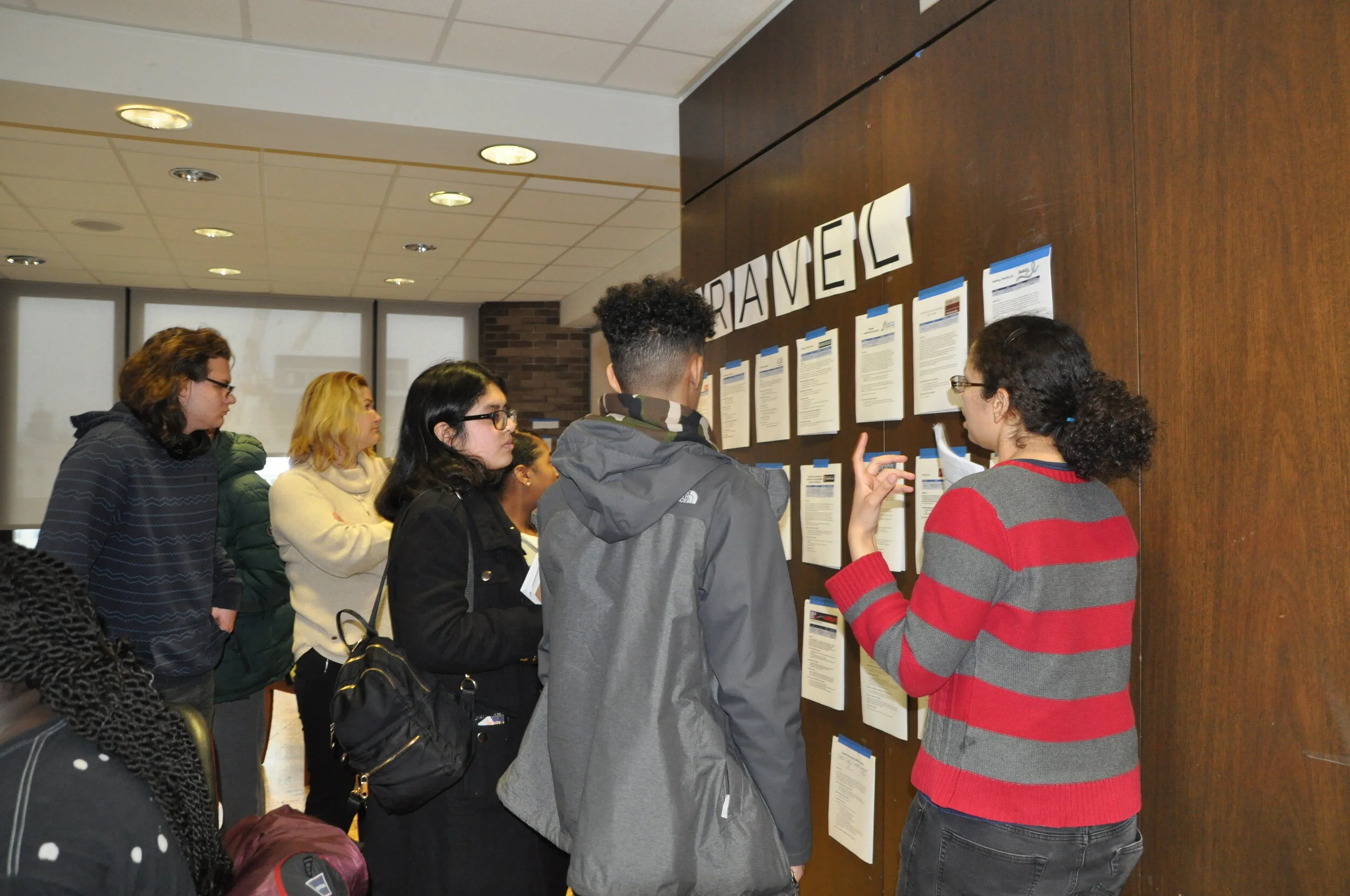
At this year’s session, the day began with an overview of the different types of summer programs: academic (class- or research-based), internships, and volunteering. Students also heard from three BEAM 12th graders — Alberto, Jennora, and Qige — who talked about their experiences in a variety of summer programs. Finally, students learned about the summer application process, from writing essays and requesting recommendation letters to submitting financial documents and confirming attendance.
Later in the day, 10th and 11th grade students browsed a selection of summer programs by topic, while 9th graders heard more from our senior student speakers.
Students worked on creating a detailed plan for completing summer applications, with internal deadlines for themselves. The info session is just the kickoff to a continued focus on completing summer applications and selecting a program that will be a great fit.
Here are just some of the great summer programs BEAM students attended last year:
Center for Talented Youth Summer Programs, Johns Hopkins University
Program in Mathematics for Young Scientists (PROMYS), Boston University
MathPath, Mt. Holyoke College
Mathworks Honors Summer Math Camp, Texas State University
Center for Excellence in Youth Education, Icahn School of Medicine, Mt. Sinai
Talent Identification Program (TIP), Duke University
Summer Research Mentoring Program, American Museum of Natural History
BEAM's Winter Newsletter has arrived!
Last Friday, BEAM's quarterly newsletter arrived in the inboxes of all our subscribers. The newsletter features:
An update on BEAM’s Multiply Your Impact Matching campaign
An overview of BEAM’s busy fall
Staff Picks: recommendations from staff members about what to read, watch, listen to, and more
Recent accomplishments of BEAM students
A reminder: we’re hiring!
Missed it? You can read the newsletter now
Make sure you don’t miss the next one! Sign up to receive BEAM’s quarterly updates.
... And Now for Some Math
This was a Challenge Problem last summer at our Bard College site. Malachi takes 42 pieces of candy, each of which is either a Skittles or an M&M…
This was a Challenge Problem last summer at our Bard College site. Challenge Problems encourage students to work collaboratively; once it's solved, the whole program gets a prize. (For this one, a sleepover on the last night!) So now it's your turn... can you solve it?
Malachi takes 42 pieces of candy, each of which is either a Skittles or an M&M, and arranges them in a circle letter side down (so they look identical!). He tells Hodaya that 23 of the candies are next to at least one Skittles, and 35 are next to at least one M&M. If Hodaya can figure out how many Skittles and how many M&Ms there are, she gets all of them!
How can Hodaya figure this out? (The answer appears below the image.)
Solution:
The important thing is to go step-by-step to figure out what you can.
If there are 23 candies next to at least one Skittles, that means 42-23=19 candies are not next to any Skittles — so they must be next to two M&Ms.
If 19 candies are next to two M&Ms and 35 are next to at least one M&M, that means 35-19=16 are next to exactly one M&M.
Now here's the key insight. Suppose there are x M&M's. Each M&M has a neighbor on the left and on the right, so if you add up for all the pieces how many M&M neighbors they have, you should get 2x. Well, we know that 19 candies are next to two M&Ms, so they have a total of 38 M&M neighbors. And 16 are next to one M&M, so they have 16 M&M neighbors. That gives 54 total M&M neighbors.
Divide by two to get 54/2=27 M&Ms in total.
With 42 candies in total, subtract out the M&Ms to get 42-17=15 Skittles.
Sometimes, it's amazing how much you can figure out with what seems like too little information!
Saturday Classes at BEAM LA
For the first time, BEAM Los Angeles is holding Saturday math enrichment classes.
Students setting up their student accounts on repl.it for their programming class.
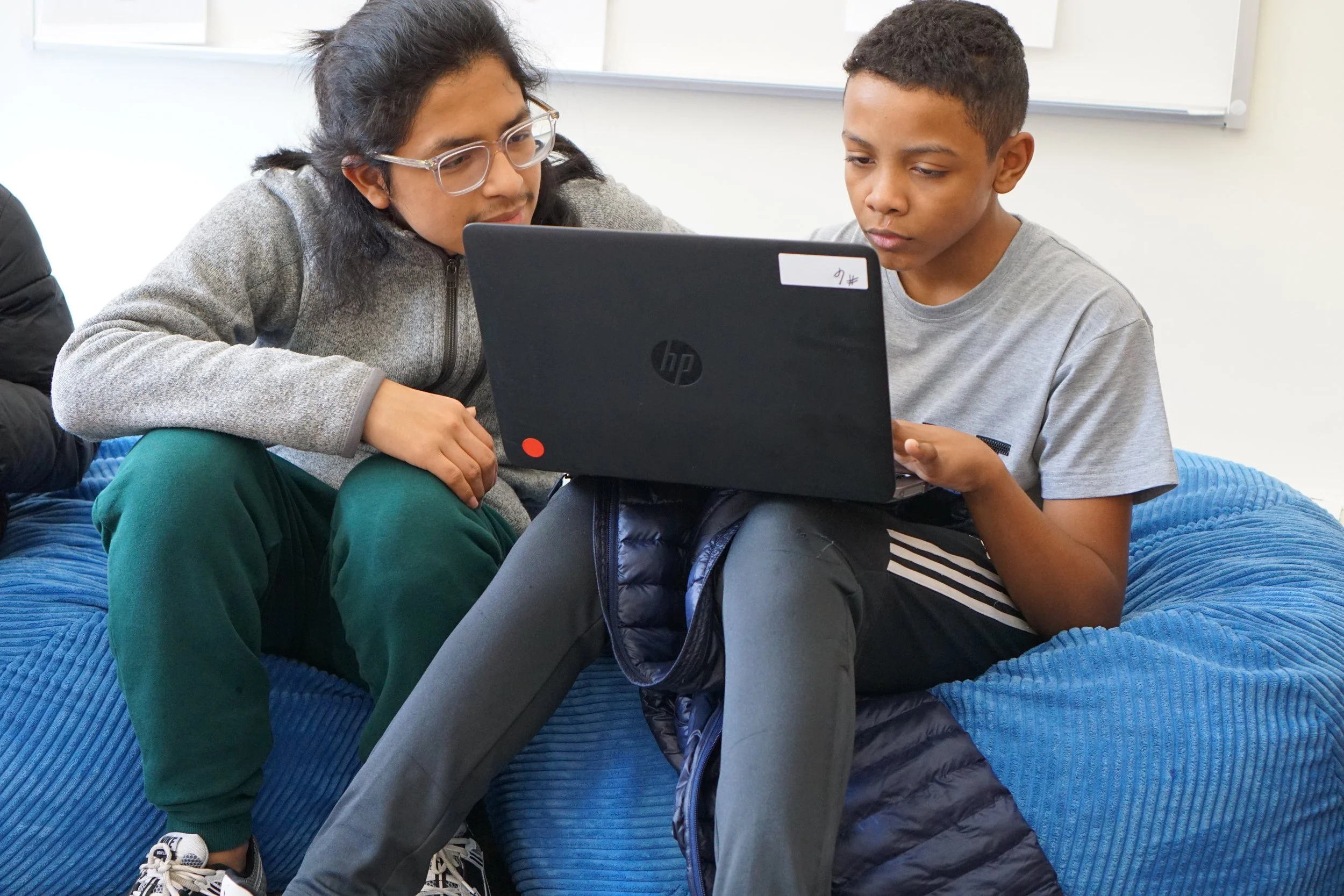
For the first time, BEAM Los Angeles is holding Saturday math enrichment classes. Twenty-six Summer Away alums are attending the classes, which are being held at BEAM’s new space in Koreatown, in the heart of the community that BEAM serves.
We have an exciting line up:
Al, who has served as faculty at BEAM Discovery LA for two summers, is teaching a class on Lines, Planes, and Coordinates as a supplement to algebra.
Jacob, Executive Director of BEAM LA, is teaching a class on Things you Missed in Prealgebra, based on elements covered in The Art of Problem Solving's pre-algebra 2 class.
Don, Programs Coordinator at BEAM LA, is teaching Solving Big Problems, which tackles difficult, multi-part questions and puzzles.
Sherry, a postdoc at UCLA, is teaching Programming with Python, which gives student a taste of computer science.
Al said this about teaching at BEAM: "Being able to see my BEAM students grow through middle school has been such a rewarding experience. They are more motivated and determined mathematicians and people. During class they talk about the fundamental principles of Euclidean geometry and during lunch they talk about how to choose the best high school for their career paths. I teach at BEAM because I see the direct impact we have on these students. Also, I've never seen a place before where so many people are pumped to do math at 9 am on a Saturday!"
We asked Abel, one of our Saturday class participants, why he comes to classes. He said, “School is boring and the classes at BEAM are challenging. I get to work on hard problems with other people that care about math and talk about the problems.”
What problems are students like Abel working on? Here’s a warm-up problem from Jacob’s class:
What sets of positive integers (n,k) satisfy the inequality n2+ k > 29?
We are excited to continue creating a space for students to engage in the mathematics they’ve experienced at BEAM’s summer programs and are glad that they are as excited as we are!
(From left) Steve, Alexis, Mischelle, Coral, and Aracely present their solution to a river crossing problem.
BEAM Career Day
What does it take to fall in love with what you do?
Choose a job you love, and you will never have to work a day in your life.
On Saturday, November 2, more than 60 BEAM high schoolers streamed into NYU’s Courant Institute for BEAM’s 2nd Annual Career Day. Students met professionals from education, law, medicine, sales, engineering, counseling, veterinary sciences, entrepreneurship, and more!
To keep things interactive, during the morning session, small groups of students rotated among speakers, who talked about their professional journeys and answered questions. Afterwards, students spent lunch networking: getting to know folks they hadn’t already met and asking more questions. Students left inspired — with business cards, LinkedIn accounts, and opportunities for future engagement!
Darryl is an algebra teacher at a charter school in Brooklyn. This summer he taught voting theory at BEAM Discovery’s downtown site.
Darryl Gladstone, a math educator in Brooklyn, said about his experience: “Career Day was wonderful and cathartic. The students were thoughtful and inquisitive about what I do and above all were sponges ready to soak up new information. It was also great to network with other professionals in different fields — ones who share the same passion for enlightening the future generation.”
Our professionals had words of wisdom for our students. They spoke about their journeys from middle school through college. Many talked about how they navigated being the “only one” in spaces. They discussed hardships they faced, and ultimately inspired our students to be their best selves.
“Any chance you get to meet people, go out and meet [them] and ask them hard questions.”
Rudy is the Director of Entrepreneurship and Gaming Programs at The DreamYard Project.
“You don’t need to know what you want to do now. People are still figuring it out. Being here today shows you’re already exploring options; that’s really great.”
Noreen works in advertising for Microsoft and is also a content creator and influencer.
“With careers, we sometimes think we need to choose one direction or another. That’s not true; for example, you can code AND write - that career exists.”
Erin is a Client Success Manager for Jopwell, a career development platform for Black, Latinx, and indigenous students and professionals.
BEAM students asked thoughtful questions to get to the crux of what passion is and why it’s so important to be in a career that you love. Some have already been reaching out to folks they met asking for guidance and potential future opportunities for internships and enrichment!
Kathy (above, right) is a 9th grader at The Brooklyn Latin School.
“I know what I want to do but I don’t know HOW to do what I want to do.”
Isabella is a senior at Manhattan Center for Science and Math and a Posse finalist!
“I was wondering, how did you develop the ideas to innovate the gaming field? Also, did it come from an entrepreneurship viewpoint? I am looking to major in engineering in college and I find many of these careers inspiring.”
Want to find out more about Career Day and the professionals who participated? Click below.
Our Favorite Math
This summer, at BEAM Summer Away at Harvey Mudd College, we asked students, What was your favorite math problem of the summer?
Adib chose a problem from the class Solving Big Problems: Can you add or subtract the numbers between 1 through n inclusive to get 0?
Don Laackman, BEAM’s Program Coordinator and the Site Director for Summer Away at Harvey Mudd, said of this problem: “This is a central problem for the class; it requires a proof of impossibility, thinking about divisibility issues, and the solution goes on to be very useful in a problem in graph theory that students tackle later on.”
Check out Adib’s work below.
The students in Solving Big Problems take time to explore this problem, building up the pieces to solve it. This summer, after the students had completed the problem, they got to see a faculty member and a counselor tackle it together, talking through their thought process so students could see how people with lots of advanced math experience approached the very same problem they already knew well.
Check out more student work (and more about what BEAM has been up to this year) in our 2019 Annual Report.
BEAM Is Expanding!
For some time now, BEAM has been brainstorming ideas about how to reach students nationally. Recently, part of this expansion idea received pilot funding through the Bill & Melinda Gates Foundation! The funding allows BEAM to develop materials for school districts, community groups, and universities to directly run summer programs modeled on BEAM Discovery, our nonresidential program for rising 7th graders. As part of the grant, Mathematica Policy Research will evaluate the results; we will be carefully monitoring the project’s progress.
We are proud to have two partners for summer 2020: Memphis Teacher Residency (MTR) in Tennessee and Albuquerque Public Schools in New Mexico. They will select staff, recruit students, and coordinate with local partners. Meanwhile, BEAM is busy packaging courses and developing training guides for faculty and staff at our partner sites. It's an experiment, but an important one. If it's successful, we can bring BEAM-style learning to many more students.
Today, we’re excited to introduce the Marjorie Lee Browne STEM Education Fellowship.
Named after a prominent African-American mathematician and educator, the Marjorie Lee Browne STEM Education Fellowship (or the Browne STEM Fellowship) is a six-week internship program and partnership between BEAM, MTR, and the National Civil Rights Museum. Fellows will receive intensive training in pedagogy, cultural competency, and math content, and will serve as counselors at MTR’s STEM Discovery Camp during summer 2020.
The National Civil Rights Museum will also be equipping fellows with a broad, historical perspective of the civil rights movement and its intersection with education.
The Browne STEM Fellowship is designed for college undergraduates who are people of color interested in teaching secondary math and science. Applications are being accepted until January 15, 2020.
Interested in the Browne STEM Fellowship? Click here for more information.
MTR visits BEAM Discovery NYC to see the program in action.
(From left to right: Chuck Butler, Austin Bettis, Caroline O’Hare, and Jordan Latham.)
Check back soon for a partner spotlight on Albuquerque Public Schools.
Helping Students Navigate High School Admissions
On September 21, BEAM hosted its annual High School Information Session to help BEAM 8th graders and their families navigate the New York City high school admissions process.
BEAM staff broke down the application process step by step, while four BEAM high schoolers talked about their admissions experiences.
Hawa, who is now in 9th grade at Beacon High School, told BEAM students: "Keep in contact with the BEAM staff because they will help you if you have an issue. When I was applying to Beacon, I almost did not apply, but because the BEAM staff helped me with my mailing, I was able to get accepted."
What’s next for BEAM 8th graders?
BEAM staff are meeting one-on-one with 8th graders and their families to develop their lists of prospective high schools. (BEAM offers advising in Spanish, Chinese, and English.)
Since August, students have also been taking Saturday classes to prepare for the SHSAT and to work on writing admissions essays for selective high schools.
BEAM staff will also be taking students on school visits soon, and will review students’ final school rankings with them before they are submitted in December.
For families who missed the High School Information Session, another session is planned for November.
BEAM's Fall Newsletter has arrived!
Today, BEAM's quarterly newsletter arrived in the inboxes of all our subscribers. The newsletter features:
An introduction to BEAM Summer Away at Harvey Mudd College, our sixth summer site
An invitation to BEAM’s Puzzles and Trivia Night
A recap of College Prep Week
Staff Picks: recommendations from staff members about what to read, watch, listen to, and more
Recent accomplishments of BEAM students
Slightly mathy trivia from last year’s Puzzles and Trivia Night for you to try out!
Missed it? You can read the newsletter now.
Make sure you don’t miss the next one! Sign up for our quarterly newsletter.