
Welcome to the BEAM Blog!

Guest User Guest User

...And Now for Some Math

To recap from the newsletter:

You are eating a special candy bar. You and a friend each take turns eating squares of blue, pink, and green candy starting from the left and moving right. You can bite off as many squares as you want, so long as they’re all the same color of candy. So, for example, your first move could be to bite off 1, 2, 3, or 4 squares. The winner is the person who eats the green square of candy (which is extra delicious!)…

To recap from the newsletter:

You are eating a special candy bar. You and a friend each take turns eating squares of blue, pink, and green candy starting from the left and moving right. You can bite off as many squares as you want, so long as they’re all the same color of candy. So, for example, your first move could be to bite off 1, 2, 3, or 4 squares. The winner is the person who eats the green square of candy (which is extra delicious!).

Start by playing around with it and learning how it works. Then, start asking yourself some questions. Can you figure out how to win the game every time you play? Do you want to go first or second to try to win? Can you figure out how to find a winning strategy even if we changed the board you’re playing on?

The Solution

If you start from the beginning, this problem is a mess: there are lots of possibilities to consider. In fact, in our weekend class “Entry to Abstract Math,” this problem was used specifically to introduce the idea of working backwards from the end. Once you have that insight, it becomes quite easy!

Of course, immediately before the final bite, this will be what remains of the candy bar:

You want your opponent to leave you with just that green square. How can you guarantee that? Well, if your opponent is faced with this board, then they have no choice but to leave you with that delicious final square!

Now, if your goal is to leave your opponent with this board, then you want to eat the square right before it, so we’ll put a little bite symbol on the squares you should bite.

To make sure you have the chance to bite that square, you must leave your opponent with just one square before it so they have no choice but to leave you with this configuration:

Which means you want to bite the square right before it:

This time, though, to make sure you can bite that marked pink bite, you need your opponent to leave you with all three pink squares. Otherwise, your opponent could bite to the pink bite and leave you in a losing position!

So how are you guaranteed to get all three pink squares? Simple, you must leave your opponent with just the single square before the pink region:

To guarantee that, you need to bite immediately to the left of that blue square:

If you want to be guaranteed that bite, your opponent must leave you with both pink squares. Otherwise, they could eat both! So you must leave them with just the one square before:

Which means you must bite the square immediately before it, which you can do on the first move:

Thus, the winning strategy is to go first, and bite up to each mark on your turn. If you go first, you will always be able to bite up to a mark (and your opponent will not!)

In addition to teaching about working backwards, this problem helps to introduce the ideas behind combinatorial game theory. In combinatorial game theory, not just can you analyze winning positions in games and develop winning strategies, but you can also develop a theory that lets you assign to each game a certain value that encodes how it works. These values (they’re not quite numbers) can be added together, and in fact, games can be added together as well in a compatible way!

In other words, this problem, which is already fun, is just the beginning!

Thanks to Mira Bernstein for creating and sharing this problem.

Read More
Guest User Guest User

...And Now for Some Math

In the newsletter, we shared problem 64 from this year’s 100 Problem Challenge. Before we dive into solving the problem, we hope you’ll take some time to work on the answers and uncover a pattern…

In the newsletter, we shared problem 64 from this year’s 100 Problem Challenge:

Remember how squaring works: a number with a 2 exponent should be multiplied by itself. For example, 52 = 5×5 = 25 or 102 = 10×10 = 100.

If

12 + 22 + 32 + 42 + ⋯ + 242 + 252 = 5525 (First Equation)

How can you figure out the following two sums without adding up all the terms?

2 2 + 4 2 + 6 2 + 8 2 + ⋯ + 48 2 + 50 2 = ??? (Second Equation)

3 2 + 6 2 + 9 2 + 12 2 + ⋯ + 72 2 + 75 2 = ??? (Third Equation)

Before we dive into solving these two equations, we hope you’ll take some time to work on the answers and uncover a pattern…

Enough delays, here is the solution!

Let's start off first with the solution, and then with some discussion of why we use this problem at BEAM.

As a BEAM student, I might first want to make sure that I know the meaning of the ellipses in each equation; it means that the pattern repeats in the same way all the way through to the last listed elements. For example, in the first equation, I continue after 42 with 52 + 62 + 72 and so on (This is always the first step of a problem: make sure you understand it!).

These problems are pretty tricky if they're new to you, but once you see it, the solution is fairly straightforward. If I want to solve this problem without adding up all the terms (or computing some of these larger squares!), I should look for a relationship between each statement. The second equation seems to have the sum of square multiples of 2, and the third equation has sums of square multiples of three. Does this mean I can just multiply each equation by 2 and 3 respectively? How can I be sure?

A bit of care shows you that right away. 42 isn't twice as big as 22; it's four times as big (16 vs 4). Similarly, 62 isn't three times as big as 22 , but nine times as big (36 vs 4). If the pattern holds true for each element in the second sum, then each element there will be four times larger; in the third sum, each element would be nine times larger. That pattern does indeed hold true, so the answers are 5525⋅4 = 22,100 and 5525⋅9 = 49,725.

12 + 22 + 32 + 42 yields 1 + 4 + 9 + 16

22 + 42 + 62 + 82 yields 4 + 16 + 36 + 64

32 + 62 + 92 + 122 yields 9 + 36 + 81 + 144

Our hope is that a BEAM student would at this point realize that this isn't just about these two sums; 42 + 82 + 122 + 162 + … + 1002 will be 16 times as large, and so on and so forth. Proving this is not too difficult once you think about it the right way. For example, (2n)2 = (2n)(2n) = (2⋅2)(n⋅n)=4n2 . In general, if you make the number being squared x times bigger, you get (x⋅n)2 = (x⋅n)(x⋅n) = (x⋅x)(n⋅n) = x2n2. Rather than multiplying the result by x, you multiply by x2.

So, why do we like this problem for BEAM students?

There are lots of things that make it compelling. For one thing, the sense of misdirection—where it's not two times larger, but four times larger—makes it compelling. It also helps build skills at both abstraction and generalization. Students learn to work with the ellipses and they're also quickly pressed to generalize from doubling each squared term to other possibilities. For students who haven’t worked with algebra, expressing that is a useful challenge.

Finally, it naturally motivates the relatively simple proof for why the pattern holds; students feel a genuine need for the proof when they see it, because the result was surprising. Motivating proof can be difficult; this problem, with its relatively simple justification, can drive that motivation.

Our 100 Problem Challenge has a mix of problems. You’ve seen more challenging problems in past newsletters, but the mix is important to give entry points to all students and drive growth in new ideas.

Read More
Guest User Guest User

BEAM Pathway Student Summer Reflections

Each summer, BEAM helps students in our 9-year Pathway Program find summer enrichment programs to help pursue their interests in science, technology, engineering, and mathematics. Students have participated in PROMYS, MathPath, and many different pre-college programs. This August, we spoke with three different BEAM students about how they spent their summers.
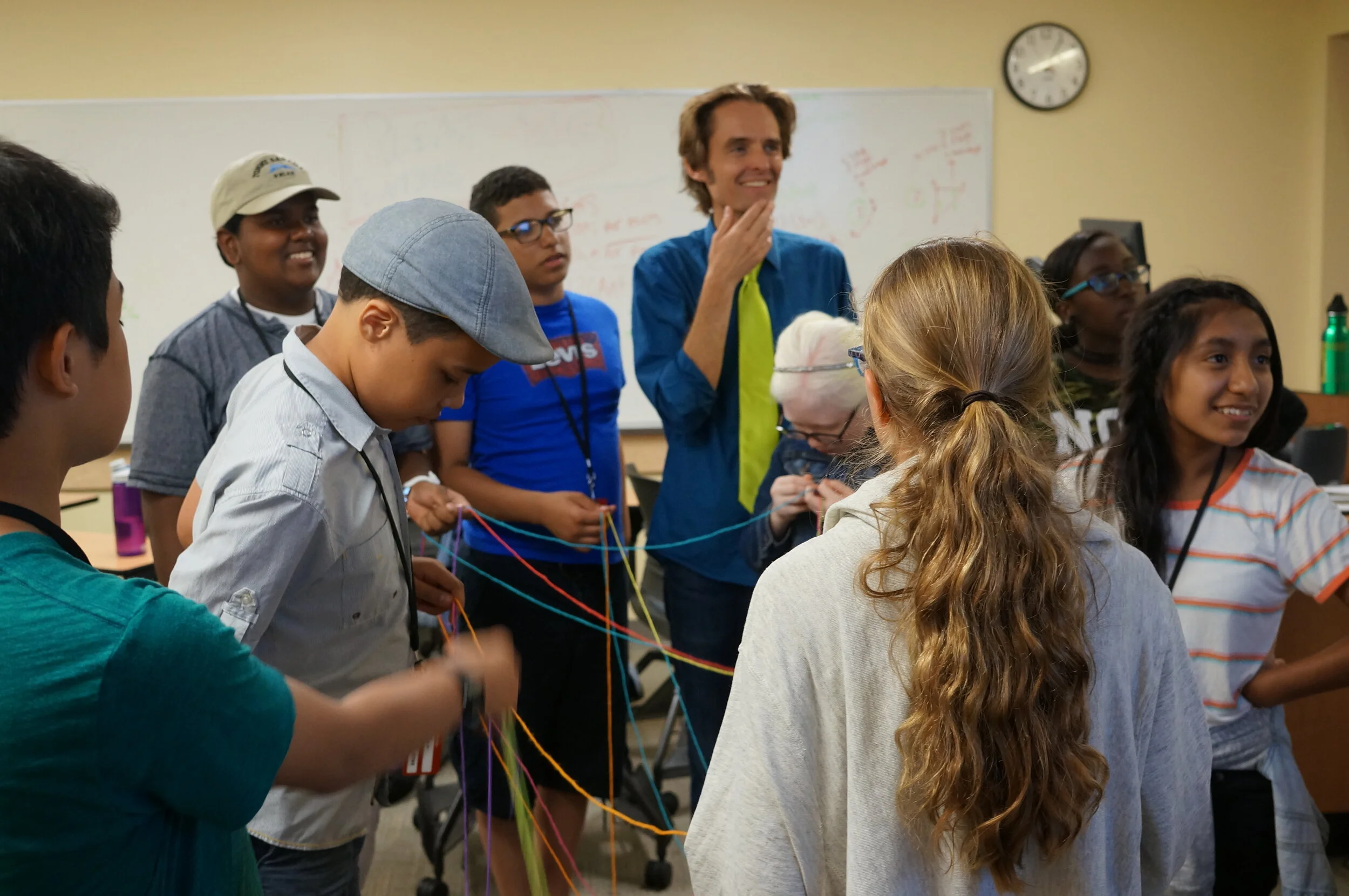
Each summer, BEAM helps students in our 9-year Pathway Program find summer enrichment programs to help pursue their interests in science, technology, engineering, and mathematics. Students have participated in PROMYS, MathPath, and many different pre-college programs. This August, we spoke with three different BEAM students about how they spent their summers.

Helen, BEAM Summer Away 2019 Bard College

This summer, Helen chose to take the Project Gateway course at the Summer STEM Program at Cooper Union. Helen wrote to us after she finished the program: 

Helen is a tenth grader in New York City.

Helen is a tenth-grader in New York City.

“In this course we became civil engineers, investigating how design and engineering impact our communities. Throughout the three weeks of the program, we created a journal where we went outside and looked at the way our neighborhood was engineered and what effect it had. We also learned how to use AutoCAD, a software program for computer design. Personally, using AutoCAD was the project I was most proud of and enjoyed doing since I’m very interested in computer designing. Our final project was to pick a neighborhood in NYC and redesign the neighborhood. My group and I focused on Clinton Hill, Brooklyn. We improved the traffic, repaired the streets, and made the neighborhood more family-oriented. Since we were learning remotely, we had the opportunity to go on a field trip to a compost yard and learned how composting works and how they compost in NYC throughout all the seasons which was very interesting. In the future, I would like to be part of the Summer STEM program at Cooper Union again and explore a different engineering course.”

Helen’s CAD drawing of a one bedroom apartment she visited.

Helen’s CAD drawing of a one bedroom apartment she visited.


Kenny, BEAM Summer Away 2020 Los Angeles

This summer, Kenny participated in MathPath, a four-week enrichment program for middle school students who show high interest and promise in mathematics. Courses include math history, combinatorics, graph theory, and more. Here’s what Kenny told us about his experience at MathPath:

Kenny is a ninth-grader in Los Angeles

Kenny is a ninth-grader in Los Angeles.

“For the math part of the program, we had problems that challenged us and made us think really hard about how to solve them. Sometimes it took more than that. We did a lot of probability and thought about how many ways could a certain event take place. My favorite part had to be the moments when classmates helped each other out to solve one problem. We all took turns and disagreed respectfully. I enjoyed working with them since I heard many ideas and had fun while talking. BEAM helped me get ready for MathPath by teaching me the skills that I would need to better understand the math problems.”


Rubi, BEAM Summer Away 2019 Los Angeles

She spent 12 weeks with Johns Hopkins University’s Center for Talented Youth, learning about many different facets of Forensics, from its history to its current application. Rubi wrote to us about the most interesting project she worked on:

Rubi is a tenth-grader in Los Angeles.

Rubi is a tenth-grader in Los Angeles.

“The class for Introduction to Forensics was challenging but it was also fun. I had a great time learning about the wide variety of topics in the class. The most interesting thing we did, in my opinion, was determining blood types. We were given sample blood types with liquids that could be used to change the color of the blood so we could determine what type the blood was. The way BEAM helped me get ready for this class was by giving me access to the materials I needed. They bought the materials, including a microscope, forensics pack, and books, without hesitation.”

Read More
Newsletter Guest User Newsletter Guest User

BEAM's Winter Newsletter is here!

Read about BEAM weekend classes, early decision college acceptances, and more in our winter newsletter, and if you aren’t already a subscriber, you can sign up here:

Screen Shot 2021-02-16 at 2.39.48 AM.png

Last Friday, BEAM's quarterly newsletter arrived in the inboxes of all our subscribers. The newsletter features:

  • An inside look at one of BEAM’s Saturday classes from BEAM instructor, Ken Baron.

  • Catching up with some of the awesome things our students are doing.

  • Staff Picks: recommendations from staff members about what to read, watch, listen to, and more

  • Announcement that we are running our summer programs online again.

  • A reminder: we’re hiring!

Learn more

Missed it? You can read the newsletter now

Make sure you don’t miss the next one! Sign up to receive BEAM’s quarterly updates.

 
Sign up!
 
Read More
Newsletter Guest User Newsletter Guest User

BEAM's Winter Newsletter has arrived!

Screen+Shot+2019-12-16+at+3.58.11+AM.jpg

Last Friday, BEAM's quarterly newsletter arrived in the inboxes of all our subscribers. The newsletter features:

  • An update on BEAM’s Multiply Your Impact Matching campaign

  • An overview of BEAM’s busy fall

  • Staff Picks: recommendations from staff members about what to read, watch, listen to, and more

  • Recent accomplishments of BEAM students

  • A reminder: we’re hiring!

Missed it? You can read the newsletter now

Learn more

Make sure you don’t miss the next one! Sign up to receive BEAM’s quarterly updates.

 
Sign up!
 
Read More
Newsletter Melissa Gillis Newsletter Melissa Gillis

BEAM's Fall Newsletter has arrived!

Today, BEAM's quarterly newsletter arrived in the inboxes of all our subscribers. The newsletter features:

  • An introduction to BEAM Summer Away at Harvey Mudd College, our sixth summer site

  • An invitation to BEAM’s Puzzles and Trivia Night

  • A recap of College Prep Week

  • Staff Picks: recommendations from staff members about what to read, watch, listen to, and more

  • Recent accomplishments of BEAM students

  • Slightly mathy trivia from last year’s Puzzles and Trivia Night for you to try out!

Missed it? You can read the newsletter now.

READ NOW

Make sure you don’t miss the next one! Sign up for our quarterly newsletter.

Sign up
Working%2Bat%2Bwhite%2Bboards%2B1.jpg
Read More
Newsletter Guest User Newsletter Guest User

BEAM's Pre-Summer Newsletter has arrived!

Today, BEAM's quarterly newsletter arrived in the inboxes of all our subscribers. The newsletter featured:

  • Information on our largest summer of operations yet

  • A recap of College Decision Day

  • Highlights from BEAM’s recent Career Day

  • “What We’re Reading”: a look at the College Board’s new “adversity score”

  • Recent accomplishments from BEAM students

  • A math puzzle for you to try out!

Missed it? You can read the newsletter now.

READ NOW

Make sure you don’t miss the next one! Sign up for our quarterly newsletter.

Sign up
newsletter.jpg
Read More
Newsletter Guest User Newsletter Guest User

BEAM's Spring Newsletter has arrived!

On Friday, BEAM's quarterly newsletter arrived in the inboxes of all our subscribers. The newsletter featured:

  • High school admissions results

  • A look at our new empowerment groups

  • Information on our job openings for summer staff

  • "What We're Reading"

Missed it? You can read the newsletter now.

READ NOW

Make sure you don’t miss the next one! Sign up for our quarterly newsletter.

Sign up
Screen%2BShot%2B2019-04-12%2Bat%2B6.46.29%2BAM.jpg
Read More
Newsletter Lynn Cartwright-Punnett Newsletter Lynn Cartwright-Punnett

BEAM's Pre-Summer Newsletter is Here!

Last Friday, BEAM's quarterly newsletter arrived in the inboxes of all our subscribers! The newsletter featured:

  • An update on BEAM's growth (380 students at BEAM programs this summer!)
  • Congratulations to our 12th graders on their college plans
  • "What We're Reading"
  • Updates on BEAM Los Angeles
Missed it? You can read the newsletter now.

Missed the newsletter?  You can always read it online.  And make sure you don't miss the next one!  Sign up for our mailing list. 

Sign Up and Never Miss a Newsletter Again!
Read More
Newsletter Lynn Cartwright-Punnett Newsletter Lynn Cartwright-Punnett

BEAM's Newsletter is Here!

Earlier this week, BEAM's quarterly newsletter arrived in the inboxes of all our subscribers! The newsletter featured:

  • Student quotes about the joy of math
  • Job opportunities at BEAM (both full-time and part-time)
  • "What We're Reading"
  • High school outcomes for our 8th graders
  • Updates on BEAM Los Angeles
  • Congratulations to our own Dan Zaharopol

Missed the newsletter?  You can always read it online.  And make sure you don't miss the next one!  Sign up for our mailing list. 

Sign Up and Never Miss a Newsletter Again!
Read More