
A Pi-Themed Challenge on Pi Day!
By Jesse Horton & Hannah Leland
Finding the area of a square or a circle is simple — right? This Pi Day, we encourage you to test your mathematical skills by solving the following five area problems (a few of which were featured with the Pi Day card)! If you think the first four problems are easy, then try your hand at the Bonus Challenge: Infinite Circles.
Hint: In the spirit of Pi Day, you will be using π in most (if not all) of your solutions. Good luck!
Problem 1
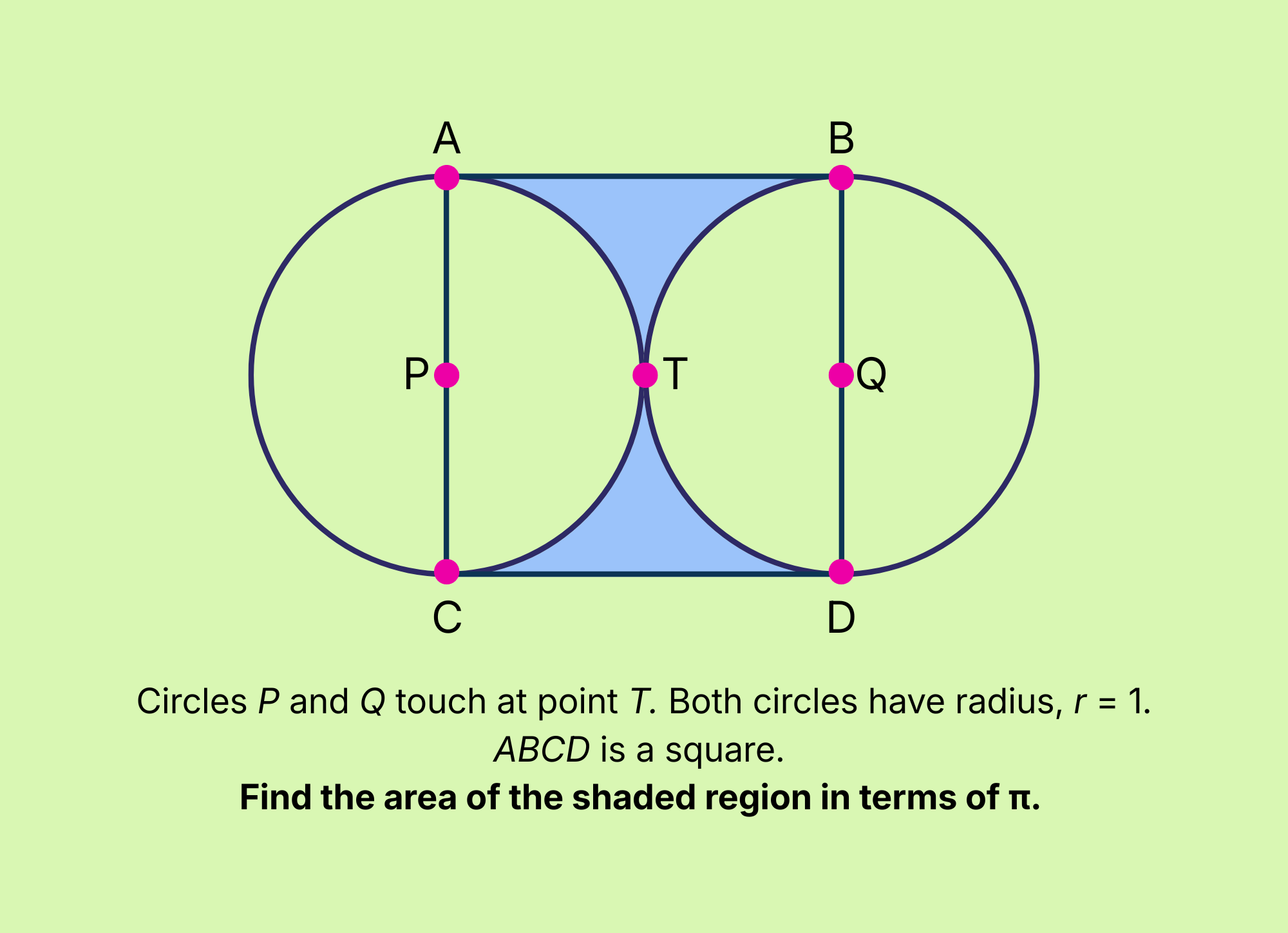
Solution
In a classic circle-meets-square scenario, here we have identical circles P and Q touching at point T, which is the center of square ABCD. If we rearrange the two semicircles inside square ABCD to form a circle, we can see that to find the area of the shaded region, we must first find the area of square ABCD and the area of circle P or Q, and then subtract the area of one circle from the area of square ABCD.
Since the radius of the circles is 1 unit, we know that the side length of the square is 2 units.
Area of square ABCD: \( A = s² = (2)² = 4 \)
Area of circles P and Q: \( A = πr² = π(1)² = π \)
Area of shaded region: \( A = \text{(area of square)} - \text{(area of a circle)} = 4 - \pi \)
Problem 2
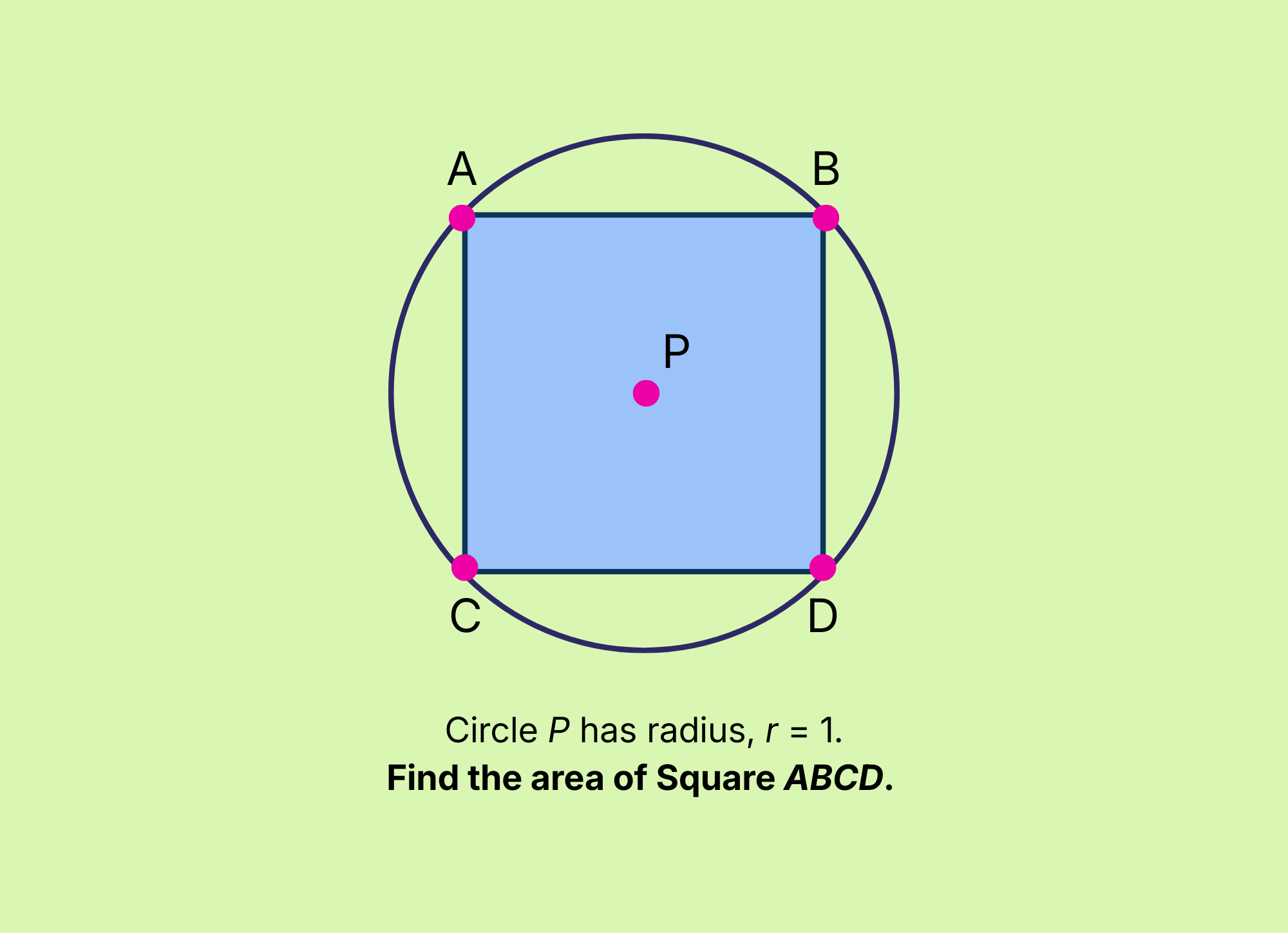
Solution
Once again, we are confronted by the overlap of circles and squares. This time, square ABCD is fully inscribed in circle P. At first glance, it's not clear how to find the side length of square ABCD, but if we inscribe a diameter at \(\overline{AD}\), we can now see that the diagonal of square P is equal to the diameter of circle P, which is \(D = 2r = 2(1) = 2\) units long.
We can now use the Pythagorean theorem to find the side length of square ABCD:
$$
\begin{align*}
a² + b² &= c² \\
s² + s² &= 2² \\
2s² &= 4 \\
s² &= 2 \\
s &= \sqrt{2}
\end{align*}
$$
Note: We can also use our knowledge of special right triangles to find the missing side length, since half of square ABCD is a 45°-45°-90° triangle.
Equipped with the side length of square ABCD, it is easy to find its area: \(A = s² = (\sqrt{2})² = 2\). A delightfully clean answer!
Problem 3
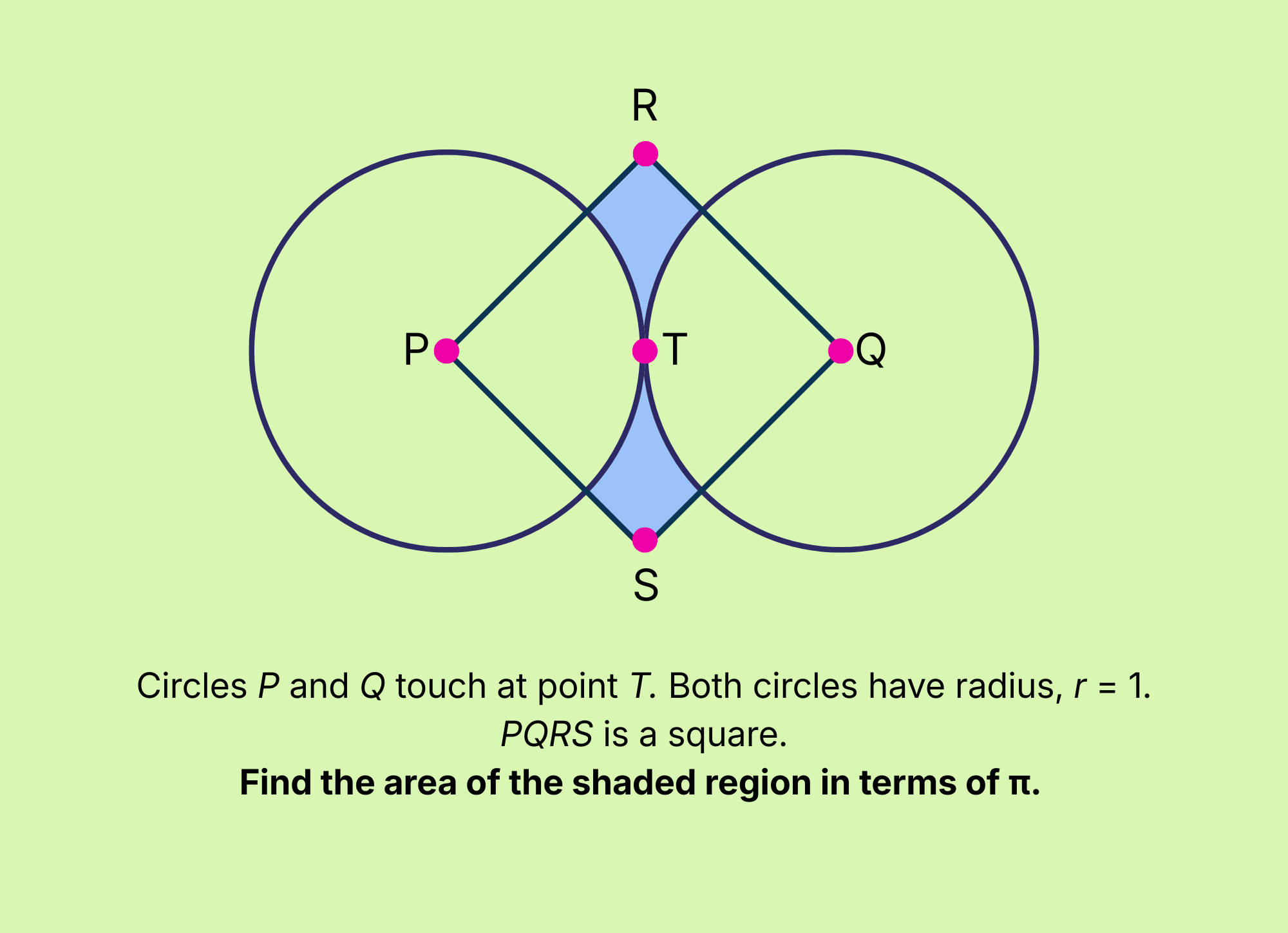
Solution
This time, the square’s gone haywire and became a diamond! No problem. Using our previous approach from problem 2, we see that \(\overline{PQ}\) — the diagonal of square PRQS — is equal to the length of two radii. This means that once again the diagonal of our square is 2 units long, making its area 2 units squared.
We note that the angle measures of squares are all 90°. This means that both \(\angle P\) and \(\angle Q\) are equal to 90°. The area of the sectors of the circle encompassed by \(\angle P\) and \(\angle Q\) will be proportional to the area of the circle. The full degree measure of a circle is 360°, and 90° is a quarter of 360°, so the portion of the circles inscribed in square PRQS at \(\angle P\) and \(\angle Q\) are each a quarter-circle. Combining two quarter-circles gives us a semicircle, so we need to subtract the area of a semicircle from the area of square PRQS to find the area of the shaded region.
Using our work from problem 1, we know that the area of a circle with radius 1 is \(A = \pi\). The area of a semicircle is thus \(A = \frac{\pi}{2}\), meaning that the area of the shaded region is equal to \( A = \text{(area of square PRQS)} - \text{(area of a semicircle)} = 2 - \frac{\pi}{2}\).
Problem 4
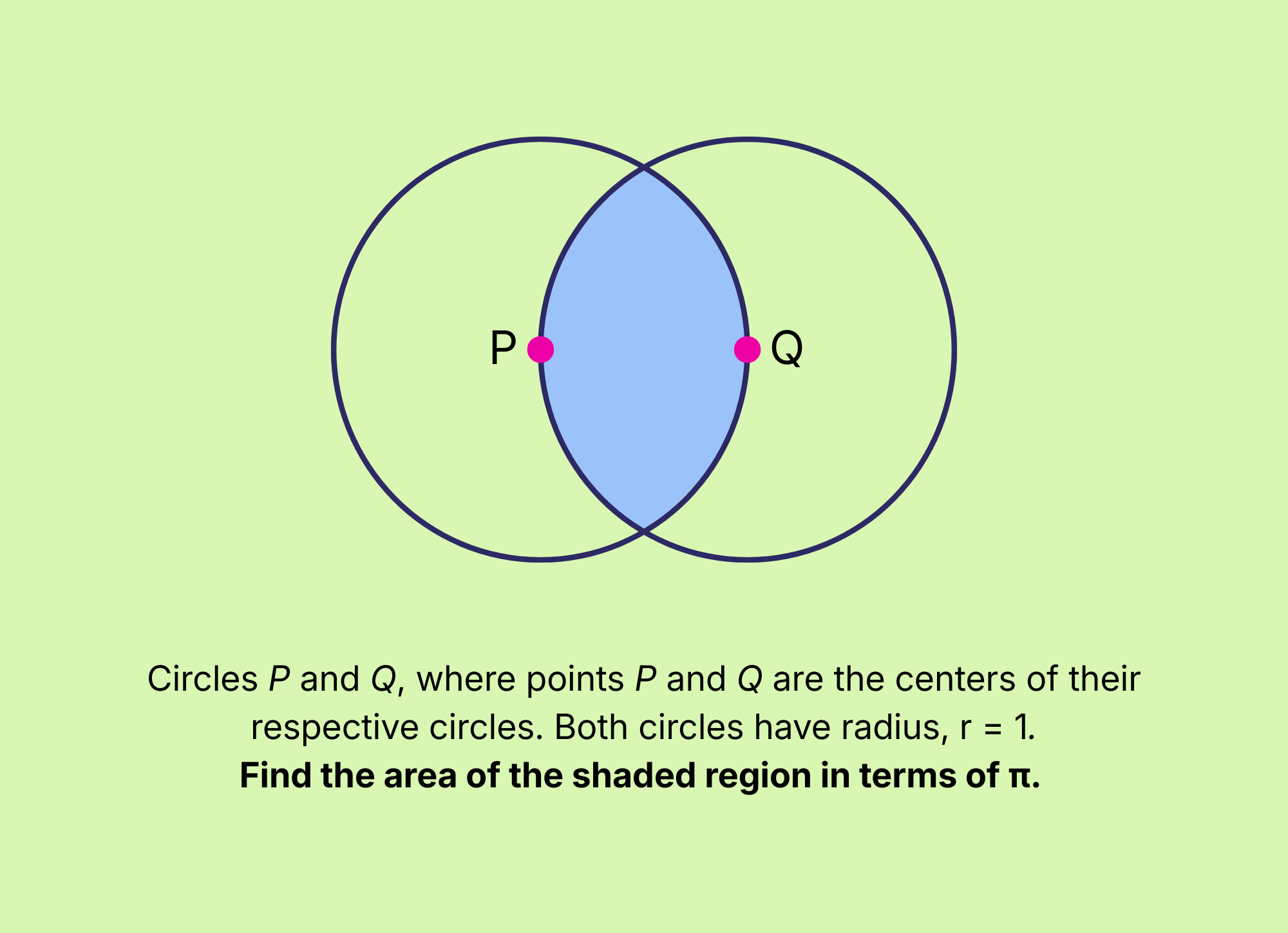
Solution
This is where things start to get tricky. We can’t find the area of this shaded region until we inscribe some equilateral triangles. After inscribing \(\Delta PRQ\) and \(\Delta PQS\), we can see that the area of the shaded region comprises 2 equilateral triangles and 4 slivers: \(A = 2a + 4b\).
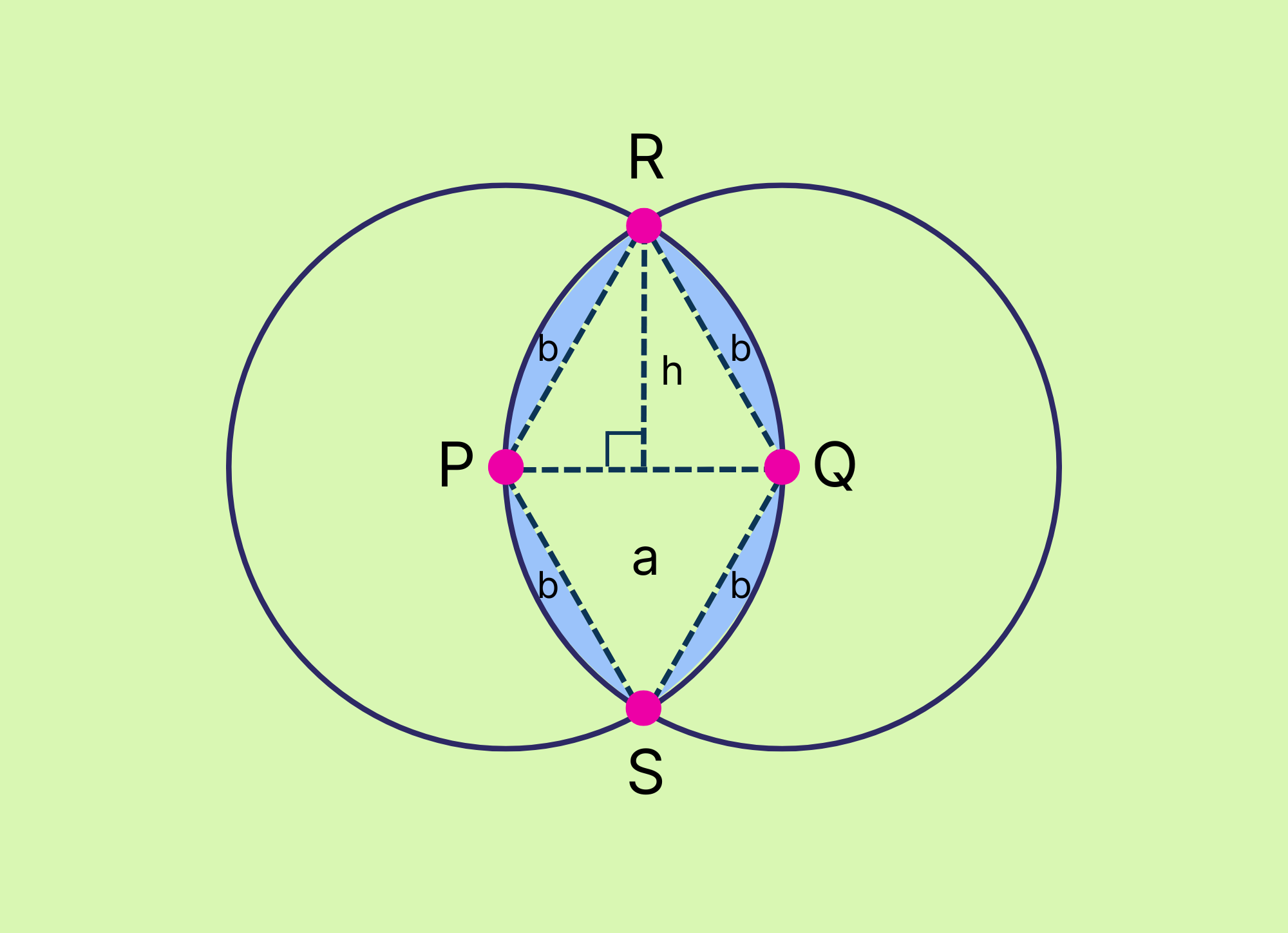
Let’s start by finding the area of \(\Delta PRQ\). Since r = 1, we see that \(\overline{PR}\), \(\overline{RQ}\), and \(\overline{QP}\) are all 1 unit long. \(A = \frac{1}{2}bh\), and we can find the height of \(\Delta PRQ\), a, using the Pythagorean theorem:
$$
\begin{align*}
a² + b² &= c² \\
(.5)² + h² &= (1)² \\
.25 + h² &= 1 \\
h² &= \frac{3}{4} \\
h &= \frac{\sqrt{3}}{2}.
\end{align*}
$$
Thus, \(A = \frac{1}{2}bh = \frac{1}{2}(1)(\frac{\sqrt{3}}{2}) = \frac{\sqrt{3}}{4}\). The area of a is \(\frac{\sqrt{3}}{4}\) units squared.
We can’t find the area of b directly, but we can find the area of \(a + b\):
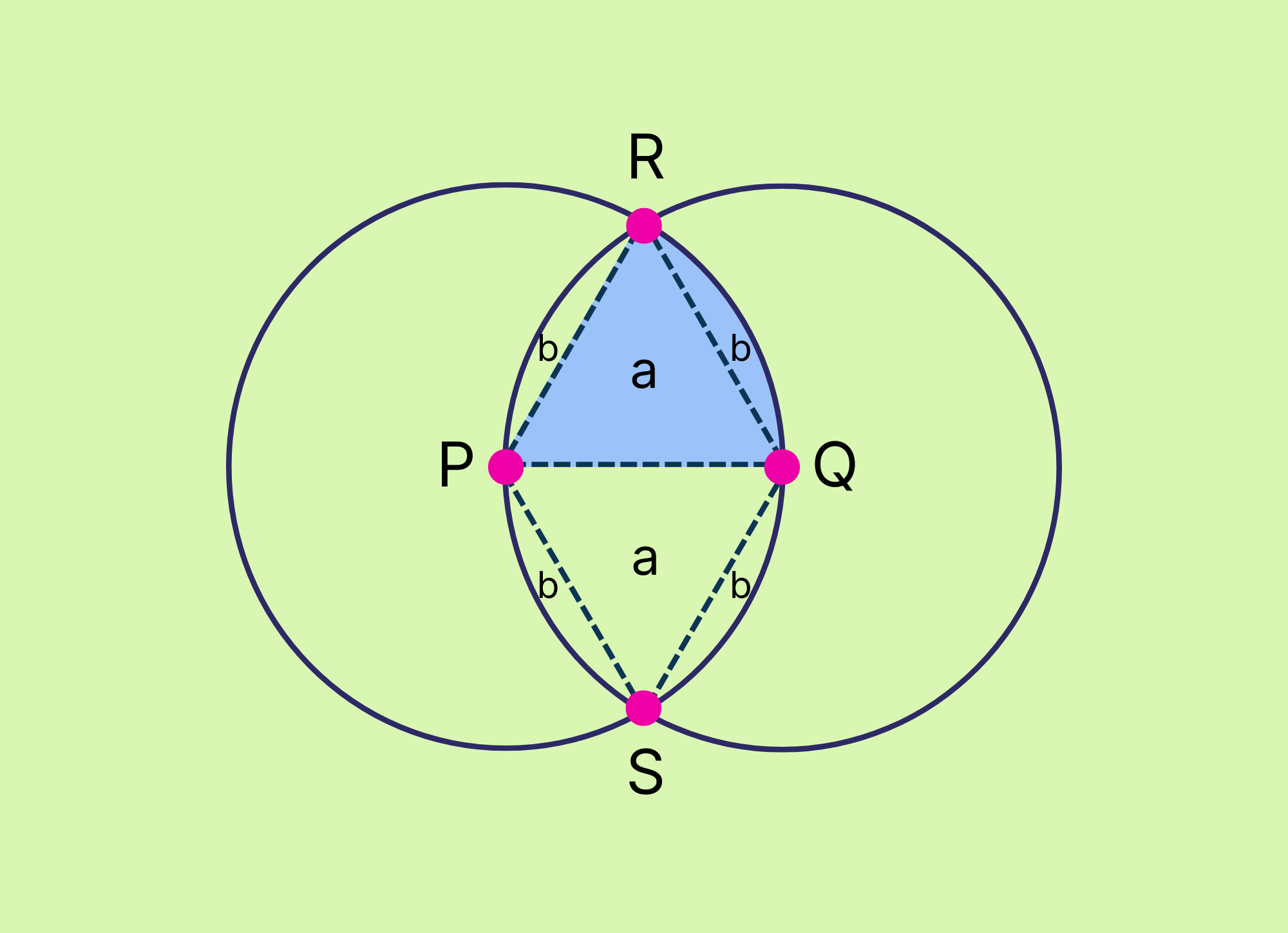
We find this area by thinking of it as a sector of circle P: a 60° sector, since \(\Delta PRQ\) is equilateral and thus \(\angle P = 60^\circ\). The area of a sector is proportional to the center angle. Since 60° is \(\frac{1}{6}\) of the total area of a circle, π. This makes the area of this sector \(\frac{\pi}{6}\).
If the area of this sector is \(\frac{\pi}{6}\), then the area of b is \(\frac{\pi}{6} - \frac{\sqrt{3}}{4} = \frac{2\pi - 3\sqrt{3}}{12}\).
Now we can find total area of the shaded region, \(A = 2a + 4b\):
\(A = (\frac{\sqrt{3}}{4} + \frac{\sqrt{3}}{4}) + (\frac{2\pi - 3\sqrt{3}}{12} + \frac{2\pi - 3\sqrt{3}}{12} + \frac{2\pi - 3\sqrt{3}}{12} + \frac{2\pi - 3\sqrt{3}}{12}) = \frac{\sqrt{3}}{2} + \frac{2\pi - 3\sqrt{3}}{3} = \frac{3\sqrt{3} + 4\pi - 6\sqrt{3}}{6} = \frac{4\pi - 3\sqrt{3}}{6}\).
Bonus Challenge: Infinite Circles
Solution
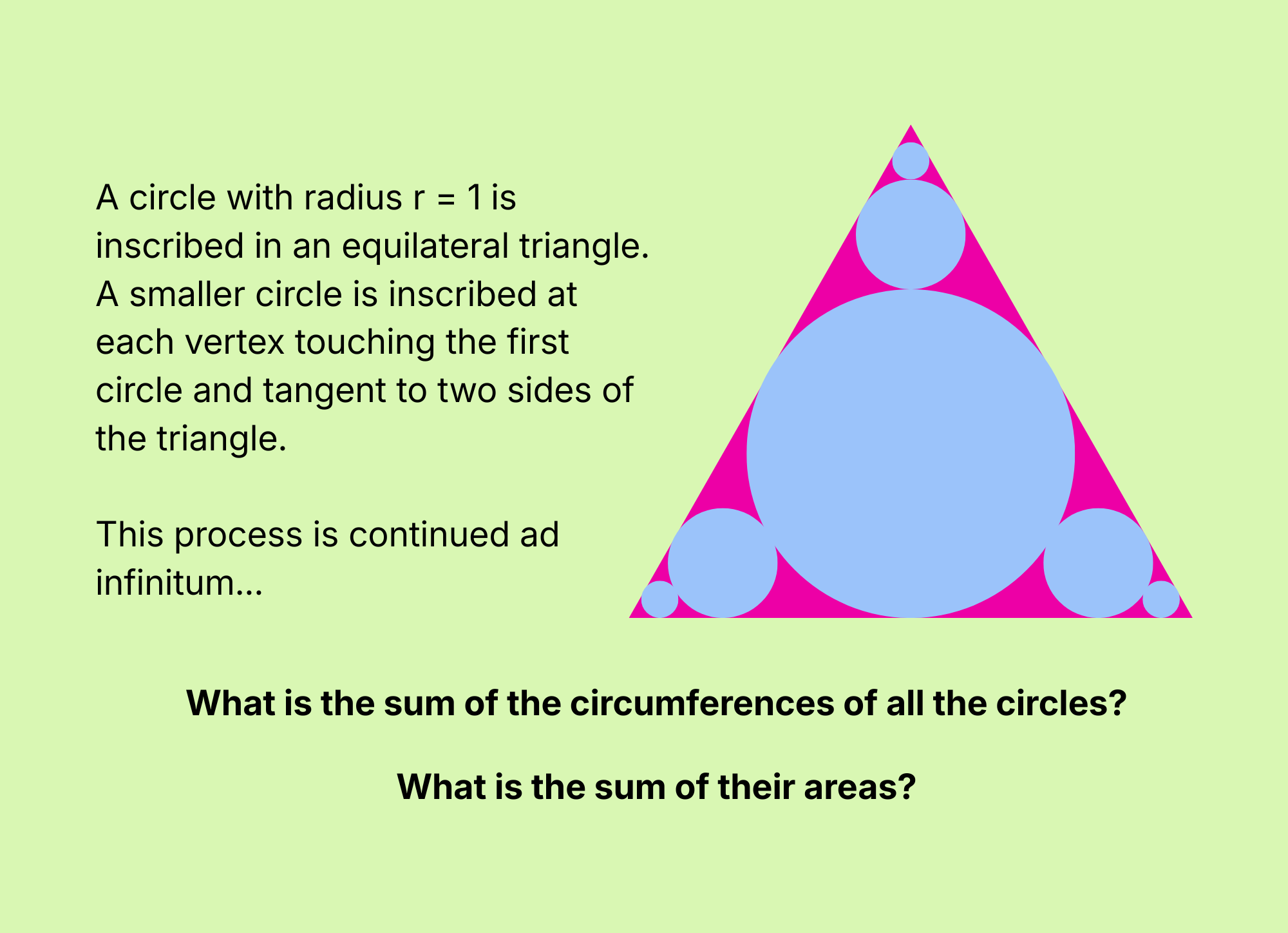
This gets us away from the kinds of problems that appear in early math contests and into something that requires much more thought!
To find the sum of the circumferences, we will need more information about the diameters of the infinite circles. To begin, we draw a 30°-60°-90° triangle like so:
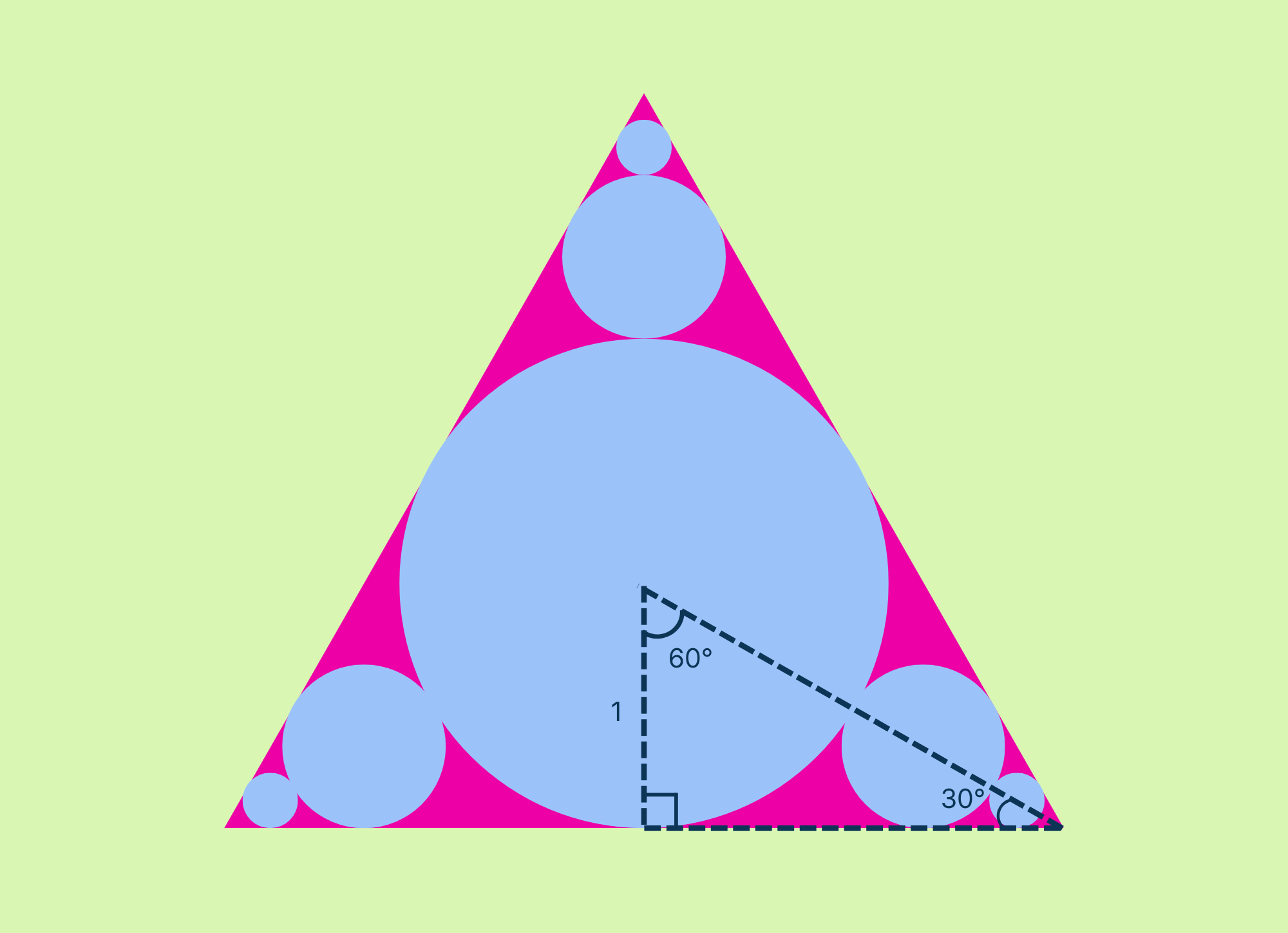
How do we know this is a 30°-60°-90° triangle?
By drawing a radius in the center circle perpendicular to the base of the triangle, we know that angle must be 90°. Since we’re working with an equilateral triangle (60°-60°-60°) and bisecting one of its vertices, we know that the smallest angle of our inscribed triangle must be 30°. This means the central angle must be 60°.
In trigonometry, perhaps you’ve heard of “special right triangles” — those triangles whose side lengths always follow a common ratio. In the case of 30°-60°-90° triangles, their side lengths always follow the ratio: \(1 : \sqrt{3} : 2\), which can be scaled up or down depending on the size of the given triangle.
In this case, however, we don’t need to scale at all. The short side of the triangle has a length of 1, so the remaining leg and hypotenuse have lengths of \(\sqrt{3}\) and 2, respectively.
Now, notice that the hypotenuse of this triangle comprises the radius of the center circle PLUS the unknown diameters of all the smaller circles in that vertex. The hypotenuse has a length of 2 and the radius of the center circle is r=1, so the sum of the unknown diameters is \(2-1=1\).
Here's the magic: if the sum of the unknown diameters is equal to 1, then the sum of the unknown circumferences is equal to π. (For example, with two circles, \(\pi d_1 + \pi d_2 = \pi(d_1 + d_2)\), so you can add the diameters before or after multiplying by π.)
Accounting for the circumferences of the circles in all three vertices of the triangle, as well as the circumference of the center circle, we can determine that the sum of the circumferences of all of the circles is equal to:
$$
\pi + \pi + \pi + 2\pi = 5\pi
$$
And with that, we've added the circumferences of infinitely many circles!
Finding the sum of the areas will require us to do a little more math. This time we really need to know the radii of each of the circles. We can start by finding the radius of the second-biggest circle. To do this, we draw the following line tangent to the center circle, and a new right triangle:
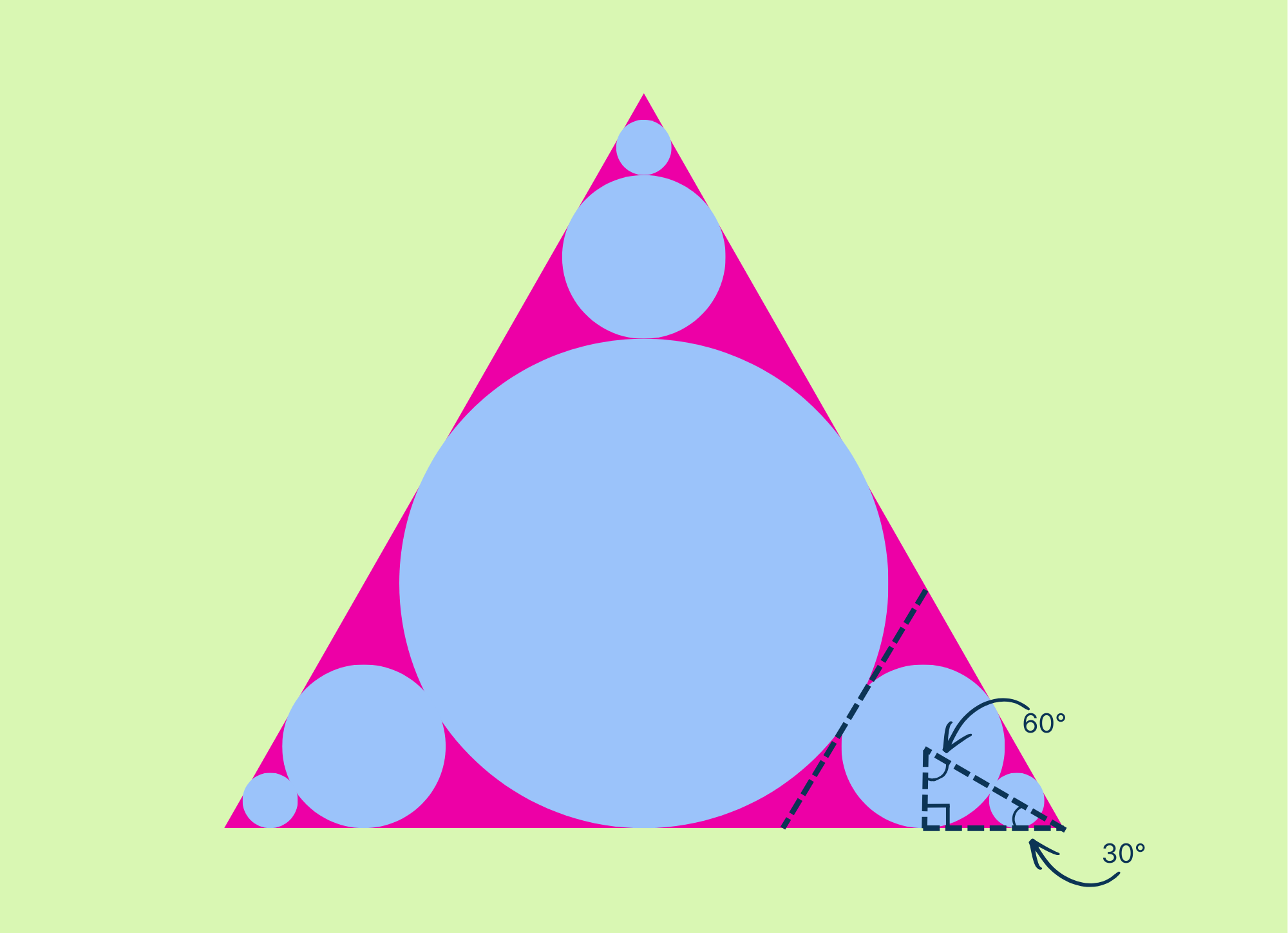
Looking closely, we see that we have essentially recreated the original equilateral triangle and special right triangle setup.
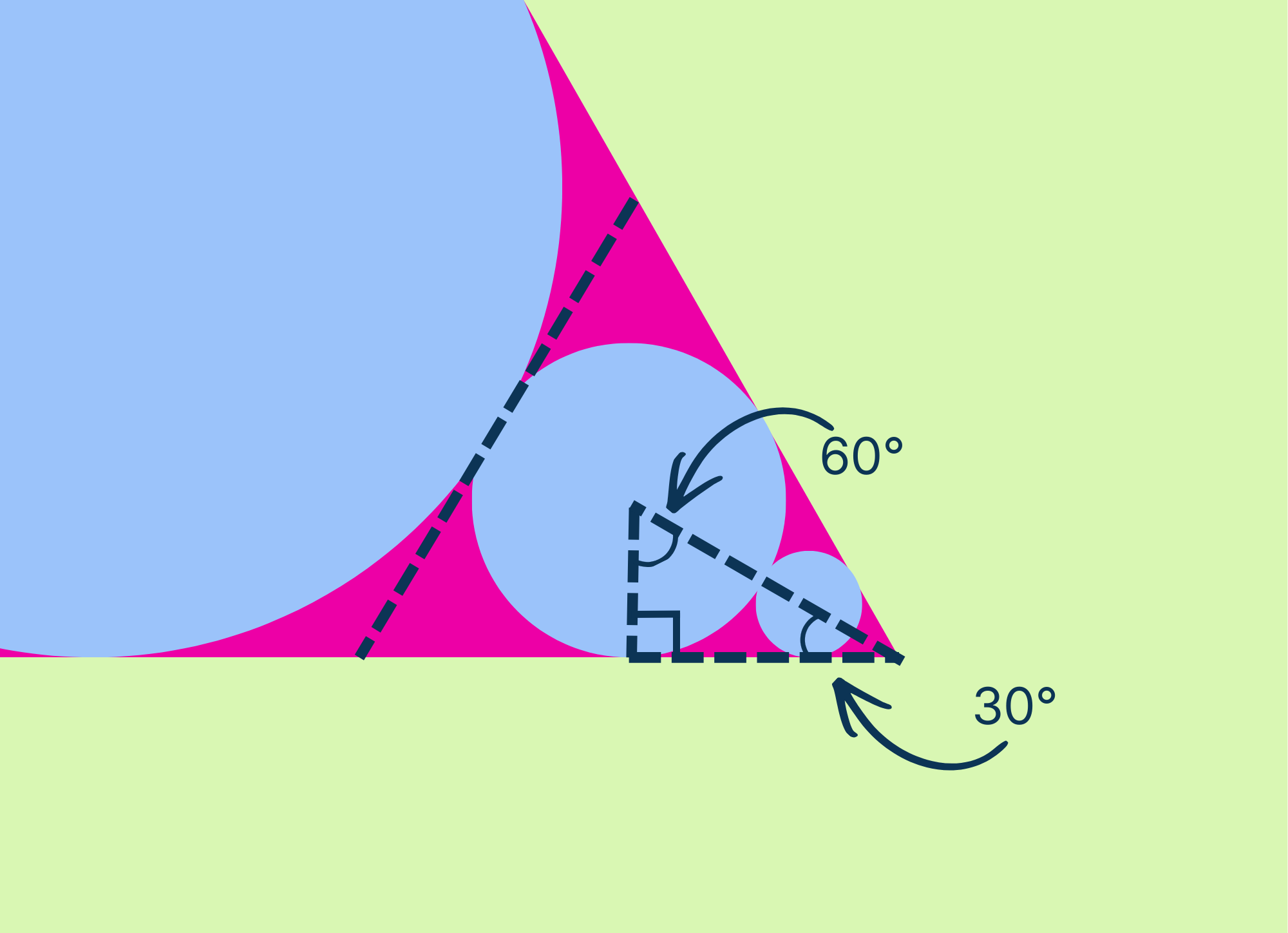
Our previous step showed that the height of this smaller equilateral triangle, E, is 1. Given that the height of E is 1, a run of the Pythagorean Theorem or knowledge of 30°-60°-90° triangles shows us that the side length of E is equal to \(\frac{2}{\sqrt{3}}\), or \(\frac{2\sqrt{3}}{3}\). If the side length of E is \(\frac{2\sqrt{3}}{3}\), then the height of the new 30°-60°-90° triangle is half of that, or \(\frac{\sqrt{3}}{3}\).
Remember that all 30°-60°-90° triangles have the same ratio between their side lengths, \(1 : \sqrt{3} : 2\), which can be scaled up or down depending on the size of the triangle. In this case, we will be scaling down. How much are we scaling down by? Well, if the height of this triangle is \(\frac{\sqrt{3}}{3}\), then all of its dimensions are \(\frac{1}{3}\) of the \(1 : \sqrt{3} : 2\) ratio. Thus, the side lengths are \(\frac{1}{3}\), \(\frac{\sqrt{3}}{3}\), and \(\frac{2}{3}\). Thus, the radius of the second-biggest circle is \(\frac{1}{3}\).
If we continue this process repeatedly, starting with the central circle (n=1), we will see that the radii of the infinite circles are decreasing by a factor of \(\frac{1}{3}\):
$$
\begin{array}{c \quad c}
\text{Circle}(n) & \text{Radius}(r_n) \\
1 & 1 \\
2 & \frac{1}{3} \\
3 & \frac{1}{9} \\
4 & \frac{1}{27} \\
\vdots & \vdots \\
n & r_n = \frac{1}{3^{n-1}} \\
\end{array}
$$
We can express the unknown circles’ total area as an infinite sum, \(\sum_{n=1}^{\infty} \pi(r_n)²\).
Let’s replace \(r_n\) with the expression we just derived for it.
$$
\sum_{n=1}^{\infty}\pi(\frac{1}{3^{n-1}})² = \pi(1 + \frac{1}{9} + \frac{1}{81} + \frac{1}{729} + …)
$$
Since π is a constant, we can pull it outside of the summation.
$$
\pi\sum_{n=1}^{\infty} (\frac{1}{3^{n-1}})² = \pi(1 + \frac{1}{9} + \frac{1}{81} + \frac{1}{729} + …)
$$
Wait, can we add infinitely many numbers together? Yes, we can! (In fact, see last year's Pi Day card for more!) Since this is a geometric series, we can find the infinite sum:
$$
1 + \frac{1}{9} + \frac{1}{81} + \frac{1}{729} + … = \frac{9}{8}.
$$
Thus, we get \(\pi\sum_{n=1}^{\infty} (\frac{1}{3^{n-1}})² = \frac{9}{8}\pi\). To find the sum of the areas, we multiply this result by 3 to account for all three corners of the triangle.
$$
\frac{9}{8}\pi \cdot 3 = \frac{27}{8}\pi
$$
Finally, we notice that this process has included the center circle’s area three times, so we must subtract it twice. The area of the center circle is π, so our final answer is:
$$
\frac{27}{8}\pi - \pi - \pi = \frac{11}{8}\pi.
$$
Even More Math on Pi Day
The infinite circles problem was created for NRICH Maths (part of the University of Cambridge) and parts of our solution for that problem came from the Eloquent Math blog. Both are great resources for more fascinating math puzzles!
Looking for an even bigger challenge? Try finding the area of an infinite sequence of circles or infinite circles nestled in a triangle!
Want to learn about Mandelbrot sets and their connection to pi? Check out this blog post written by our CEO, Dan Zaharopol. And happy Pi Day!