
Holiday Card Problem + Answers!
A Panoply of Place Value Problems
By Dan Zaharopol, BEAM's Founder and CEO
Everyone learns about place value in school. The ones place, the tens place, the hundreds place… it all seems so boring! It's just memorizing, right?!?
As usual, though, when you think deeply about a topic, you discover hidden depths. For this year's set of holiday problems, I looked for place value problems because I wanted to show that even with something you learn in elementary school, there are still interesting problems to do and more to discover. Let's have some fun with this!
The first problem on our holiday card came from our "Puzzling, Yet Logical" class for 6th graders. The problem was:
If each letter represents a digit, what is the true equation?
MA X CA = WWW
STOP! Give the problem a good try before you read the solution below!
SOLUTION:
We can't possibly try all of the possibilities. There are 9 possibilities for M and C, and 10 possibilities for A (because A is allowed to be zero), so altogether there are 9 x 9 x 10 = 810 possibilities. We'd need to try them all and see which results in a three-digit answer with the same digit repeated. That's way too much work!
Sometimes, it’s easier to start by working backwards: think about where you want to be, and ask if it’s possible to get there. That especially works when you need to narrow things down. So, can W = 1? In that case, WWW would represent 111. Can 111 be the product of two 2-digit numbers?
When you're looking at multiplication, all numbers are built out of primes. The prime factorization of 111 is 111 = 3 x 37. Because both 3 and 37 are prime, there's no way to break them down further. But then we can't write 111 as a product of two 2-digit numbers, because there's no way to recombine the primes into two 2-digit numbers.
What if W = 2? We can do the same thing: 222 = 3 x 74 = 2 x 3 x 37. Again, there's no way to recombine those primes to get two 2-digit numbers to multiply together.
Now, when you look at that prime factorization, you might realize something: of course, 222 is just two times 111, so its prime factorization just includes an extra 2! That makes it much easier to get prime factorizations rather than tedious dividing things.
333 = 32 x 37, because it's just 3 times the prime factorization of 111. Again, there are no ways to recombine those primes to get two 2-digit numbers!
What about 444 = 4 x 3 x 37 = 22 x 3 x 37? You can break it down as 12 x 37, but the final digits are different, so it doesn't fit the pattern of digits the problem asked for.
555 = 3 x 5 x 37? Unfortunately, 15 x 37 doesn't fit the pattern either.
666 = 6 x 3 x 37 = 2 x 32 x 37? The only way to do it is 18 x 37, which still doesn't fit the pattern.
777 = 3 x 7 x 37? That breaks down as 21 x 37, which also doesn't fit the pattern. We're almost done... but we might be worried if we'll actually find anything!
888 = 23 x 3 x 37. This is the first one that gives two options: we can recombine all the primes other than 37 to get 24 x 37, or we can move one of the 2's to multiply with the 37 to give 12 x 74. But neither option fits the pattern.
One possibility left. 999 = 9 x 3 x 37 = 33 x 37. We can only break that down into 2-digit numbers in one way: 27 x 37. That fits the pattern, so it must be the answer!
So M = 2, C = 3, A = 7, and W = 9. By thinking carefully, we could bypass 810 possibilities and quickly find the only one that works. As a bonus, we've also proven that there's only one possible answer.
The second problem on our holiday card is a problem of the week at our BEAM Discovery program (for sixth graders). Here's the problem:
The numbers 1234 and 4213 are both four-digit numbers that use each of the digits 1, 2, 3, and 4 exactly once.
Find the sum of all possible four-digit numbers that use each of the digits 1, 2, 3, and 4 exactly once. Find a clever way to do this without adding all the numbers. A full solution to this challenge problem means that you must explain why your answer is correct — you can’t just give a number, you have to prove it!
STOP! Give the problem a good try before you read the solution below!
SOLUTION:
You could write out all 24 four-digit numbers that use each of the digits 1, 2, 3, and 4 exactly once and then add them together, but we can do a lot better. Instead of actually doing the addition… let's just be lazy and imagine we did it.
What does that mean? Well, suppose you write them all out. How many times does 1 appear in the 1000s place? Well, every number with 1 in the 1000s place is of the form 1XYZ, which gives you 3 options for X (2, 3, or 4); 2 options for Y (whatever's left after X), and only one option for Z (whichever of 2, 3, and 4 are left after X and Y each claim one). That's 3 x 2 x 1 = 6 possibilities. So there are 6 numbers with 1 in the 1000s spot. There are also 6 numbers with 2 in the 1000s spot, 6 numbers with 3 in the 1000s spot, and 6 numbers with 4 in the 1000s spot.
Do the same reasoning, and you find that in that giant, tedious addition problem, each digit appears six times in each position.
So what if you just added up the 1000s places? How many 1000s are in the sum? That's easy: the thousands place will add to 4 x 6 + 3 x 6 + 2 x 6 + 1 x 6 = 60, so we get sixty 1000s in the sum.
How many 100s in the sum? If you add all the numbers in the 100s place, you get sixty again.
There are also sixty 10s, and sixty 1s.
So the sum is 60 x 1000 + 60 x 100 + 60 x 10 + 60 x 1 = 60(1000 + 100 + 10 + 1) = 66,660.
That proves that if you did that whole boring addition problem, you'd just get 66,660! It also shows how understanding place value can simplify a big messy problem.
That’s it for the problems on the holiday card, but if you want more, let me share a couple more that might be different from what you've seen before! I went rooting around in our archives and came across a cool place value problem from our January 2019 newsletter to our high school students.
Crystal is filling in the blanks in the following addition problem:
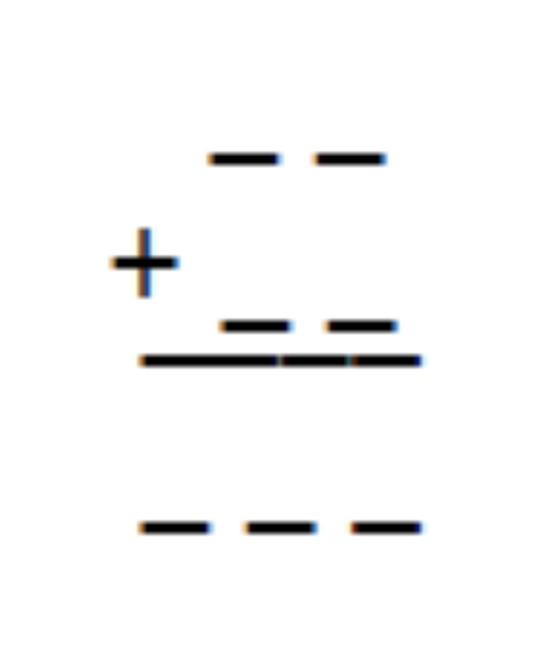
First, she chooses a random two-digit number for the first line. Then, she chooses a random two-digit number for the second line. Finally, she chooses a random three-digit number for the third line. What is the probability that the addition comes out correct?
Remember: Numbers don't start with 0.
STOP! Give the problem a good try before you read the solution below!
This is the kind of question I always asked myself while doing addition — wondering, if you filled things in at random, how likely it would be to get a correct answer. I'll share two solution methods, each of which gives different insight into the problem.
SOLUTION 1:
To figure out the probability, we need the total number of ways to fill in two two-digit numbers and one three-digit number, and the total number of ways to fill the addition in correctly. Then the probability is:
(# of ways to fill in the addition correctly) / (# of ways to fill in the numbers, even if the addition is wrong).
Finding all the ways to fill in the numbers, even if the addition is wrong: This is actually the easy part! There are 90 two-digit numbers from 10 to 99. There are 900 three-digit numbers (going from 100 to 999). So in total, you have 90 options for the first two-digit number, times 90 options for the second, times 900 options for the three-digit number: 90 x 90 x 900 = 7,290,000.
Finding how many ways there are to fill the addition in correctly: One way to count correct addition problems is to fill in the first two-digit number, and then count how many two-digit numbers can be added to it to produce a three-digit number. Each second two-digit number is a way to fill in a correct addition, so long as the two actually add to a three digit number (and that they’re not too small—it might be less than 100, and so not a three-digit number). If we look, we’ll find a pattern.
If the first two-digit number is 10, then the second two-digit number can be 90-99 to get a three-digit number as the answer. That's 10 possibilities.
If the first two-digit number is 11, then 89-99 works, giving 11 possibilities.
If the first two-digit number is 12, then 88-99 works, giving 12 possibilities.
And so on . . .
Until, if the first two-digit number is 90, then every single other two-digit number 10-99 works, giving 90 possibilities.
It's the same for 91, 92, all the way up through 99: each one gives 90 possibilities, because any two-digit number you add gives a three-digit number. In total, ten different two-digit numbers have 90 options each for how to finish the addition.
So there are ten ways to make the addition work if your first two-digit number is 10. There are 11 ways to make it work if your first two-digit number is 11. Altogether, the total number of ways to make the addition work is:
10 + 11 + 12 + … + 89 + (10 x 90)
There are several addition tricks you can use to calculate this sum, but however you do it, the number of ways to correctly fill in the addition is 4,860.
The probability is the number of ways it might come out correct divided by the number of ways to do it in total: 4860/7,290,000 = 0.06667%. That translates to 1/1500; so about one out of every 1500 times, Crystal will randomly fill in the addition correctly!
SOLUTION 2:
Just for fun, here's another way to figure out the total number of ways to fill in the addition correctly, starting instead from the three-digit number.
If it's 199 or bigger, the addition doesn't work, because the largest possible number we can get is 99 + 99 = 198.
If it's 198, there is exactly one way to fill in the 2-digit numbers: 99 + 99.
If it's 197, there are exactly two ways: 99 + 98 or 98 + 99.
If it's 196, there are exactly three ways: 99 + 97, 98 + 98, or 97 + 99.
If it's 195, there are exactly four ways: 99 + 96, 98 + 97, 97 + 98, or 96 + 99.
And so on . . .
For 109, there are 90 ways to do it: 99 + 10, 98 + 11, 97 + 12, ..., 10 + 99.
For 108, there are 89 ways to do it: 99 + 11, 98 + 12, ..., 11 + 99
And so on . . .
Until 100, where there are 81 ways to do it: 90 + 10, 89 + 11, ..., 10 + 90
Below 100, it is no longer a three-digit number.
So to find all the ways that work, the final step is to add up all of the ways we've found so far. That means we must add:
1 + 2 + 3 + 4 + … + 88 + 89 + 90 + 89 + 88 + … + 81
Again using your favorite way to add numbers, you will once again get 4,860 ways to fill in a correct addition problem, leading to the same answer as before!
This next problem, from our May 2018 newsletter, is also a bit different from most place value problems I've seen before.
0._ _ _ + 0._ _ _ + 0._ _ _
Write the digits 1 - 9 into the sum above, using each digit exactly once, to make it as close to 1 as possible. The sum can be over or under; all that matters is how far it is from 1. Include an explanation of how you decided where to put the numbers.
How do you know that is as close to 1 as you can get?
STOP! Give the problem a good try before you read the solution below!
SOLUTION:
This problem can be solved by really diving into the decimals, which presents a nice little logical way to get through it. I’ll leave that to you to explore, and instead what I want to show you is a really beautiful way to quickly see the closest you can get to 1.
Forget about the decimals for a minute. Imagine just adding three three-digit numbers: ABC+DEF+GHI, where each of A through I represents the digits 1 through 9 in some order. It turns out that this sum will have to be divisible by 9! This is very similar to the classic divisibility trick to check if something is divisible by 9: add the digits, and if the result is divisible by 9, so is the original number.
To prove that the sum is divisible by 9, we can just use place value:
ABC + DEF + GHI
= 100(A + D + G) + 10(B + E + H) + (C + F + I)
= 99(A + D +G) + A + D +G + 9(B + E + H) + B + E + H +C + F + I
= 99(A + D + G) + 9(B + E + H) + (A + B + C + D + E + F + G + H + I)
= 99(A + D + G) + 9(B + E + H) + 45
(You might be wondering how we got 45 in the last line. Adding A + B + … + I is just adding all the numbers 1 through 9 in some order, which is 45.)
Look closely at this addition: 99 is divisible by 9, and 9 is divisible by 9, and 45 is divisible by 9, so each of the summands is divisible by 9. Thus, ABC + DEF + GHI is itself divisible by 9!
In other words, the closest that ABC + DEF + GHI can get to 1000 is 999. (The next biggest multiple of 9 is 1008, which is farther from 1000.) Going back to our original problem: add 0.ABC + 0.DEF + 0.GHI and the closest you can get to 1.000 is 0.999!
All that remains is to verify you can actually get the sum of 0.999. To find a way to do it, Look at the addition problem by columns:
0. A B C
0. D E F
+____0.___G___H____I
The easiest thing would be to get A + D + G = 9, B + E + H = 9, and C + F + I = 9. However, that doesn't work because 9 + 9 + 9 = 27, but the sum of 1 through 9 is 45.
What if you take advantage of "regrouping" (or "carrying" as they called it back in the day)? Aim for A + D + G = 8, B + E + H = 18, and C + F + I = 19. Then the addition will give 0.999, and the digits correctly add up to 45. To get 8, you must use {1, 3, 4}. Now to get 18, you can use {2, 7, 9}. Finally, what's left gives you 19, in our case {5, 6, 8}. Then the following sum does, indeed, give you 0.999, which is the closest to 1 that we can get:
0.196 + 0.425 + 0.378 = 0.999
Finally, I'll wrap up with a problem that involves a bit of place value but is really just a fun logic puzzle in disguise. It comes from BEAM Discovery's problem of the week. Here's the problem:
Is there a 10-digit number where the first digit is equal to how many 0s are in the number, the second digit is equal to how many 1s are in the number, the third digit is equal to how many 2s are in the number, all the way up to the last digit, which is equal to how many 9s are in the number? If yes, can you find all of them? If no, how do you know for sure?
STOP! Give the problem a good try before you read the solution below!
SOLUTION:
Let's explore and see what we can figure out.
First of all, the sum of the digits of the mystery number is 10, because the number is 10 digits long and the digits count themselves. So how many 5's, 6's, 7's, 8's, or 9's can you have? It's at most one, or else the sum gets above 10! Thus, of the final five digits in the number, at least four of them are 0's.
Even better, you can't have all five of them be zeros, or there would be five 0's and then there would be a 5 or bigger in the first spot! So we know that of the last five spots, four are 0's, and exactly one is a 1.
Let's consider how many zeros there can be in total. This is a great problem to learn methodical thinking!
If there are nine zeros, there must be one 9 in the first digit to count them, which means our number is 9XXXX00001. Now we need a number in the 1's spot to count the 1, but that makes our total bigger than 10, which doesn't work!
If there are eight zeros, our number is 8XXXX00010. Again, we must put a number in the 1's spot, but if we put a 1 there, that’s incorrect because there are now two 1s; if we put a 2 in the 1's spot, now we must fit in another 1 somewhere, which does not leave room for eight zeros!
If there are seven zeros, our number is 7XXXX00100. Once more, we need to put a number in the 1's spot. It can't be a 1 because there would be two 1's. If it's a 3, there isn't space for seven 0s and three 1s and a 3. Hence, it must be a 2. Then the number is 72XXX00100. Unfortunately, we now need a non-zero number in the 2's spot, which doesn't leave room for seven 0s (plus two 1s and one 2).
If there are six zeros, our number is 6XXXX01000. Again, we must have a number in the 1's spot, which cannot be a 1. It also cannot be a 3 or we quickly run out of space for six zeros. Can it be a 2? If so, we'd get 62XXX01000. Now we can't fit two 2's (we'd run out of space for the zeros), so there must only be one 2. That would give 621XX01000. This works if the X's are all 0's! 6210001000 has six 0's, two 1's, and one 2, and nothing of any other digit. This is a possibility!
What about five zeros? In that case, our number is 5XXXX10000. Try to fill this in, and you'll see that the sum of the digits gets bigger than 10 really quickly. (For example, we can only fit in one more zero, but that means that out of the numbers 1, 2, 3, 4, we'd need three of them to appear, which makes our sum bigger than 10.)
You can similarly eliminate four zeros, and we already proved there must be at least four zeros.
So not just did we find the number that works — 6,210,001,000 — but we proved that it's the only one that does! It's cool and surprising that this simple question has only one solution.
One of my favorite things to do at BEAM is take something students think they know well and then show them that there's much more to learn to really understand it deeply. I hope that you had fun with these place value problems, and perhaps that you too discovered there's more to it when problems get tricky!